
Local search optimization is the practice of tailoring your website, Google Business Profile, and online citations so your business appears when nearby customers search for what you offer. For small businesses, this is one of the most direct paths to new customers. GBP signals alone account for roughly 32–36% of local map pack rankings in 2026, with review signals adding another 16–20%. Getting this right means showing up before your competitors do, in the exact moment someone nearby is ready to buy.
How to optimize your website for local search: the foundation
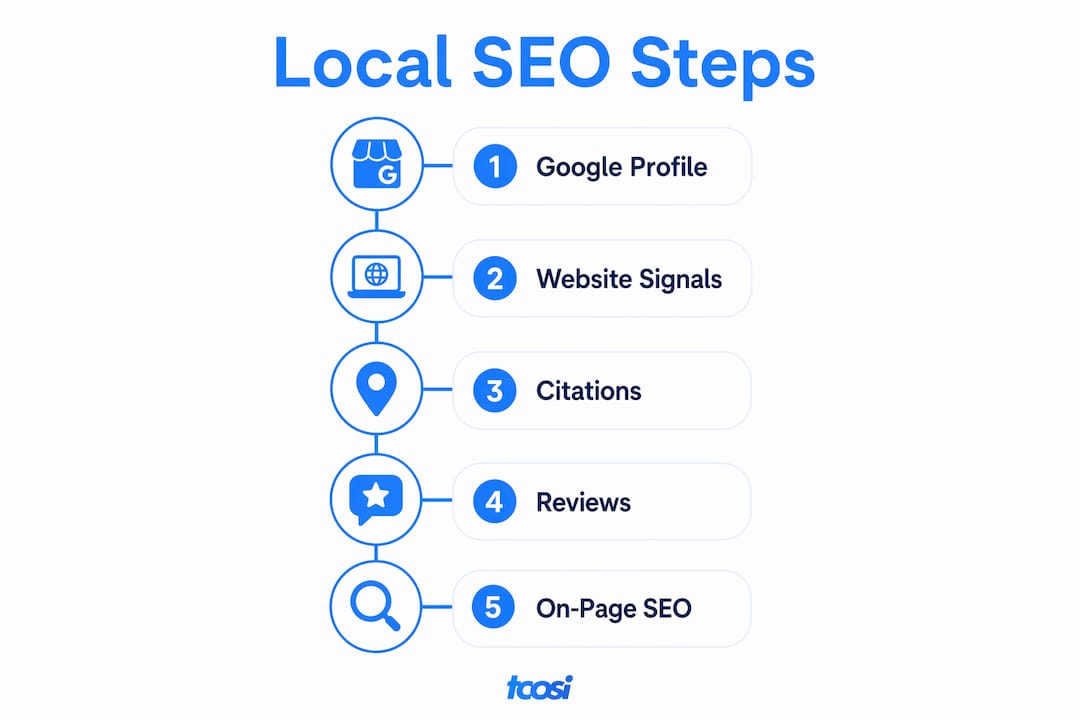
The three pillars of local SEO are your Google Business Profile, your website’s on-page signals, and your citation consistency across the web. Each one reinforces the others. A well-built website without a complete GBP leaves ranking power on the table. A great GBP without matching website signals loses ground in organic results.
Website signals are secondary to GBP and reviews for Map Pack rankings, but they are the primary driver of organic local rankings. That distinction matters. If you want to rank in the map pack and in the regular search results, you need both.

40.16% of local business queries now trigger AI Overviews in 2026. That means Google is pulling your business data directly into AI-generated answers. A thin or incomplete profile gets skipped entirely.
What makes a Google Business Profile rank higher?
Your GBP is the single most influential factor in local map pack rankings. The details you fill in, the photos you upload, and the reviews you collect all feed directly into how Google scores your relevance and prominence.
Here is what moves the needle most:
- Category precision. Choosing the most specific primary category can improve your map pack ranking by 2 to 4 positions within 3 to 5 weeks. “Roofing contractor” outperforms “contractor” every time.
- Photo volume. Businesses with 100+ photos see 520% more calls than those with few or none. Upload photos of your work, your team, and your location regularly.
- Q&A section. Seeding 10–15 self-answered questions on common customer concerns can boost call clicks by 18% to 28%. Think about what your customers ask before they call you, and answer those questions directly in the Q&A.
- Review velocity. Fresh reviews carry more weight than total review count in current algorithms. Aim for a steady stream of new reviews, not a one-time push.
- Business description. Write a clear, keyword-rich description that names your services and your city. This feeds directly into AI Overview results.
Pro Tip: Ask for reviews right after a job is complete, while the experience is fresh. A simple text message with a direct link to your GBP review page gets far more responses than a follow-up email a week later.
Responding to every review, positive or negative, signals active management to Google. It also builds trust with potential customers reading those reviews before they call.
Best practices for on-page local SEO
Your website needs to speak the same language as your GBP and your citations. That means using your city and service names in the right places, structuring your pages correctly, and making sure the technical side is solid.
- Put location keywords in your title tags and H1 headings. “Plumber in Austin, TX” in your title tag tells Google exactly who you serve. Generic titles like “Home Services” do not.
- Match your NAP exactly. Your name, address, and phone number on your website must match your GBP and every directory listing character for character. A suite number written as “Ste.” in one place and “Suite” in another creates a signal conflict.
- Add LocalBusiness schema markup. This structured data tells search engines your business name, address, phone, hours, and service area in a format they can read directly. FAQPage schema on relevant pages can boost click-through rates by 15% to 30% through rich snippet displays.
- Build unique location pages. If you serve multiple cities, each city deserves its own page with original content, local testimonials, and an embedded Google Map. Businesses focused on a single primary location consistently outperform those spreading thin, template-based content across dozens of location pages.
- Pass Core Web Vitals. Mobile usage drives 64% of local searches, and Google uses mobile-first indexing. Your site needs to load in under 3 seconds on a phone, with tap-to-call buttons and easy navigation.
Pro Tip: Embed a Google Map on your contact page and any location-specific pages. It reinforces your location relevance signal to search engines and makes it easier for customers to find you.
For a deeper look at how design and SEO work together, the SEO-optimized web design guide at tcosi covers the connection between site structure and local rankings.
How do citations and backlinks affect local rankings?
Citations are any online mention of your business name, address, and phone number. They appear on directories like Yelp, the Better Business Bureau, Apple Maps, and dozens of industry-specific sites. Consistency across all of them builds trust with search engines.
The most common citation problem is mismatched data. A business that moved, changed phone numbers, or rebranded often has conflicting information scattered across the web. Tools like BrightLocal and Whitespark can audit your citations and flag inconsistencies. Fixing them is not glamorous work, but it removes a real ranking obstacle.
Backlinks from local sources carry significant weight for prominence signals. Five quality local backlinks from a local newspaper, a chamber of commerce, a community event sponsorship, or a neighborhood business partner outperform dozens of generic directory links. The logic is simple: a link from a trusted local source tells Google you are genuinely part of that community.
Here are the most reliable ways to earn local backlinks:
- Sponsor a local event or youth sports team and request a link from the event website.
- Partner with complementary local businesses for cross-referral pages.
- Pitch a story to your local newspaper or business journal. A feature article almost always includes a link.
- Join your local chamber of commerce. Most chambers link to member websites.
- Donate to a local nonprofit and ask to be listed as a sponsor.
Avoid low-quality citation farms and paid link schemes. Google’s local algorithm penalizes spammy signals, and the short-term gains are not worth the long-term risk. For more on why local SEO matters for small businesses, that resource covers the strategic case clearly.
Common local SEO mistakes and how to fix them
Small businesses lose local rankings for predictable reasons. Recognizing these patterns early saves months of wasted effort.
- Using a generic GBP category. “Restaurant” when you should be “Thai Restaurant” costs you map pack positions. Review your primary category and pick the most specific option available.
- Ignoring mobile speed. A site that loads slowly on a phone loses visitors before they read a single word. Run your site through Google PageSpeed Insights and fix the issues flagged as high priority.
- Letting reviews go stale. Review velocity matters more than total count. If your last review is six months old, set up a system to ask every satisfied customer for one. A structured review generation system targeting 4 to 6 new reviews in the first month creates momentum that compounds over time.
- Creating duplicate location pages. Swapping a city name into a template page and publishing it 20 times does not work. Google’s helpful content system recognizes thin, repetitive pages and discounts them.
- Not responding to reviews. Ignoring reviews, especially negative ones, signals low engagement. Respond to every review within 48 hours.
Pro Tip: Fix your title tags, headers, and footer NAP consistency first. These on-page changes take 2 to 3 weeks to implement and deliver measurable improvements faster than almost any other local SEO tactic.
The local business website best practices guide at tcosi walks through these fixes in a practical, step-by-step format if you want a structured checklist to follow.
Key Takeaways
Effective local search optimization requires three things working together: a complete and actively managed Google Business Profile, a technically sound website with localized content, and consistent citations backed by quality local backlinks.
| Point | Details |
|---|---|
| GBP is the top ranking factor | Category precision, photo volume, and review velocity drive 32–36% of map pack rankings. |
| On-page signals power organic rankings | Location keywords, NAP consistency, and schema markup are the primary drivers outside the map pack. |
| Citation consistency builds trust | Mismatched NAP data across directories creates ranking conflicts that are easy to fix but easy to overlook. |
| Local backlinks beat generic ones | Five quality links from local newspapers, events, or partners outperform dozens of low-authority directory links. |
| Mobile speed is non-negotiable | 64% of local searches happen on mobile, and slow sites lose rankings and visitors simultaneously. |
What I’ve learned about local SEO after building sites for local businesses
The most common thing I see with local businesses is that they treat their website and their Google Business Profile as two separate projects. They are not. They are one system, and they need to tell the same story.
I have worked with service businesses that had beautiful websites but almost no local visibility. The fix was rarely a full redesign. It was usually a combination of tightening up their GBP category, adding location-specific content to their service pages, and getting a consistent review cadence going. Those changes, done well, move the needle faster than most business owners expect.
The AI Overview shift is real and worth paying attention to. When 40% of local queries now surface an AI-generated answer at the top of the page, your GBP data becomes your most visible marketing asset. A sparse profile is not just a missed opportunity. It is actively handing visibility to a competitor who took the time to fill theirs out.
My honest advice: do not try to rank in 15 cities at once. Pick your primary market, build real content around it, earn a few genuine local links, and manage your reviews consistently. That focused approach builds authority that holds up over time. Spreading thin across too many locations without unique content is one of the most common ways small businesses undermine their own efforts.
Schema markup and mobile performance are the two technical items I push hardest on. Both are invisible to the average visitor, but both have a direct, measurable impact on how search engines read and rank your site. If your site is not passing Core Web Vitals on mobile, that is the first thing to fix before anything else.
— Tommy Cosimano
Local SEO support for small business websites
Getting the strategy right is one thing. Having a website built to support it from the ground up is another.
tcosi builds custom WordPress websites designed with local search visibility in mind from day one. That means clean site structure, proper schema markup, location-specific pages built with real content, and mobile performance that meets Google’s standards. For agencies and business owners who need ongoing support, the white-label WordPress development services at tcosi cover everything from initial builds to long-term optimization. Local search rankings are not a one-time project. They require consistent attention, and tcosi is built to provide exactly that. If you are ready to build a site that works as hard as you do, reach out here.
FAQ
What is the most important factor for local search rankings?
Google Business Profile signals, including category accuracy, photo count, and review velocity, account for roughly 32–36% of local map pack rankings. Keeping your GBP complete and actively managed is the highest-leverage action you can take.
How does mobile optimization affect local SEO?
Mobile usage drives 64% of local searches, and Google uses mobile-first indexing to rank sites. A site that loads slowly or is hard to navigate on a phone will rank lower and lose visitors before they contact you.
What is NAP consistency and why does it matter?
NAP stands for name, address, and phone number. When this information appears differently across your website, GBP, and online directories, it creates conflicting signals that weaken your local rankings. Consistent NAP data across all platforms builds trust with search engines.
How many reviews do I need to rank locally?
Review velocity matters more than total count. Earning 4 to 6 new reviews per month consistently outperforms a business with 100 old reviews and no recent activity. Fresh reviews with localized language improve both ranking and engagement.
Does schema markup really help local SEO?
Yes. LocalBusiness schema tells search engines your exact business details in a structured format. FAQPage schema on relevant pages can increase click-through rates by 15% to 30% through rich snippet displays in search results.


