
What are the best home service websites in 2026?
The strongest home service websites in 2026 share a clear pattern: they make it easy to book, easy to trust, and easy to say yes. Whether you’re building your own site or looking for inspiration, the examples below show exactly what that looks like in practice.
Each site below was evaluated on service clarity, booking flow, trust signals, and design quality. Here’s how 35 of the most notable home service platforms stack up.
| Website | Service Type / Specialty | Key Design Wins | Conversion-Focused Elements | Best For |
|---|---|---|---|---|
| United Home Services | Multi-service home care | Clean navigation, high trust signals | Online booking, service filters | Homeowners wanting variety |
| PreFix | HVAC and appliance repair | Clear pricing layout | Upfront pricing, fast booking flow | Quick HVAC and appliance fixes |
| Absolute Home Services | Full home maintenance | Live chat integration | Real-time chat, order tracking | Direct provider communication |
| Kitchen Cabinet Guys | Cabinetry design and install | Visual project galleries | Photo galleries, customer reviews | Kitchen remodeling clients |
| Carter Services | Plumbing and electrical | Simplified contact layout | FAQ section, fast booking links | Local plumbing and electrical |
| Puetz Construction | Construction and remodeling | Estimate tools, testimonials | Online quote calculator | Complex project quotes |
| Smock Heating & Air | HVAC seasonal service | Promotion banners | Seasonal deals, clear CTAs | Seasonal HVAC deals |
| Veterans Home Services | Veteran-operated maintenance | Brand story, trust badges | Veteran credentials, testimonials | Clients valuing veteran service |
| Southern Home Services | Cleaning and lawn care | Package builder | Subscription options, custom packages | Tailored maintenance plans |
| Sears Home Services | Appliance repair and HVAC | Extensive service listings | Warranty details, same-day scheduling | National coverage and warranties |
| Fluid-Aire Dynamics | Commercial and residential HVAC | Certification highlights | Detailed service descriptions | Energy-efficient HVAC clients |
| Handyman on Purpose | General handyman | Simple UX, clear service list | Quote request forms, rapid response | Small repairs with fast quotes |
| 5 Star Home Services Inc | Multi-service home care | Review aggregates | Customer testimonials, star ratings | Review-driven decisions |
| Lion Home Service | Eco-friendly repairs | Green certification display | Environmental benefit callouts | Eco-conscious homeowners |
| Air Duct Brothers | Duct cleaning and air quality | Before/after visuals | Guarantee badges, satisfaction promise | Air quality improvement |
| Veterans Contracting | Veteran-led contracting | Project timelines, certifications | Accountability messaging | Reliable, accountable contractors |
| Genz-Ryan | Home inspection and repair | Inspection report samples | Appointment booking, report previews | Home buyers and inspections |
| Northface Construction | Residential and commercial build | Client portal | Status tracking, progress updates | Transparency-focused clients |
| Bear’s Plumbing Services | Local plumbing | Emergency call buttons | Instant estimate calculator | Urgent plumbing needs |
| Certified Roofing Solutions | Roof inspection and repair | Drone imagery | Warranty coverage, HD visuals | Roof condition transparency |
| Home Front Exteriors | Exterior home improvement | Financing calculator | Payment plan explanations | Budget-friendly exterior work |
| Thelen Mechanical | Mechanical systems repair | Diagnostic user portals | Service history logs, reminders | Technical service tracking |
| GreenTek Roofing & Solar | Solar and roofing | Energy savings calculator | Solar rebate info, green messaging | Combined roofing and solar |
| Integrity Home Solutions | Home repair with guarantees | Guarantee messaging | Support chat, post-service follow-up | Trustworthy guarantees |
| NJR Home Services | Heating and plumbing | Bundled package display | Maintenance contracts, renewal flow | Preventive maintenance plans |
| Sanders Home Services | Full home maintenance | Subscription scheduling | Recurring appointments, online booking | Convenient regular care |
| ACE Home Services | Multi-skill local technicians | Emergency contact prominence | Combo discounts, emergency availability | Quick repairs and emergencies |
| Colorado Home Services | Home improvement, Western U.S. | Localized content | Community testimonials, local stories | Regional community connection |
| Five Star Home Services Inc. | Home repair contractor | Review highlights | Detailed service menus, reputation focus | Online reputation-driven buyers |
| Stafford Home Service | General home services | Clean UX, step-by-step booking | Transparent contact info | Straightforward service booking |
| Maitz Home Services | Custom repair and renovation | Visual-rich galleries | Client feedback, project photos | High-end renovation clients |
| Mr. Rooter | National plumbing franchise | Local service locator | Franchise trust badges, local directory | Brand recognition with local reach |
| Bone Dry Roofing | Roofing installation and repair | Storm damage promotions | Emergency contact, seasonal banners | Storm-prone area homeowners |
| Expert Home Service | Home repair and cleaning | Live review feeds | Satisfaction guarantees, review display | Trustworthy service with feedback |
| T&S Roofing Systems | Specialized roofing systems | Material innovation display | Warranty terms, advanced materials info | High-tech roofing solutions |
A few patterns stand out across the strongest performers. Sears Home Services handles over 7 million repairs annually, and that scale shows up in how the site is built: warranty plan details are front and center, same-day scheduling is prominently placed, and the service directory covers every major appliance category. That’s a masterclass in turning operational scale into website credibility.

Certified Roofing Solutions takes a different approach to trust. Drone imagery of actual roof conditions gives homeowners something concrete to evaluate before committing. GreenTek Roofing & Solar pairs energy savings calculators with solar rebate information, making the financial case for a combined install without requiring a phone call. Both sites convert because they answer the buyer’s real question before it’s asked.
Northface Construction’s client portal is worth noting separately. Giving clients login access to track project progress turns a passive website into an active relationship tool. Thelen Mechanical does something similar with diagnostic portals and service history logs, which are especially useful for repeat maintenance clients who want to see their full service record in one place.
Pro Tip: Study how Bear’s Plumbing Services handles emergency scenarios. An emergency call button that’s visible on every page, paired with an instant estimate calculator, removes every barrier between a panicked homeowner and a booked appointment. That’s the kind of UX detail that wins jobs at 11 PM.
What features do high-converting home service websites share?
The gap between a home service site that books jobs and one that just sits there usually comes down to a handful of specific features. Getting these right is what separates the top performers from everyone else.
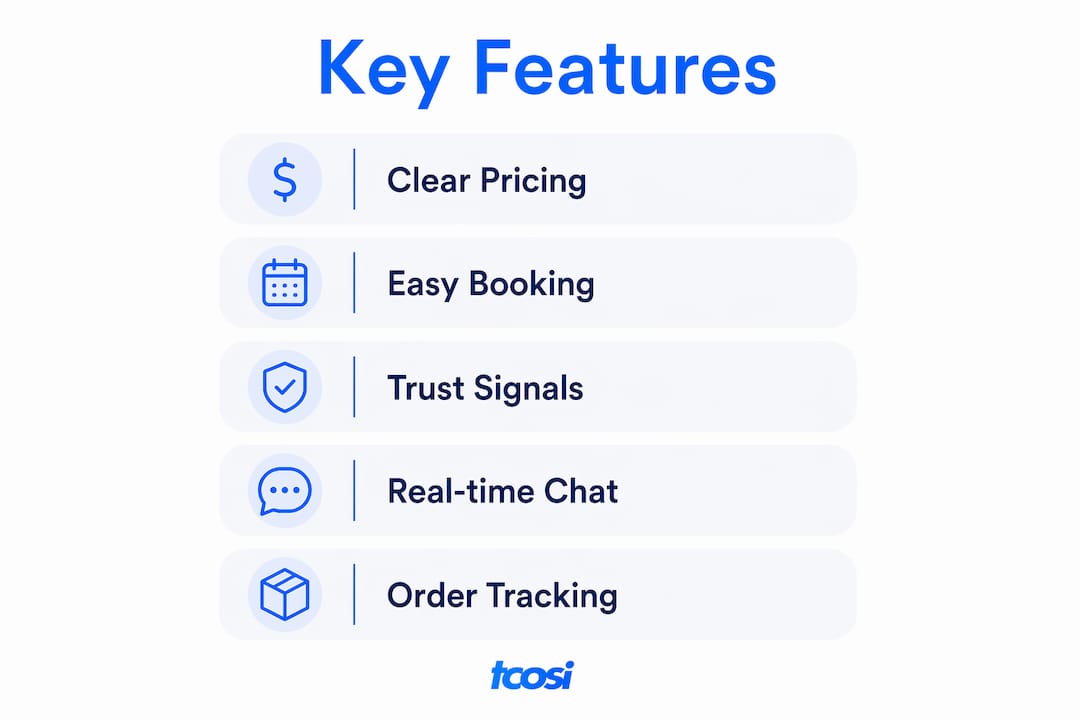
The most effective sites integrate secure payments, real-time chat, and order tracking on the customer side, while giving business owners a clean admin dashboard to manage providers, track performance, and handle scheduling. Front-end polish matters, but without a solid backend, the whole operation breaks down fast.
Upfront pricing is one of the biggest conversion drivers right now. The shift away from “request a quote and wait” toward transparent, fixed booking prices has measurably reduced friction for homeowners. PreFix and Handyman on Purpose both demonstrate this well: the price is visible before the booking form is even submitted. That single change removes the most common reason people abandon a service site.
Trust signals deserve their own conversation. Platforms like Fixer show that background-checked, insured workers with warranties convert at higher rates because homeowners are letting strangers into their homes. A badge or certification mark isn’t decoration. It’s the answer to the question every visitor is silently asking: “Can I trust these people?”
Here are the core features every high-performing home service site should have:
- Clear, upfront pricing visible before the booking step, not after a form submission
- Online booking with real-time availability, not a “we’ll call you back” form
- Live chat or instant messaging so visitors get answers without picking up the phone
- Trust badges: insurance verification, licenses, background checks, and warranties
- Customer reviews and ratings pulled from Google or displayed natively on the site
- Mobile-first design since most local service searches happen on a phone
- Fast load times because a slow site loses visitors before they see your services
- Service-specific landing pages that match what someone searched for, not a generic homepage
Neighborly’s approach to trust is worth studying. Their Neighborly Done Right Promise acts as a universal guarantee across their entire family of brands, which reduces the decision fatigue homeowners feel when choosing between providers. That kind of platform-level credibility is hard to replicate on a single-service site, but the principle applies: make the guarantee explicit and make it easy to find.
Pro Tip: Run a simple A/B test on your primary call-to-action button. Changing the text from “Contact Us” to “Book Your Free Estimate” on a service page can meaningfully lift click-through rates. Test one element at a time and let real user behavior guide the changes.
What red flags should you watch for on home service websites?
Some home service sites actively work against the people using them. Knowing what to look for protects you from wasting money on a platform that won’t perform.
The most damaging red flag is hidden pricing. When a site requires a phone call or form submission just to get a ballpark number, most visitors leave. Unclear pricing signals either a lack of confidence in the service or a sales tactic that puts the homeowner at a disadvantage. Neither builds trust.
Lead-generation platforms that sell your contact information to multiple contractors are another serious problem. When your phone number gets sent to four or six contractors simultaneously, those contractors roll the lead cost into their quotes, and you end up paying more than you should. Escrow-based systems, like the model used by AllBetter where verified pros bid in about 10 minutes and payment stays protected until work is approved, solve this by keeping the homeowner in control throughout the process.
Here’s a checklist of red flags to watch for, and what to do about each:
- No pricing information anywhere on the site. Fix: add a pricing page or at minimum a “starting from” range for common services.
- Difficult or broken navigation. Fix: test your site on mobile and desktop with a fresh set of eyes, or ask a friend to find a specific service without your help.
- Slow page load times. Fix: compress images, use a reliable host, and run a speed test through Google PageSpeed Insights.
- No reviews or testimonials. Fix: set up a Google Business Profile and actively ask satisfied customers to leave a review after each job.
- No contact information visible above the fold. Fix: put your phone number and a “Book Now” button in the header on every page.
- Stock photos instead of real work photos. Fix: photograph actual completed jobs and use those images throughout the site.
- No mention of licensing, insurance, or certifications. Fix: display credentials clearly on the homepage and service pages.
- Forms that don’t confirm submission. Fix: add a confirmation message or redirect to a thank-you page so visitors know their request was received.
Run a site audit at least twice a year. User behavior changes, browsers update, and what worked well two years ago may now be creating friction you’re not aware of. Tools like Hotjar or Microsoft Clarity show you exactly where visitors drop off, which is far more useful than guessing.
How do you build or upgrade a home service website that actually converts?
Building a home service site that consistently books jobs requires more than a good-looking design. The structure, content, and technical setup all have to work together.
Start with a clear definition of your core services. Trying to list everything you do on one page dilutes the message. Each major service category should have its own dedicated page with a specific headline, a short description of what’s included, trust signals relevant to that service, and a direct booking option. That structure also helps with local SEO, since Google can match individual pages to specific search queries.
WordPress remains the most practical platform for home service businesses that want flexibility without being locked into a proprietary system. It powers a large share of small business websites in the U.S., has a mature ecosystem of booking plugins, and can be handed off to a developer or agency without starting from scratch. Ongoing optimization after launch is just as important as the initial build.
Here’s a practical sequence for building or upgrading a home service site:
- Define your services and target areas before touching any design or copy
- Map the customer journey from search to booked appointment, and identify every point where someone might drop off
- Choose a platform that supports your booking and payment needs without requiring constant developer intervention
- Design for mobile first, since most local searches happen on a phone
- Write service pages that answer real questions, not just describe what you do
- Add trust signals on every page: licenses, insurance, reviews, and guarantees
- Set up Google Analytics and Search Console before launch so you have baseline data from day one
- Plan for a phased launch rather than waiting until everything is perfect
- Schedule monthly maintenance for security updates, plugin updates, and content refreshes
Pricing transparency deserves special attention. Moving from a “call for a quote” model to upfront fixed pricing, even for common service categories, removes a major barrier. Homeowners who can see a price before booking are more likely to commit. For complex jobs, a clear estimate request form with a fast turnaround promise works better than a generic contact form.
Budget realistically. A professionally built WordPress site for a home service business typically requires investment in design, development, copywriting, and ongoing maintenance. Cutting corners on any of those usually shows up in the conversion rate. Know what you’re paying for, and ask any agency you consider to show you examples of home service sites they’ve built, not just general portfolio work.
How do you work with a WordPress agency to build a home service site?
Choosing the right agency is often the decision that determines whether a home service website actually performs. The wrong fit costs time, money, and momentum.
The first thing to look for is relevant experience. An agency that has built sites for HVAC companies, plumbers, or contractors understands the specific challenges: emergency service CTAs, service area pages, review integration, and booking flows that work under pressure. General portfolio work is a starting point, but ask specifically for home service examples. Tommy Cosimano at tcosi works with local service providers and understands how to translate what a business does in the field into a site that books jobs online.
Before signing with any agency, ask these questions:
- Can you show me home service websites you’ve built and their results?
- What platform do you build on, and will I own the site outright after launch?
- How do you handle revisions and feedback during the build?
- What does ongoing support look like after the site goes live?
- How long does a typical project take from kickoff to launch?
- Do you offer maintenance plans, and what do they include?
Clear communication throughout the project is what separates a smooth build from a frustrating one. Set milestones with specific deliverables, not just a launch date. Review the site at each stage, not just at the end. The more specific your feedback, the faster the agency can move.
A few common misconceptions are worth addressing. Many business owners assume a website is finished when it launches. It isn’t. Search rankings, booking rates, and user behavior all shift over time, and a site that isn’t maintained and updated will lose ground. Local business website best practices consistently point to ongoing content updates and technical maintenance as key factors in sustained performance.
Pro Tip: If you run a marketing agency that serves home service clients, white-label WordPress development is worth exploring. You handle the client relationship and strategy while a development partner handles the build. tcosi offers a structured white-label delivery process designed specifically for agencies that want to expand their service offering without adding in-house developers.
Collaboration works best when both sides are honest about constraints. If your budget limits what’s possible in phase one, say so upfront. A good agency will help you prioritize the features that drive the most bookings first, and build a roadmap for adding more over time. That’s a more useful conversation than trying to fit everything into a fixed budget and ending up with a site that does nothing well.
tcosi builds home service websites that are built to last
If you’ve been comparing the sites in this article and thinking about what your own site could look like, tcosi is a practical next step worth considering. Rather than hiring one of the service providers listed above, you’re working with a web design and development agency that builds the kind of site those companies need.
tcosi, founded by Tommy Cosimano, specializes in custom WordPress websites for small businesses, including home service companies across the United States. The approach is straightforward: clear communication, a collaborative process, and a site built to support real business growth, not just look good at launch. There’s no handoff to a junior team or a templated build that looks like everyone else’s site. Tommy works directly with clients from kickoff to launch and beyond.
For home service businesses that want a professionally designed website with booking flows, trust signals, and mobile-first design built in from the start, or for agencies looking for a reliable white-label WordPress partner, tcosi offers a focused, transparent alternative to large agencies with long timelines and unclear pricing. You can review website pricing directly on the site, no discovery call required.
Key Takeaways
The most effective home service websites combine upfront pricing, clear trust signals, and mobile-first booking flows to convert visitors into booked jobs.
| Point | Details |
|---|---|
| Upfront pricing converts | Showing prices before the booking step removes the most common reason visitors leave without booking. |
| Trust signals are required | Licenses, insurance, background checks, and warranties answer the question every homeowner is silently asking. |
| Mobile-first design matters | Most local service searches happen on a phone, so desktop-only design loses jobs before they start. |
| Red flags cost real money | Hidden pricing, slow load times, and no reviews actively drive visitors away from your site. |
| tcosi for custom WordPress builds | tcosi builds home service websites on WordPress with direct communication, transparent pricing, and ongoing support. |
FAQ
What makes a home service website convert well?
Clear upfront pricing, visible trust signals like licenses and reviews, and a simple online booking flow are the three factors that most directly drive conversions on home service sites.
How long does it take to build a home service website?
A professionally built WordPress site for a home service business typically takes four to eight weeks from kickoff to launch, depending on the number of service pages, custom features, and how quickly feedback is provided during the review stages.
Should I use WordPress for my home service website?
WordPress is the most practical choice for most home service businesses. It offers full ownership of your site, a wide range of booking and payment plugins, and the flexibility to grow without switching platforms.
What are the biggest red flags on home service websites?
No pricing information, broken or confusing navigation, missing contact details above the fold, and no customer reviews are the most common issues that reduce trust and drive visitors away before they book.
Can a marketing agency offer home service website builds without an in-house developer?
Yes. White-label WordPress development lets agencies handle the client relationship while a development partner manages the build. tcosi offers a structured white-label process designed for agencies serving home service clients.


