Choosing the right web designer means selecting a professional who understands your business goals, offers transparent pricing, follows a clear design process, and provides ongoing support after launch. The wrong hire costs you time, money, and a website that does not actually work for your business. This guide walks you through every step of the selection process, from setting your budget to asking the right questions, so you can make a confident, informed decision.
What to know before you choose a web designer
Before you start comparing portfolios or requesting quotes, you need to get clear on three things: what your website needs to do, what you can realistically spend, and whether your content is ready to go.
Define your website type first
Not all websites serve the same purpose, and the type you need directly affects which designer is the right fit. A brochure site for a local service business is a very different project from an ecommerce store or a booking platform. A designer who specializes in simple informational sites may not have the technical depth to build a WooCommerce store or integrate scheduling software like Acuity Scheduling or Calendly. Know your type before you reach out.

Set a realistic budget
Budget shapes every decision in this process. DIY builders like Squarespace or Wix are a solid option for budgets under £500, giving very small businesses a workable starting point. Beyond that, freelancers typically cost £500–£2,000, UK agencies run £3,000–£8,000 or more, and overseas agencies land in the £1,200–£4,000 range, often 40–60% cheaper than local rates. Knowing where you fall in that range tells you which tier of designer to approach.
Get your content ready before you hire
This is the step most small business owners skip, and it causes real problems. Content delivery delays are the top reason web design projects miss their deadlines. That means your text, photos, logos, and any other materials need to be organized before the project starts, not during it.
- Write out your page copy or hire a copywriter in advance
- Gather high-resolution photos and brand assets
- Prepare your logo in vector format (SVG or AI file)
- Decide on your site structure and page list before kickoff
Pro Tip: Create a shared Google Drive or Dropbox folder before your first designer meeting. Drop all your content in there as you collect it. When the project starts, your designer has everything on day one, and you avoid the most common cause of delays.
How to evaluate a web designer’s portfolio
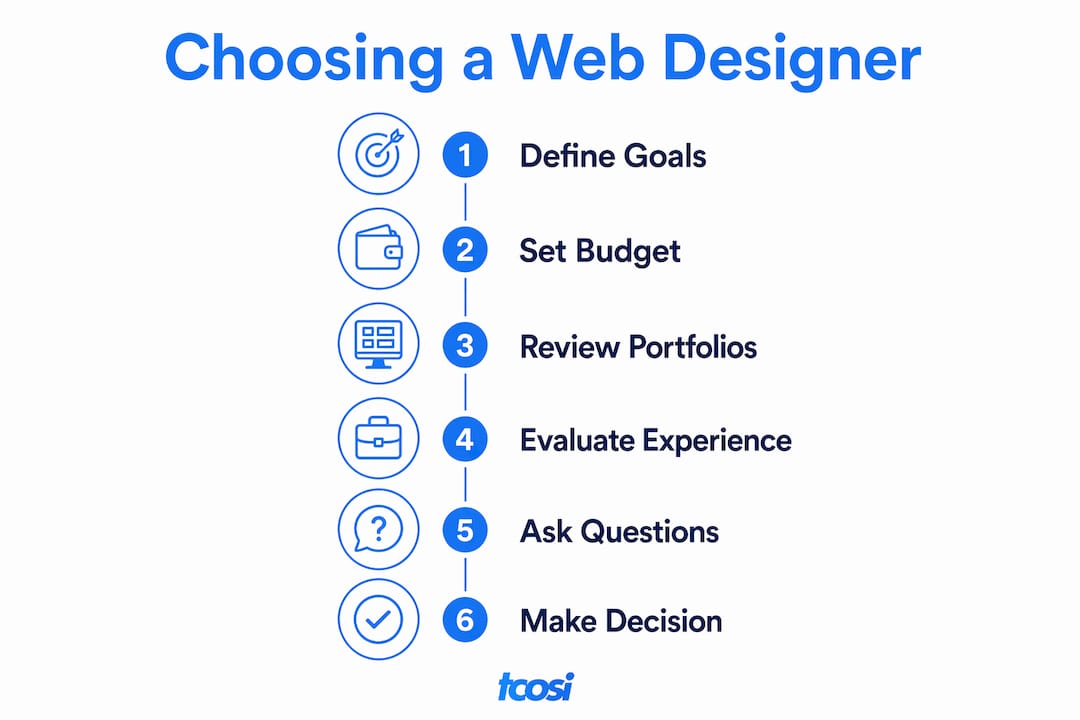
A portfolio tells you more than whether a designer has good taste. It tells you whether they can solve real business problems with their work.
Look for relevant experience, not just pretty sites
The most important thing in a portfolio is relevance. A designer who has built sites for law firms, contractors, or healthcare providers understands the specific needs of those industries. That context speeds up the project and reduces back-and-forth. If you run a restaurant and every site in their portfolio is for tech startups, that is a gap worth noting.
Judge function, not just form
A well-designed site should be fast, easy to navigate, and built with search visibility in mind. When you review portfolio sites, open them on your phone. Check how fast they load. Click through the menus. If a site looks great on a desktop but falls apart on mobile, that tells you something about the designer’s priorities. Choosing a designer who understands your business goals and builds for function, not just aesthetics, is more valuable than selecting on visual style alone.
Positive signs in a portfolio:
- Mobile-friendly layouts that work across screen sizes
- Clear calls to action on every key page
- Fast load times (test with Google PageSpeed Insights)
- Clean URL structures and visible SEO attention
Red flags to watch for:
- Sites that are not mobile-responsive
- No visible contact forms or conversion points
- Broken links or outdated content on live sites
- Every site looks identical, suggesting heavy template reliance
Freelancers vs. agencies vs. overseas: which fits your needs?
The type of designer you hire matters as much as the individual. Each model comes with different tradeoffs on cost, support, and communication.
Freelancers tend to be more affordable and flexible, agencies provide broader skill sets and structured support, and overseas agencies offer competitive pricing but require careful vetting for quality and time zone impact. Here is how they compare side by side.
| Type | Typical Cost | Strengths | Weaknesses |
|---|---|---|---|
| Freelancer | £500–£2,000 | Affordable, direct communication | Limited bandwidth, less post-launch support |
| UK/US Agency | £3,000–£8,000+ | Full team, structured process | Higher cost, less personal attention |
| Overseas Agency | £1,200–£4,000 | Lower cost, often full-service | Time zone gaps, quality varies widely |
| DIY (Squarespace/Wix) | Under £500 | Lowest cost, full control | Time-intensive, limited customization |
For most small businesses, a skilled freelancer or a small boutique agency is the right fit. You get direct communication, reasonable pricing, and a designer who is personally invested in your project. Large agencies often assign junior staff to smaller accounts, which means you pay premium rates but do not always get senior-level attention.
Overseas agencies can deliver solid work, but you need to vet them carefully. Ask for references from clients in your country, review live sites they have built, and test their communication responsiveness before signing anything.
What questions should you ask a web designer?
The interview stage is where you separate good designers from great ones. The answers matter, but so does how they are delivered.
- What does your design process look like from start to launch? A designer with a well-structured process will walk you through defined stages: discovery, wireframes, design, development, review, and launch. Vague answers here are a warning sign.
- How do you handle SEO during the build? You want to hear about clean code, proper heading structure, meta descriptions, image optimization, and mobile performance. Not just “we add keywords.”
- How many revision rounds are included? Get this in writing. Unlimited revisions is a red flag. Two to three structured rounds is standard and professional.
- Who owns the domain, hosting, and all site files after launch? Ownership of your domain, hosting, and files must be non-negotiable. If a designer cannot give you a clear yes on this, walk away.
- What does post-launch support look like? Some designers disappear after launch. Others offer monthly maintenance plans. Know what you are getting before you sign.
- Can I speak with a past client? A confident designer will say yes without hesitation.
Pro Tip: Pay attention to how a designer communicates during the sales process. If they are slow to respond, vague in their answers, or hard to reach before you have even hired them, that behavior will not improve once the project starts. Communication style and transparency are better predictors of a good outcome than a polished portfolio alone.
Common mistakes to avoid when hiring a web designer
Even well-prepared business owners make avoidable mistakes. These are the ones that cause the most damage.
- Skipping a written contract. A verbal agreement is not enough. Your contract should cover scope, timeline, payment schedule, revision rounds, and ownership of all deliverables.
- Choosing on price alone. The cheapest quote rarely delivers the best result. A site that does not convert visitors into customers is not a bargain at any price.
- Providing a vague brief. “I want something clean and modern” is not a brief. Describe your audience, your goals, your competitors, and the specific pages you need. The more specific you are, the better the result.
- Delaying content delivery. As noted earlier, content delays are the leading cause of missed deadlines. Do not start a project until your copy and images are ready.
- Ignoring hidden costs. Ask upfront about hosting fees, plugin licenses, stock photo costs, and ongoing maintenance charges. Surprises in the invoice are almost always avoidable with one direct conversation.
The best way to avoid all of these is to treat the hiring process like any other business decision. Do your research, ask direct questions, and get everything in writing.
Key takeaways
The right web designer is one who aligns with your business goals, communicates clearly, follows a defined process, and hands you full ownership of your site at launch.
| Point | Details |
|---|---|
| Define goals and budget first | Know your website type and realistic spend before contacting any designer. |
| Prepare content in advance | Organized copy and images before kickoff prevents the most common cause of delays. |
| Evaluate portfolios for function | Check mobile performance, load speed, and conversion focus, not just visual style. |
| Ask about ownership upfront | Confirm you will own your domain, hosting, and all site files before signing anything. |
| Communication predicts outcomes | How a designer responds before the project starts reflects how they will perform during it. |
What i have learned after years of building small business websites
Most small business owners come to me after a bad experience with another designer. The story is almost always the same: the project took twice as long as expected, communication dropped off after the deposit was paid, and the final site did not reflect what was discussed at the start.
Here is what I have found to be true after working with businesses of all sizes: the flashiest portfolio does not predict the best outcome. What actually predicts a good outcome is process and communication. A designer who can walk you through exactly what happens from week one to launch, who responds to your emails within a business day, and who asks smart questions about your business before touching a design tool is the one worth hiring.
I also want to push back on the idea that you should always go with the lowest price. A cheap site that does not load fast, does not rank in search, and does not convert visitors is not a deal. It is a cost you will pay twice when you hire someone to fix it. Invest in the right fit the first time.
One more thing: own your stuff. Your domain, your hosting account, your files. I have seen business owners held hostage by designers who refused to hand over login credentials. That should never happen. If a designer cannot clearly confirm you will own everything at the end of the project, that is a dealbreaker.
— Tommy Cosimano
Ready to find the right fit for your business?
At tcosi, I work with small businesses across the United States to build custom WordPress websites that are clear, fast, and built to support real growth. Every project starts with a straightforward conversation about your goals, your budget, and what success looks like for your business.
The process is transparent from day one. You will always know what stage we are in, what is coming next, and what you own at the end. If you are ready to stop guessing and start building something that actually works, visit tcosi to learn more about how we work and what we can build together.
FAQ
How do i know if a web designer is right for my business?
Look for relevant portfolio experience, a clear design process, and strong communication before the project starts. A designer who asks smart questions about your goals is a better sign than one who jumps straight to pricing.
What is a realistic budget for a small business website?
Freelancers typically cost £500–£2,000, while small agencies range from £3,000 to £8,000 or more. For very tight budgets, DIY builders like Squarespace or Wix are a workable option under £500.
Who should own the domain and hosting after a website is built?
You should. Ownership of your domain, hosting account, and all site files must belong to you as the client. Confirm this in writing before signing any contract.
What is the biggest reason web design projects run late?
Content delays are the leading cause of missed deadlines. Having your copy, photos, and brand assets ready before the project starts is the single most effective way to stay on schedule.
What questions should i ask before hiring a web designer?
Ask about their process, how they handle SEO, how many revisions are included, who owns the files, and what post-launch support looks like. How clearly and confidently they answer tells you as much as the answers themselves.