Storytelling in web design is the deliberate use of narrative elements to guide visitors emotionally and logically through a website, shaping how they perceive your brand and whether they take action. This is not a soft, decorative concept. It is a core design mechanic that determines whether a visitor stays or leaves, connects or bounces, converts or disappears. Visitors have just 3 seconds to engage with a website’s story hook before they decide to move on. That window is your entire first impression. The role of storytelling in web design is to fill that window with something worth staying for, using narrative structure, visual pacing, and intentional content to create a real connection.
How the role of storytelling in web design shapes user journeys
Traditional story structures are not just for novels and films. They map directly onto how users move through a website. The most widely applied model is the three-act structure: setup, tension, and resolution. On a website, setup means orienting the visitor quickly with context and a clear value proposition. Tension introduces the problem your audience faces. Resolution presents your solution and calls the visitor to act.
Effective website narratives often follow this three-act structure, mapped into modular content units that guide users from context to conversion within the first screen view. That modularity matters because it lets you build a story that works whether a user reads every word or skims the page.

The customer as hero, brand as guide
One of the most effective narrative frameworks for business websites positions the customer as the hero of the story, not the brand. The brand plays the guide: the trusted advisor who helps the hero solve their problem. This shift changes everything about how you write headlines, structure service pages, and present testimonials.
Positioning the customer as the hero increases engagement and trust, especially when proof points like testimonials and outcomes are embedded within that customer-centered story. A testimonial reads very differently when it is framed as “Here is how Sarah solved her problem” versus “Here is what a client said about us.”
Storytelling structures compared
| Structure | Web Design Application | Best For |
|---|---|---|
| Three-Act (Setup, Tension, Resolution) | Homepage flow from problem to solution | Service and product pages |
| Hero’s Journey | Customer transformation narrative | Case studies and about pages |
| Beat Sheet | Scene-by-scene scroll experience | Long-form landing pages |
| Problem-Agitate-Solve | Short, punchy narrative arc | Campaign and ad landing pages |
Pro Tip: Map your homepage scroll to the three-act structure before you write a single word of copy. Define the setup (who this is for), the tension (what problem exists), and the resolution (what you offer) as three distinct scroll zones.
What visual storytelling techniques actually drive engagement
Visual storytelling in web development goes well beyond adding a hero image or an animation. It is the deliberate use of motion, imagery, pacing, and interaction to carry the narrative forward without relying solely on text.
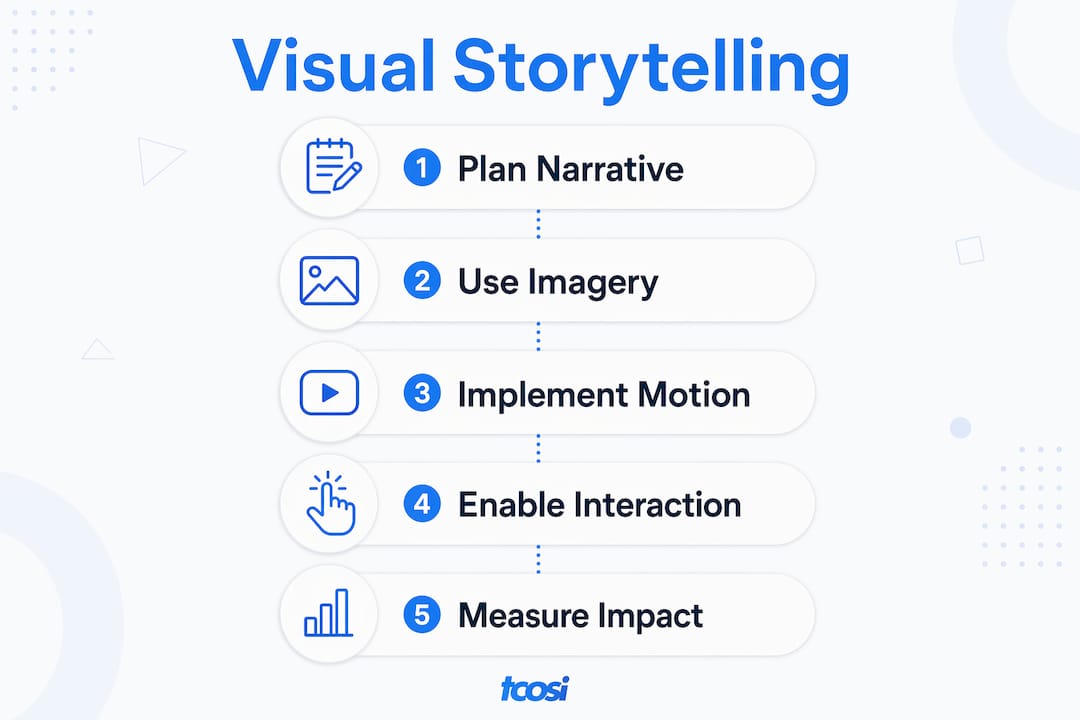
Scroll-triggered narratives and interactive motion design replace static navigation with curated paths that give users a sense of discovery. That participatory quality creates stronger memory and emotional connection to a brand than a traditional brochure-style website ever could. When a user feels like they are uncovering a story rather than reading a page, they stay longer and engage more deeply.
Core visual storytelling elements
- Scroll-triggered reveals: Content appears as the user scrolls, creating a sense of progression and momentum that mirrors turning a page.
- Animation and motion design: Purposeful movement draws the eye, signals importance, and reinforces the emotional tone of the narrative.
- 3D objects and immersive visuals: Used selectively, three-dimensional elements create depth and make a product or concept feel tangible.
- Cinematic imagery: High-quality, contextually relevant photography or video sets the emotional atmosphere before a single word is read.
- Sound design: Subtle audio cues, when used appropriately, add a sensory layer that deepens immersion on experience-driven sites.
- Pacing and white space: The rhythm of how content appears and breathes on the page controls cognitive load and emotional intensity.
The critical distinction is between storytelling and decoration. Decorative animations add visual noise without advancing the narrative. Storytelling animations reveal information, signal transitions, or reinforce a brand’s emotional tone. Every visual element should earn its place by serving the story.
Pro Tip: Before adding any animation or visual effect, ask one question: does this move the story forward? If the answer is no, cut it. Restraint is what separates purposeful visual storytelling from a site that just looks busy.
How storytelling improves UX and conversion on business websites
Storytelling is not just a branding exercise. It has a direct impact on user experience and measurable business outcomes. Design is not neutral; effective storytelling respects how users already perceive the world, and that alignment is what creates meaningful connection. A design that fights against a user’s existing mental model creates friction. A design that works with it creates trust.
The Lucky Iron Fish is a well-documented example from AND Academy. A product designed to address iron deficiency in Cambodia failed until its creators reframed the design around local cultural stories and cooking rituals. The product did not change. The narrative did. Sales followed. That principle applies directly to web design: a site that speaks the user’s language, reflects their values, and acknowledges their context will outperform one that simply lists features.
Storytelling in design shapes user beliefs and actions at a fundamental level. It is not packaging applied after the design is done. It is the mechanism through which design communicates meaning. When narrative is built into the UX from the start, every interaction reinforces the brand story.
Practical outcomes of narrative-driven website design include:
- Higher time-on-page because users follow a story rather than scan for information
- Lower bounce rates because the hook in the first scroll zone earns continued attention
- Stronger conversion rates because the resolution of the narrative naturally leads to a call to action
- Greater brand recall because emotionally resonant experiences are remembered longer than informational ones
- More qualified leads because the story filters for the right audience before they ever fill out a form
For narrative mapping in practice, the most effective approach integrates storytelling decisions into the UX framework from the wireframe stage, not as a copywriting pass at the end.
How to build a storytelling-driven website step by step
Integrating narrative into a web design project requires a clear workflow. The following sequence works for both new builds and redesigns.
- Define the audience’s story first. Before any design begins, identify the specific problem your audience faces, what they have already tried, and what success looks like for them. This becomes the emotional core of the site.
- Map the narrative arc to the page structure. Assign setup, tension, and resolution to specific scroll zones or pages. Every section should have a narrative purpose, not just an informational one.
- Build a storyboard before wireframes. Sketch the emotional journey visually, scene by scene, before committing to layout. This catches narrative gaps early.
- Write copy in story order. Draft headlines and body copy following the narrative arc. The copy should feel like a conversation, not a brochure.
- Apply visual storytelling in production. Add scroll-triggered animations, imagery, and pacing decisions that reinforce the narrative tone established in the storyboard.
- Keep the experience tight. Concise narratives of 2–3 minutes total experience time across about 5 key scenes optimize user retention and manage cognitive load effectively.
- Measure narrative performance. Track scroll depth, time on page, and conversion rates by section to identify where the story loses users and where it converts them.
Common pitfalls include starting with visual design before the narrative is defined, adding storytelling elements as decoration rather than structure, and making the brand the hero instead of the customer.
Key takeaways
Narrative-driven website design works because it aligns every visual, structural, and copy decision with a story that respects how users think, feel, and decide.
| Point | Details |
|---|---|
| Hook within 3 seconds | Place your strongest narrative hook in the first scroll zone to capture attention before users leave. |
| Three-act structure guides flow | Map setup, tension, and resolution to distinct page sections to create logical emotional progression. |
| Customer is the hero | Frame your brand as the guide, not the hero, to build trust and increase engagement. |
| Visual elements must serve the story | Every animation, image, and motion effect should advance the narrative, not just decorate the page. |
| Keep it to 5 scenes | Limit the full experience to 2–3 minutes across roughly 5 key scenes to protect retention and reduce cognitive load. |
Storytelling is a design decision, not a writing task
I have worked on enough websites to know where storytelling goes wrong. Most of the time, it gets treated as a copywriting job. The designer builds the layout, the developer builds the site, and then someone writes words to fill the boxes. That process produces brochures, not stories.
Storytelling is a fundamental design mechanic, not a presentation layer. It has to be built into the structure of a site from the first conversation about goals and audience. When I start a project at tcosi, the narrative questions come before the design questions. Who is this for? What do they believe when they arrive? What do we want them to feel and do? Those answers shape everything: the layout, the imagery choices, the scroll behavior, the calls to action.
The other mistake I see constantly is brands making themselves the hero. They lead with their history, their awards, their team. Visitors do not care about any of that until they trust you. You earn that trust by showing them you understand their problem first. The brand story comes after the customer story, not before it.
What I find most rewarding about this work is that good narrative design is invisible. When it works, users do not notice the story. They just feel like the site gets them. They stay, they explore, and they reach out. That is the goal: not a website that looks impressive, but one that feels right.
— Tommy Cosimano
Build a website that tells your brand’s story
If you have read this far, you already know that a great website is more than a good-looking page. It is a structured experience that earns attention, builds trust, and guides visitors toward a decision.
At tcosi, every project starts with the story before the design. Whether you need a new website built from scratch or a redesign that finally reflects what your business actually does, the process is built around your audience and your goals. Take a look at tcosi’s web design work to see how narrative-driven design translates into real results for businesses across the United States. If you are ready to talk through your project, reach out directly and let’s figure out what your site should be saying.
FAQ
What is the role of storytelling in web design?
Storytelling in web design is the use of narrative structure, visual pacing, and intentional content to guide users emotionally and logically through a website. It shapes how visitors perceive a brand and whether they take action.
How does the three-act structure apply to websites?
The three-act structure maps setup, tension, and resolution onto distinct scroll zones or page sections, moving users from context to problem to solution in a logical, emotionally engaging sequence.
What makes visual storytelling different from decorative design?
Visual storytelling uses motion, imagery, and interaction to advance the narrative and reinforce meaning. Decorative design adds visual elements without serving the story or guiding user behavior.
How long should a website’s storytelling experience be?
Research shows that 5 key scenes lasting 2–3 minutes total experience time optimize user retention and prevent cognitive overload on narrative-driven websites.
Does storytelling actually improve conversion rates?
Yes. Narrative-driven websites produce higher time-on-page, lower bounce rates, and stronger conversion rates because the story naturally leads users toward a call to action rather than leaving them to figure out next steps on their own.