Entrepreneurs need SEO-built websites because a site planned for search finds qualified customers while you focus on running your business. Organic search accounts for about 53% of website traffic, meaning a majority of your potential customers are already searching on Google before they ever hear your name. Building SEO into your site from day one, rather than bolting it on after launch, is the difference between a site that compounds in value and one that just sits there.
Here is what that looks like in practice:
- Visibility for buyer-intent queries: Your pages appear when someone searches for exactly what you sell, not just your brand name.
- Ongoing lead flow: Organic traffic keeps arriving after the build is done, without paying for every click.
- Lower long-term marketing cost: As rankings strengthen, your customer acquisition cost (CAC) drops compared to paid channels that stop the moment your budget does.
Table of Contents
- Why entrepreneurs need SEO-built websites: the core business case
- What does an SEO-built website actually include?
- How does an SEO-built site support your other marketing channels?
- What local SEO do you need if you serve a specific area?
- What timeline and cost should you expect from SEO?
- What mistakes and red flags should you watch for?
- Is SEO dead, or is it evolving with AI?
- How tcosi builds SEO-first WordPress websites for entrepreneurs
- Key Takeaways
- The case for building it right the first time
- Ready to build a site that actually gets found?
- Useful sources
- FAQ
Why entrepreneurs need SEO-built websites: the core business case
SEO shifts how customers find you. Instead of interrupting people with ads, you show up when they are already looking for a solution. That intent gap matters enormously for conversion. A visitor who found you by searching “commercial cleaning services in Austin” is far closer to buying than someone who scrolled past a Facebook ad.
The compounding effect is what makes this so valuable for founders. SEO can turn into compounding revenue over multiple years, unlike paid ads that deliver results only while the spend is active. Think of it as building equity in your website rather than renting attention.
Statistic callout: Organic search drives about 53% of long-term website traffic, with topical authority and content quality as the top-weighted ranking signals. For most small businesses, that makes SEO the highest-leverage acquisition channel available.
There are three additional business benefits worth naming clearly:
- Brand authority and trust: A well-structured site with strong content signals credibility to both Google and real buyers. Google’s E-E-A-T framework (Experience, Expertise, Authoritativeness, Trustworthiness) rewards sites that demonstrate genuine knowledge, and those same signals help you get cited by AI tools like ChatGPT and Perplexity.
- Backlink value: Quality content earns links from other sites, which raises your authority and compounds your rankings further.
- Marketing leverage: Roughly 80% of organic growth comes from 20% of high-intent pages. Focusing your content budget on those pages produces outsized returns.
What does an SEO-built website actually include?
Sites built without SEO architecture require costly structural rewrites and consistently underperform in organic visibility. Knowing what to require from a developer before the build starts saves you that expense.
Technical foundation
- Mobile-first design (Google indexes the mobile version of your site first)
- Page speed under 3 seconds on mobile, per mobile-first indexing standards
- Clean crawlability: no broken links, no orphaned pages, no blocked resources
- XML sitemap submitted to Google Search Console
- Canonical tags to prevent duplicate-content issues
- Structured data (schema markup) for your business type, services, and FAQs
- Reliable hosting with uptime guarantees and SSL
Content architecture
- One primary keyword per page, matched to a specific buyer intent
- Topic clusters: a pillar page supported by related supporting pages
- Descriptive H1 and H2 hierarchy that mirrors how searchers phrase questions
- Meta titles and descriptions written for click-through, not just keyword presence
- Long-tail keywords (3–5 words) with moderate volume and low difficulty for early traction
Internal linking and measurement
Internal links tell Google which pages matter most. A clear navigation structure, with your highest-value service pages linked from multiple places, signals priority. Set up Google Search Console and Google Analytics before launch so you have a baseline from day one. Monthly KPIs to track: impressions, clicks, average position, and organic conversions.
Pro Tip: Plan your SEO architecture, including page-level keyword mapping, canonical rules, and internal linking structure, before design comps are finalized. Changing the structure after design is done costs time and money. Get the SEO-optimized web design benefits conversation started at the brief stage, not the revision stage.
How does an SEO-built site support your other marketing channels?
A well-built site does not just rank. It feeds every other channel you run.

Your SEO content becomes the raw material for paid campaigns. A landing page already optimized for “best HR software for small teams” performs better as a Google Ads destination because the message matches the query. That alignment improves your Quality Score, which lowers your cost per click. Technical improvements like faster page speed reduce bounce rates across paid and organic traffic alike.
Here is how the cross-channel multiplier works in practice:
- Paid ads: Use your highest-ranking organic pages as paid landing pages. The SEO work you already did improves ad relevance and conversion.
- Social and email: Blog posts and resource pages give you content to share and link to, extending the reach of each piece.
- Sales conversations: A well-structured service page or case study page gives your sales team something credible to send a prospect before a call.
- PR: Journalists and partners who find you through search are already pre-qualified. A strong organic presence makes outreach easier.
On the question of when to prioritize SEO versus paid: if you have limited cash runway, paid ads deliver faster results but stop immediately when spend stops. SEO takes longer to build but creates an asset. The practical answer for most founders is to run a modest paid campaign for immediate leads while building the SEO foundation in parallel.
What local SEO do you need if you serve a specific area?
If your business serves a geographic area, whether you have a physical location or operate as a service-area business, local SEO is where you will see the fastest, most measurable results.
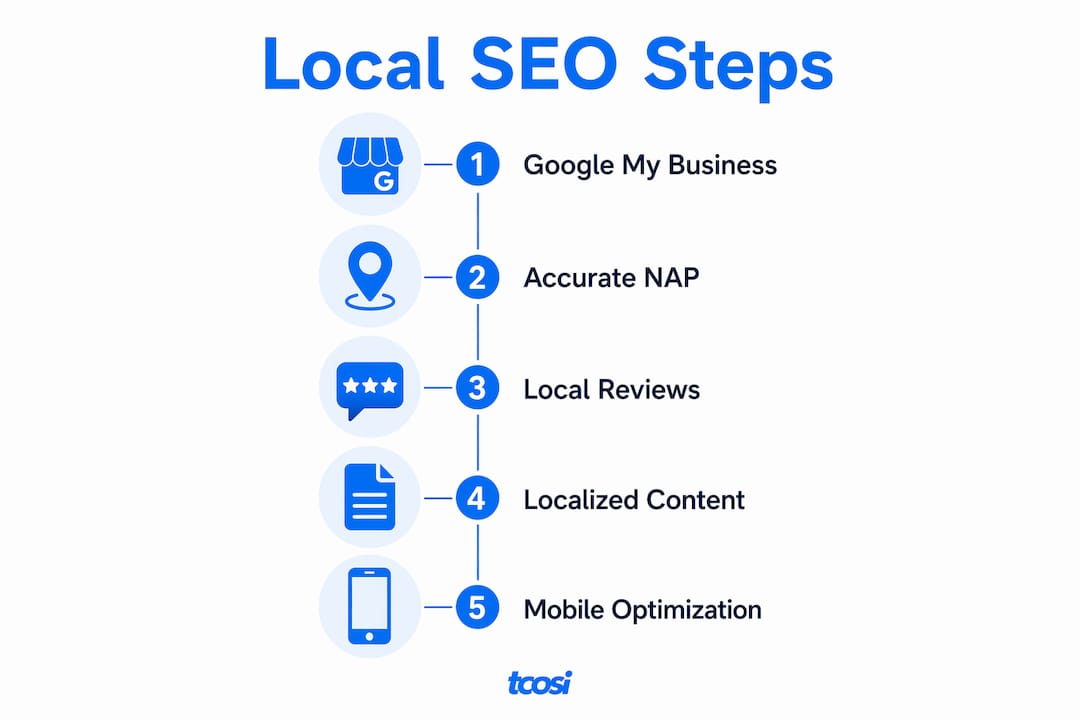
Start with your Google Business Profile. Claim it, verify it, and fill every field: business name, address, phone (NAP), hours, categories, services, and photos. Consistent NAP across your website, Google Business Profile, and every directory listing is a foundational trust signal. Inconsistencies confuse Google and suppress your map-pack placement.
Local checklist for founders:
- Claim and fully complete your Google Business Profile
- Add your business to major directories (Yelp, Apple Maps, Bing Places) with identical NAP
- Create location-specific landing pages if you serve multiple cities or neighborhoods
- Add LocalBusiness schema markup to your site
- Actively request reviews from satisfied customers and respond to every one
- Use geo-targeted language naturally in your page content and meta descriptions
Reviews are a direct ranking signal for local map-pack placement. A steady stream of genuine, recent reviews outperforms a one-time burst from years ago.
What timeline and cost should you expect from SEO?
SEO is a long-term investment. Setting realistic expectations from the start prevents frustration and bad vendor decisions.
| Timeline | Expected signals | Founder actions |
|---|---|---|
| Months 1–3 | Site indexed, technical errors resolved, Search Console data flowing | Fix crawl errors, submit sitemap, confirm mobile speed |
| Months 3–6 | Early keyword rankings, impressions growing, first organic clicks | Publish intent-driven content, build initial citations |
| Months 6–12 | Meaningful organic traffic, qualified leads from search | Review top pages, expand topic clusters, request reviews |
| 12+ months | Compounding traffic moat, lower CAC, stronger domain authority | Maintain content cadence, audit and update top pages |
Cost brackets vary significantly by approach:
- DIY: Near-zero cash cost, high time cost. Realistic for founders with technical comfort and 5–10 hours per week. Tools like Google Search Console, Ahrefs, and Semrush help, but execution quality varies.
- Freelance consultant plus content: Typically a project fee for the technical build and a monthly content budget. Faster results than DIY with more accountability.
- Agency project plus retainer: Higher upfront investment, but you get a coordinated strategy, consistent execution, and measurable reporting. Best for founders who want to focus on the business rather than the website.
Metrics to track monthly: impressions, clicks, average position in Search Console, organic conversions, and CAC trends by channel. A website SEO audit at the 6-month mark helps you identify what is working and where to double down.
What mistakes and red flags should you watch for?
Treating SEO as a post-launch task creates structural problems and delayed indexing. That is the most common and most expensive mistake founders make. Here are the others:
Mistakes to avoid:
- Prioritizing visual design over page structure and keyword intent
- Launching with no keyword-mapped pages, just a homepage and an “About” page
- Ignoring technical SEO entirely (no sitemap, no schema, slow load times)
- Tracking only vanity metrics like total visitors while ignoring conversions and position data
- Spreading content thin across too many topics instead of building depth on high-intent pages
Vendor red flags:
- Promises of page-one rankings within 30 days
- Vague deliverables with no defined KPIs
- No access to your own Google Search Console or analytics accounts
- Pitches involving link schemes or “guaranteed” backlinks
- Monthly reports that show activity (posts published, links built) but no ranking or traffic data
What to require in a proposal:
- Clear deliverables tied to milestones, not just hours
- Ownership of all content, accounts, and domain assets stays with you
- Realistic timelines with defined checkpoints
- Monthly reporting that includes impressions, clicks, and conversions
A good partner will also flag common SEO mistakes proactively, not wait for you to ask.
Is SEO dead, or is it evolving with AI?
Short answer: SEO is evolving, not dying. The mechanics are shifting, but the underlying need, getting found by people who want what you offer, has not changed.
AI-driven search, including Google’s AI Overviews and answers from LLMs like ChatGPT and Perplexity, raises the importance of structured, authoritative content. These systems pull answers from pages that are well-organized, clearly written, and backed by credible sources. A thin, poorly structured page is less likely to be cited by an AI system than a comprehensive, well-sourced one.
What this means for your site:
- Topical depth: Cover your subject area thoroughly. A single shallow page on a topic is less likely to rank or be cited than a cluster of pages that address the topic from multiple angles.
- Clear, sourceable claims: Write in a way that makes your content easy to quote. Specific facts, named examples, and direct answers to questions are what AI systems pull.
- Structured data: Schema markup helps AI systems understand what your page is about and who it serves.
- Authoritative backlinks: Links from credible sources remain a strong signal for both traditional search and AI-driven discovery.
Pro Tip: Pages that answer a specific buyer question in depth, such as “how much does commercial landscaping cost in New Jersey,” are more likely to appear in AI Overviews and LLM answers than generic service pages. Structure at least a few pages around the exact questions your best customers ask. For a practical framework, optimizing content for AI search is a useful starting point.
The practical next step: audit your existing pages for question-based content gaps, add FAQ schema where relevant, and make sure your most important pages have clear, direct answers in the first two paragraphs.
How tcosi builds SEO-first WordPress websites for entrepreneurs
tcosi approaches every website build as a search-first project. The process is designed so that SEO is never an afterthought, and founders leave with a site that is built to be found.
Here is how a typical engagement works:
-
Discovery: Understand your business goals, top customer questions, and the three to five pages that matter most for lead generation.
-
Keyword-informed architecture: Map each page to a specific buyer intent and keyword before any design work begins. This prevents structural rework later.
-
Technical build: WordPress development with mobile-first design, page speed optimization, clean URL structure, XML sitemap, and canonical tags configured from the start.
-
Content and schema: On-page content written or reviewed for keyword alignment, plus structured data markup for your business type, services, and FAQs.
-
Launch and handoff: Google Search Console connected, analytics configured, and a walkthrough so you understand what to monitor.
-
Ongoing optimization: Monthly reporting on impressions, clicks, and conversions, with recommendations for content and technical improvements as your site matures.
Content quality and topical authority are primary ranking drivers, and tcosi builds that foundation into the project from the start rather than treating it as a separate engagement.
Key Takeaways
An SEO-built website is a compounding growth asset for entrepreneurs: it delivers qualified organic traffic, lowers customer acquisition cost over time, and supports every other marketing channel you run.
| Point | Details |
|---|---|
| Build SEO in from day one | Sites without SEO architecture require costly rewrites and underperform in organic visibility. |
| Organic traffic compounds | Unlike paid ads, SEO builds a traffic asset that grows over 6–12 months and beyond. |
| Focus on high-intent pages | Roughly 80% of organic growth comes from 20% of your pages — prioritize those first. |
| Expect a 3–12 month horizon | Meaningful organic traffic and leads typically appear between months 6–12; compounding begins after month 12. |
| tcosi builds SEO-first | tcosi plans keyword architecture, technical health, and content strategy before design begins, so your site is built to rank. |
The case for building it right the first time
Most of the founders I work with arrive at the same place: they have a website they are proud of visually, but it is not bringing in customers. When we dig in, the problem is almost always structural. The SEO was never planned. The pages were built around what the founder wanted to say, not around what their customers are searching for.
What I have come to believe, after working with service businesses, professional firms, and startups across the country, is that the website build is the highest-leverage moment in a founder’s marketing timeline. Get the architecture right at that stage and everything else, content, paid ads, local search, AI visibility, gets easier. Miss it and you are patching problems indefinitely.
The founders who see the best results are not the ones who spent the most. They are the ones who asked the right questions before the build started: What pages do my customers search for? What does a fast, crawlable site actually require? What does success look like at month six? Those questions are exactly what a discovery call with tcosi is designed to answer.
For founders who want to understand what a well-built site can do for their business, the SEO-optimized web design benefits page is a good place to start. And for those already running a site that is not performing, ongoing optimization is often the faster path to results than a full rebuild.
Ready to build a site that actually gets found?
If you are a founder who is tired of a website that looks good but does not generate leads, tcosi builds custom WordPress websites designed to rank from day one, not after an expensive retrofit. The difference is in the planning: keyword architecture, technical health, and content strategy are all decided before a single design comp is created.

A discovery call with tcosi typically covers your traffic goals, the three to five pages that matter most for your business, and a clear picture of what a well-built site should deliver in the first 6–12 months. Come prepared with your top customer questions and a sense of which competitors are showing up in search when you are not.
To get started, review tcosi’s custom WordPress options or visit tcosi.com to request a proposal. Bring your goals. The conversation is straightforward.
Useful sources
- SEO for Non-Technical Founders in 2026 (Sunil Pratap Singh) — Practical founder-level guide covering technical health, content strategy, and measurement priorities.
- How Doubling Down on SEO Turns Into Compounding Revenue (Entrepreneur) — Industry analysis of SEO’s long-term ROI compared to paid channels.
- I Built a Beautiful Website. So Why Is Nobody Coming? (Technology.org) — Explains why design-first builds fail at search and what to require instead.
- 12 Benefits of SEO for Your Business: From Traffic to AI Visibility (Semrush) — Covers traditional SEO benefits and how AI Overviews change the discovery equation.
- SEO for Startups: The Complete 2026 Founder’s Guide (AIStartupFlow) — Startup-focused guide with keyword targeting and early-stage SEO priorities.
- SEO for (Busy) Founders (Ahrefs) — Concise, high-authority guide on content strategy and topical authority for time-constrained founders.
- 10 Reasons Why SEO Is Important for Small Businesses (Fort Lewis College Innovation) — Accessible overview of why SEO matters for small business owners and local visibility.
- Why SEO Is Important for Business (Augment) — Covers SEO’s role in brand credibility, lead generation, and long-term growth.
- SEO in Digital Marketing: Driving Growth for Tech Startups (BizDev Strategy) — Partner resource explaining how SEO fits into a broader startup marketing strategy.
- How to Optimize Content for AI Search Success (BabyLove Growth) — Practical guidance on structuring content to appear in AI Overviews and LLM answers.
FAQ
Why is SEO important for small business websites?
SEO puts your website in front of people who are already searching for what you sell, which means higher-quality traffic and lower customer acquisition costs over time. For small businesses without large ad budgets, organic search accounts for about 53% of website traffic and is often the most cost-effective long-term acquisition channel available.
Is SEO dead or evolving in 2026?
SEO is evolving, not dead. AI-driven search tools like Google’s AI Overviews and LLMs still pull answers from well-structured, authoritative web pages, so the need for quality content and technical SEO has grown, not shrunk.
What is the 80/20 rule of SEO?
Roughly 80% of organic growth comes from 20% of your pages, specifically the high-intent pages that directly answer what your best customers are searching for. Focusing your content budget on those pages first produces the fastest, most measurable results.
Will SEO be replaced by AI?
No. AI search tools depend on indexed, authoritative web content to generate their answers, which means a well-optimized site is more valuable in an AI-driven search environment, not less. The shift is toward deeper, more structured content rather than away from SEO entirely.
How long does SEO take to show results?
Most founders see early ranking signals between months 3–6 and meaningful organic traffic and leads between months 6–12. Compounding growth, where the site builds a defensible traffic moat, typically begins after the 12-month mark.