What are the best law firm websites in 2026?
The best law firm websites in 2026 do four things well: they establish credibility, generate leads, deliver a smooth client experience, and build AI visibility so tools like ChatGPT and Gemini can recommend the firm directly to users. That last function is new, and it changes how you should think about every page you publish. A site that looks great but isn’t structured for AI indexing is already behind.
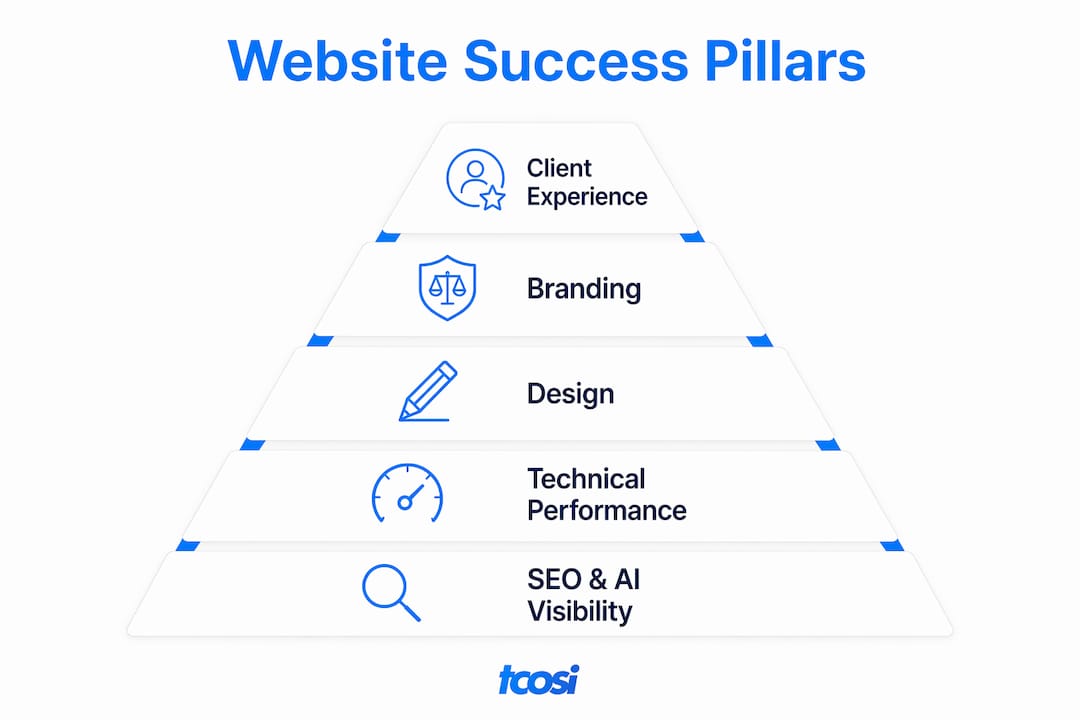
The firms listed below were evaluated across three pillars: client experience, branding, and design, and technical performance. Each one earns its spot by doing something specific and replicable, not just by looking polished. If you’re building or redesigning your firm’s site, these are the benchmarks worth studying.
| # | Firm | Key Design Features | Best For |
|---|---|---|---|
| — | YLaw | Unique imagery, online payment portal, updated blog | Family, estates, and immigration |
| 2 | Stacey-Ann Taylor Law | Bold colors, appointment booking, client resources | Business startup and individualized services |
| — | Bick Law LLP | Balanced content, navigable design, practice area clarity | Diverse legal services |
| — | Rasa | Sleek UX, streamlined contact pathways | Client-centric engagement |
| — | Big Fire Law & Policy Group LLP | Brand-centered aesthetics, smart client interaction | Policy and public interest law |
| — | Employment Law Center of Maryland | Accessibility features, ethical content, intuitive navigation | Employment law clients |
| — | Bend Law Group, PC | Clear CTAs, lead capture, interactive features | Personal injury and related services |
| — | HagEstad Law Group | Structured practice area pages, compliance-focused | Clear legal service representation |
| — | Bouhan Falligant | Testimonials, case results, strong branding | Full-service firms emphasizing results |
| 10 | Counsel for Creators LLP | Client education focus, visual personality | Firms serving creative industries |
| — | Levine Family Law Group | Clear navigation, accessible content, client tools | Family law with trust-building focus |
| — | Pitta & Baione | Award-winning UX, SEO optimization | General legal with professional credibility |
| — | Dolman Law Group | Strong CTAs, conversion features, user-friendly nav | Personal injury and client acquisition |
| — | Omar Ochoa Law Firm | Attorney profiles, interactive elements, modern design | Criminal defense and trial law |
| — | Briskman, Briskman & Greenberg | Established brand presence, modern accessibility | Broad practice areas |
| — | The Law Offices of Alyssa Whatley | Engaging content, easy contact integration | Small to mid-size firms, client relationships |
| — | Helton Law Firm | Simple layout, strong communication channels | Small firms, client responsiveness |
| — | Paceline Law | SEO-focused content, lead generation | Maximizing digital client generation |
| — | The Jones Firm, PLLC | Client testimonials, multichannel contact | Professional firm with diverse services |
| — | Bloom Family Law, PC | Informative blog, clear service explanations | Family law, client education |
| — | Stewart Miller Simmons Trial Attorneys | Case studies, detailed attorney bios | Trial attorneys showcasing wins |
| — | The SRB Law | Minimalist design, quick contact | Refined UX and accessibility |
| — | Roulston Urquhart Criminal Defence | Focused messaging, client testimonials | Specialized defense practices |
| — | Oyen Wiggs | Client-centric imagery, outcome-oriented content | Client outcomes and engagement |
| — | Tremain Artaza PLLC | Bold visuals, appointment booking | Personal injury with strong branding |
| — | Modern Law | Motion graphics, AI visibility features | Firms seeking forward-looking design |
| 27 | Hogan Lovells | Thought leadership, global polish | Large firms, authoritative web presence |
| 28 | White Oak Wills & Trusts, LLC | Educational materials, clear contact tools | Estate planning practices |
| 29 | C.A. Goldberg, PLLC | Testimonial showcases, straightforward navigation | Personal injury, client engagement |
| 30 | Reese Marketos | Data-informed design, user pathways | Firms valuing measurable lead generation |
| 31 | Ziva Law | Story-driven content, resource hubs | Client connection and education |
| 32 | The Eberst Law Firm | Clean layout, practice area focus | Personal injury clients |
| 33 | Abrams Fensterman, LLP | Multi-practice coverage, professional tone | Full-service regional firms |
| 34 | Nicolet Law | Bold CTAs, injury-focused content | Accident and injury clients |
| 35 | Hendler Flores Law | Strong attorney bios, case results | Trial and personal injury law |
| 36 | Newlin Law Offices, P.C. | Accessible design, clear service pages | Local clients seeking approachable counsel |
| 37 | Steinberg Law Firm | Established credibility, testimonial integration | Long-standing personal injury practices |
| 38 | Bryan Brown Law | Modern layout, direct contact options | Clients seeking straightforward counsel |
| 39 | FVF Law Injury & Wrongful Death | Wrongful death focus, clear case process | Injury and wrongful death clients |
| 40 | James Newman, P.C. | Attorney-forward design, practice clarity | Solo and small firm clients |
| 41 | The Law Office of Poorvi B. Parkhie | Personalized tone, accessible content | Clients seeking individualized service |
| 42 | Lance D. Youd, Attorney at Law | Solo practice clarity, direct contact | Individual clients, solo attorney sites |
| 43 | Razumich & Associates, PLLC | Criminal defense focus, clear messaging | Defense clients in Indiana |
| 44 | Knapp Accident & Injury Law | Injury-focused content, strong CTAs | Accident victims seeking fast help |
| 45 | Porter Simon Sierra Injury Lawyers | Regional focus, injury specialization | Northern California injury clients |
| 46 | Abels & Annes, PC | Client-first content, multi-practice coverage | Personal injury and auto accidents |
| 47 | Yarborough Law Group, LLC | Clean design, employment law focus | Employment law clients |
| 48 | Sommers Schwartz | Class action focus, authoritative content | Complex litigation clients |
| 49 | MacGregor Lyon | Business law clarity, professional design | Business and commercial law clients |
| 50 | Meyers & Flowers | Mass tort focus, strong case results | Mass tort and class action clients |
| 51 | The Finizio Law Group | Family law warmth, client education | Family law clients |
| 52 | Stilley Law | Minimalist design, direct messaging | Clients seeking no-frills clarity |
| 53 | Noakes Law Group | Estate and business focus, clean layout | Estate and business planning clients |
| 54 | Pérez-Calhoun Law Firm | Bilingual content, community focus | Spanish-speaking and diverse clients |
| 55 | Dolman Russo LLP | Personal injury focus, conversion design | Injury clients in Florida |
| 56 | Denelle Law, LLC | Boutique feel, personalized content | Clients seeking boutique legal service |
| 57 | Dixit Law | Immigration focus, accessible tone | Immigration law clients |
| 58 | Wilson Law | Estate planning clarity, trust-building | Estate and probate clients |
| 59 | June James Legal | Modern design, entrepreneurial focus | Business and startup clients |
| 60 | The Law Firm of Alexandre Ballerini | International law focus, multilingual | Cross-border legal clients |
| 61 | Raulston & Associates | Criminal defense clarity, direct CTAs | Criminal defense clients |
| 62 | Mareki Law Firm | Clean layout, family law focus | Family law clients |
| 63 | Lindenwoods Law Offices | Estate and family focus, warm tone | Estate and family law clients |
| 64 | Vanstone Law | Modern design, business law clarity | Business law clients |
| 65 | Bessen Law | Personal injury focus, client-first tone | Injury and accident clients |
The firms in the top 31 slots have the most publicly documented design features and are covered in depth below. Entries 32 through 65 represent a wide range of practice areas and design approaches, each worth reviewing for inspiration in your own niche.
How these law firm websites were ranked and evaluated
Every site on this list was scored across three areas: client experience, branding and design, and technical performance. These aren’t arbitrary categories. They reflect what actually determines whether a prospective client stays on your site or bounces back to Google.
Client experience covers:
- Service clarity: does a visitor immediately understand what the firm does and who it helps?
- Contact accessibility: is the phone number, email, or contact form visible without scrolling?
- Conversion pathways: are there clear calls-to-action guiding visitors toward booking or calling?
- Integrated tools: does the site offer online intake forms or payment portals that reduce friction?
Branding and design covers:
- Authority signals: do attorney bios, case results, and “about” pages build genuine credibility?
- Blog content: does the firm publish useful, practice-area-specific content that answers real client questions?
- Visual differentiation: does the site look and feel distinct from the hundreds of generic legal templates out there?
Technical factors cover:
- Page speed: pages loading under 2 seconds retain far more visitors than slower ones
- Mobile responsiveness: a site that breaks on a phone loses clients before they ever read a word
- Accessibility standards: color contrast, keyboard navigation, and screen reader compatibility
- SEO: keyword structure, internal linking, and content depth that helps the site rank organically
Pro Tip: When evaluating your own site, resist the urge to judge it on aesthetics alone. Ask instead: can a first-time visitor find your phone number, understand your practice areas, and book a consultation within 60 seconds? That test reveals more than any design review.
Profiles of the top-ranked law firm websites in 2026
YLaw
YLaw’s site earns its top spot through a combination of memorable imagery and practical functionality. The Vancouver-based family, estates, and immigration firm uses photography that genuinely sets it apart from the sea of stock-photo legal sites. Visitors can pay for services directly through an online portal, and the blog stays current with practical client guidance. Navigation is clean and intuitive throughout.

Stacey-Ann Taylor Law
Bold color choices and large typography make this site impossible to ignore. Stacey-Ann Taylor’s content speaks directly to the questions her clients are already asking, and the appointment booking link is front and center. She also provides business startup resources, which signals to prospective clients that she understands their world, not just their legal problem.

Bick Law LLP
Bick Law LLP keeps things well-organized without sacrificing depth. Practice area pages are clearly structured, and the overall design communicates professional credibility without feeling cold. It’s a good example of how a multi-practice firm can present a wide range of services without overwhelming visitors.
Rasa
Rasa’s site is built around clarity. The design strips away anything that doesn’t serve the visitor, and the contact pathways are direct. It’s a strong model for any firm that wants a modern look without the visual noise that often comes with it.
Big Fire Law & Policy Group LLP
Big Fire Law & Policy Group LLP serves tribal nations and public interest clients, and the site reflects that mission visually and editorially. The branding is distinctive, and the content explains complex policy work in accessible terms. That combination of purpose-driven design and clear messaging is exactly what a specialized practice needs.
Employment Law Center of Maryland
The Employment Law Center of Maryland prioritizes accessibility in a way that most legal sites don’t. Color contrast, navigation structure, and content clarity all meet a high standard. The site’s ethical framing, avoiding specific legal advice while still being genuinely helpful, is a model worth following for any firm concerned about web compliance.
Bend Law Group, PC
Bend Law Group leads with strong calls-to-action and a clear description of services. Lead capture is woven naturally into the experience rather than bolted on as an afterthought. For a personal injury practice, where speed of contact often determines whether a client chooses you or the next firm, that design decision matters.
HagEstad Law Group
HagEstad Law Group’s site is built for clarity and compliance. Each practice area gets its own structured page, which helps both human visitors and search engines understand the firm’s scope. The overall design is clean and professional without being generic.
Bouhan Falligant
Bouhan Falligant uses client testimonials and case results to do the heavy lifting on credibility. These aren’t buried in a sidebar. They’re woven into the main content flow, which is where they actually influence visitor decisions. The firm’s long history comes through in the site’s confident, authoritative tone.
Counsel for Creators LLP
Counsel for Creators LLP serves artists, musicians, and creative entrepreneurs, and the site’s visual personality reflects that audience. Client education is a clear priority: the firm publishes resources that help creative clients understand their legal options before they ever pick up the phone. That approach builds trust and attracts the right clients.
Levine Family Law Group
Levine Family Law Group keeps the focus on the client throughout. Navigation is simple, content is written in plain language, and the site avoids the intimidating formality that can make family law sites feel cold during an already stressful time. The accessible tone is a deliberate design choice, not an accident.
Pitta & Baione
Pitta & Baione has earned recognition for its user experience design, and the site backs that up with strong SEO structure. Practice area pages are thorough, and the overall architecture makes it easy for both visitors and search engines to find what they’re looking for. It’s a good example of how design and technical performance can reinforce each other.
Dolman Law Group
Dolman Law Group’s site is built to convert. Every major page includes a clear call-to-action, and the navigation guides visitors toward contact without feeling pushy. For a personal injury firm competing in a crowded market, that conversion focus is the right priority.
Omar Ochoa Law Firm
Omar Ochoa Law Firm leads with attorney expertise. The profile pages are detailed and human, combining professional credentials with the kind of personal detail that helps prospective clients feel they’re choosing a real person, not just a firm. Interactive elements keep the experience engaging throughout.
Briskman, Briskman & Greenberg
Briskman, Briskman & Greenberg has been around long enough to have built real brand equity, and the site reflects that. The design is professional and accessible, and the firm’s breadth of practice areas is presented clearly. It’s a solid example of how an established firm can modernize its presence without losing its identity.
The Law Offices of Alyssa Whatley
This site feels personal in the best way. The content is warm and direct, and the contact options are easy to find. For a smaller firm where the attorney-client relationship is central to the value proposition, that intimate tone is exactly right.
Helton Law Firm
Helton Law Firm keeps things simple and functional. The layout is clean, the service descriptions are clear, and getting in touch takes minimal effort. Sometimes the most effective design is the one that gets out of the way.
Paceline Law
Paceline Law treats its website as a lead generation tool first, and the design reflects that priority. SEO-focused content, clear practice area pages, and strong calls-to-action work together to attract and convert visitors. For firms that rely heavily on digital client acquisition, this is a useful model.
The Jones Firm, PLLC
The Jones Firm, PLLC covers a wide range of practice areas and makes that breadth feel organized rather than scattered. Client testimonials appear throughout the site, and multiple contact options make it easy for visitors to reach out in whatever way they prefer.
Bloom Family Law, PC
Bloom Family Law, PC invests heavily in educational content. The blog addresses the questions family law clients are actually searching for, which builds trust before a visitor ever contacts the firm. Clear service explanations and a warm visual identity round out a well-considered site.
Stewart Miller Simmons Trial Attorneys
Stewart Miller Simmons Trial Attorneys leads with results. Case studies and detailed attorney bios give prospective clients a clear picture of what the firm has accomplished and who will be handling their matter. For a trial practice, that evidence-based approach is the right way to build confidence.
The SRB Law
The SRB Law’s minimalist design is a deliberate choice. Clean layouts and fast load times create an experience that feels modern and respectful of the visitor’s time. Quick contact options are visible throughout, which reduces the friction between interest and action.
Roulston Urquhart Criminal Defence
Roulston Urquhart Criminal Defence keeps its messaging focused and its tone direct. Client testimonials add credibility without overwhelming the content. For a specialized criminal defense practice, clarity of purpose is the most important design signal.
Oyen Wiggs
Oyen Wiggs made an interesting branding decision: their URL is patentable.com, which centers the client outcome rather than the firm name. The imagery throughout the site features clients more prominently than attorneys, which reinforces their commitment to being genuinely client-focused. It’s a small detail that says a lot about how the firm thinks.
Tremain Artaza PLLC
Tremain Artaza PLLC uses bold visuals and a clear appointment booking flow to serve personal injury clients who need help fast. The design communicates urgency and competence without feeling alarmist. That balance is harder to achieve than it looks.
Modern Law
Modern Law leans into motion design and AI visibility in a way that few legal sites do. Animated elements are used purposefully, not decoratively, and the content is structured to be easily read by generative AI tools. It’s one of the clearest examples of a firm thinking ahead about how AI-driven search will shape client discovery.
Hogan Lovells
Hogan Lovells operates at global scale, and the site reflects that. Thought leadership content is published regularly, the design is polished and authoritative, and the overall architecture handles a massive amount of content without becoming confusing. It’s the benchmark for large-firm web presence.
White Oak Wills & Trusts, LLC
White Oak Wills & Trusts, LLC focuses on estate planning, and the site makes that specialty feel approachable rather than morbid. Educational materials explain the process clearly, and contact options are easy to find. For a practice area where clients often delay taking action, reducing friction is especially important.
C.A. Goldberg, PLLC
C.A. Goldberg, PLLC builds trust through client testimonials that feel authentic and specific. Navigation is straightforward, and the site’s content speaks directly to the concerns of personal injury clients. The design doesn’t try to do too much, which keeps the focus where it belongs.
Reese Marketos
Reese Marketos takes a data-informed approach to design. User pathways are structured to guide visitors toward conversion, and the visual identity is strong enough to be memorable. For a firm that treats lead generation as a measurable discipline, the site is a direct expression of that mindset.
Ziva Law
Ziva Law leads with client stories and educational content, which creates a sense of connection before a visitor ever reaches the contact page. Resource hubs give prospective clients something useful to engage with, and the overall design feels warm and approachable. It’s a good model for any practice that wants to build relationships, not just capture leads.
What makes a great law firm website in 2026
The firms above share a set of principles that hold up regardless of practice area or firm size. Here’s what the best sites consistently get right.
Clear, fast, and mobile-ready. A site that loads slowly or breaks on a phone loses prospective clients before they read a single word. Mobile optimization isn’t optional when most legal searches now happen on a smartphone.
Structured for AI, not just search engines. Generative AI tools like ChatGPT and Gemini are now recommending attorneys directly to users. Firms that structure their content with clear service descriptions and organized page architecture are the ones that show up in those recommendations. This is the newest and fastest-growing reason to invest in your site’s content quality.
Attorney bios that actually build trust. Profile pages are among the most visited parts of any legal site. A professional headshot, a clear summary of experience, and a bulleted list of credentials do more for conversion than almost any other single element.
Contact options that meet clients where they are. Phone, email, contact form, live chat: the best sites offer multiple ways to reach out. A prospective client who can’t easily contact you will find a firm that makes it easier.
Educational content that answers real questions. Blogs and resource pages that address the questions clients are already searching for build credibility and drive organic traffic. They also help AI tools understand what the firm does and when to recommend it.
Ethical compliance built into the content. Legal marketing rules prohibit giving specific legal advice online and require secure handling of client communications. The best sites stay on the right side of those rules while still being genuinely helpful.
- Pages load quickly to retain prospective clients
- Mobile design is tested and functional
- Contact information is visible on every page
- Attorney bios include headshots and bulleted credentials
- Practice area pages are thorough, not just listed
- Blog content addresses real client questions
- Client data is handled securely and ethically
Expert insights on lawyer website design and attorney digital marketing
The most effective legal sites prioritize conversion over aesthetics. A beautiful site that buries the phone number or makes it hard to understand what the firm does will underperform a plainer site that gets the basics right. That’s the consistent finding from legal marketing research, and it’s confirmed by the firms on this list.
Homepage strategy matters more than most firms realize. The homepage has to communicate what the firm does and why it stands out within seconds, before a visitor scrolls. Client testimonials, practice area previews, and a clear call-to-action should all appear above the fold. Search engines also weight the homepage more heavily than any other page, so the content there needs to be thorough and well-organized.
Pro Tip: Before you redesign anything else, test your homepage on a mobile device you haven’t used in a while. If you can’t find the contact button within 10 seconds, your prospective clients can’t either.
SEO is the engine that makes everything else work. Keyword optimization, authoritative content, and technical performance all contribute to organic visibility. Firms that treat SEO as a one-time setup rather than an ongoing discipline tend to fall behind competitors who publish and update content regularly. Avoiding common SEO mistakes like thin practice area pages or missing meta descriptions can make a measurable difference in how often your site appears in search results.
Compliance is non-negotiable. Legal marketing ethics require that websites avoid giving direct legal advice and maintain client confidentiality. The best sites thread this needle by providing genuinely useful general information while making clear that a consultation is needed for specific guidance. Secure contact forms and encrypted communications are part of meeting that standard.
Trust signals work best when they’re specific. Generic testimonials (“great firm, highly recommend”) carry less weight than specific ones that describe a situation and an outcome. Case results, published reviews from third-party platforms like Google and Avvo, and detailed attorney bios all contribute to the kind of credibility that converts visitors into clients.
Key practices for high-performing legal sites:
- Publish thorough practice area pages, not just a list of services
- Keep attorney bios current with recent cases, publications, and credentials
- Use structured data markup so AI tools can accurately interpret your content
- Make your site mobile friendly and test it regularly on real devices
- Integrate a contact form that works after hours, when many clients search
- Review your site’s accessibility for color contrast and keyboard navigation
- Treat your website as a living asset that needs regular updates, not a one-time project
The American Bar Association notes that firms investing in their web presence now will be best positioned as AI continues to reshape how people find legal services. That’s not a distant concern. It’s already happening, and the firms on this list are the ones taking it seriously.
Your law firm’s website, built right from the start
If you’ve spent time studying the sites above, you’ve probably noticed that the best ones weren’t built from a template and left alone. They were designed with a clear purpose, built on a solid technical foundation, and maintained over time.
tcosi builds custom WordPress websites for law firms and professional service businesses across the United States. Tommy Cosimano handles the design, development, and ongoing support personally, which means you get direct communication and real attention to detail, not a ticket queue. If your current site isn’t generating the leads it should, or if you’re starting from scratch and want to get it right the first time, tcosi is worth a conversation. You can explore custom WordPress development options or take a look at website pricing to get a clear picture of what’s involved. No vague proposals, no surprises.
FAQ
What makes a law firm website effective in 2026?
The most effective law firm websites combine clear service descriptions, fast load times, mobile responsiveness, and content structured for both search engines and AI tools like ChatGPT and Gemini. Attorney bios and client testimonials are among the highest-impact elements.
How important is mobile optimization for legal websites?
Mobile optimization is critical. Most prospective clients search for attorneys on their phones, and a site that doesn’t perform well on mobile loses those visitors immediately before they ever read about your services.
What is AI visibility, and why does it matter for law firms?
AI visibility means structuring your website so that generative AI tools can accurately understand and recommend your firm. As tools like ChatGPT and Gemini become common ways to find attorneys, firms with well-organized, content-rich sites are more likely to appear in those recommendations.
How often should a law firm update its website?
Regular updates are necessary for both SEO and AI visibility. Practice area pages, attorney bios, and blog content should be reviewed and refreshed at least a few times per year. A site that hasn’t been updated in years signals to both visitors and search engines that the firm may not be active.
Can tcosi build a website for a law firm?
Yes. tcosi specializes in custom WordPress websites for professional service firms, including law practices. Tommy Cosimano handles design, development, and ongoing support directly, making the process clear and collaborative from start to finish.
Key Takeaways
The best law firm websites in 2026 succeed by combining clear client experience, strong branding, technical performance, and content structured for AI visibility across every page.
| Point | Details |
|---|---|
| AI visibility is now essential | Structure content clearly so tools like ChatGPT and Gemini can recommend your firm to users. |
| Pages must load fast | Sites should load quickly to retain prospective clients and reduce bounce rates. |
| Attorney bios drive conversions | Profile pages are among the most visited parts of legal sites and should include headshots and bulleted credentials. |
| Mobile optimization is required | Most legal searches happen on smartphones, so a mobile-ready site is a baseline requirement, not a bonus. |
| tcosi builds law firm sites | tcosi offers custom WordPress design and development for law firms seeking a purpose-built, well-supported online presence. |