If you need a professional website that actually brings in customers, hire a local, conversion-focused WordPress agency. tcosi builds custom WordPress sites for New Jersey businesses of every size, from solo contractors in Toms River to professional firms in Red Bank, with a clear process, honest pricing, and a focus on real results. Get an accurate quote in minutes using the free estimator.
Here’s why this approach works for NJ business owners:
- Local market knowledge. tcosi works with businesses across central New Jersey, including Monmouth, Ocean, and Middlesex counties, so the design and messaging reflect what local customers actually respond to.
- Custom WordPress builds. Every site is built on WordPress, the CMS that powers a significant share of the web, giving you full ownership, flexibility, and a platform your team can manage without a developer on call.
- Lead-generation focus. The goal isn’t just a good-looking site. It’s a site that ranks in local search, loads fast, and turns visitors into phone calls, form fills, and booked appointments.
Table of Contents
- What do New Jersey web design agencies actually deliver?
- What does New Jersey website design typically cost?
- How do you choose the right New Jersey web design firm?
- What does working with tcosi actually look like?
- What technical features should every NJ business site include?
- Real results: what tcosi has built for New Jersey clients
- Contract terms and payment schedules for New Jersey projects
- Key Takeaways
- Why I build sites the way I do
- tcosi builds custom WordPress sites for New Jersey businesses
- Useful sources
- FAQ
What do New Jersey web design agencies actually deliver?
A well-rounded New Jersey web design agency does more than put pages on the internet. The service set you should expect covers the full lifecycle of a business site, from initial strategy through ongoing maintenance.
Core services to look for:
- Custom WordPress design. A site built to your brand, not a recycled template. This matters because generic templates rarely convert well for local service businesses.
- Website redesigns. If your current site is slow, outdated, or not generating leads, a redesign addresses the root causes rather than applying surface fixes. Not sure if yours qualifies? These 10 signs your site needs a redesign are worth a quick read.
- E-commerce development. For retail shops, restaurants with online ordering, or any business selling products, a properly built WooCommerce or similar setup handles transactions securely.
- UI/UX design. Good user experience means visitors find what they need quickly and take action. Poor UX is one of the top reasons sites lose leads.
- Content and copywriting. Many agencies offer basic page copy as part of the build. Strong copy, especially for service pages, directly affects both SEO and conversion rates.
- Local SEO. On-page optimization, Google Business Profile alignment, and location-targeted content help your site rank when someone in Freehold or Eatontown searches for your service. tcosi’s SEO services for NJ businesses pair directly with web design for this reason.
- Hosting and security. Managed hosting keeps your site fast and online. Security monitoring prevents the kind of malware or downtime that costs you customers.
- Maintenance and updates. WordPress requires regular plugin, theme, and core updates. An agency that offers ongoing maintenance means you’re not left managing that yourself.
- Analytics and conversion rate optimization (CRO). Setting up Google Analytics 4, tracking form submissions, and reviewing heatmaps helps you understand what’s working and what isn’t after launch.
Who needs what: A dentist in Point Pleasant needs a mobile-friendly booking flow and local SEO. A general contractor in Toms River needs a portfolio, a clear quote request form, and fast load times on mobile. A retail boutique in Red Bank needs e-commerce and product photography integration. A law firm in central New Jersey needs trust signals, clear practice area pages, and a contact form that actually works. The service mix shifts by business type, but the foundation is always the same: fast, clean, and built to convert.
What does New Jersey website design typically cost?
Pricing for web design in New Jersey varies based on scope, complexity, and the agency you choose. Costs vary widely depending on project needs. You can also use tcosi’s free website price estimator to get a ballpark specific to your project.

| Tier | Typical Price Range | What’s Usually Included |
|---|---|---|
| Entry-level | Typically lower-cost tier | Small sites with WordPress CMS, mobile-responsive design, basic contact forms, and starter SEO |
| Growth | Mid-tier pricing | Larger sites with custom design, local SEO, blogging, lead capture, and multiple design rounds |
| Custom / E-commerce | Higher-tier pricing | Fully custom designs with e-commerce or booking integrations, advanced SEO, conversion optimization, and accessibility reviews |
Typical project timeline (discovery to launch):
- Discovery and strategy: 1–2 weeks (goals, audience, sitemap, content plan)
- Design mockups: 2–3 weeks (homepage and key pages, 1–2 revision rounds)
- Development and build: 3–5 weeks (WordPress build, content entry, integrations)
- Quality assurance and testing: 1 week (cross-browser, mobile, speed, forms)
- Launch and handoff: 1–3 days (DNS, final checks, training)
Most projects run several weeks from kickoff to launch, depending on how quickly the client provides content and feedback.
What drives the price up:
- Custom design vs. a premium template
- E-commerce functionality (product count, payment gateways, inventory)
- Third-party integrations (CRM, booking systems, ERP)
- Content creation (copywriting, photography, video)
- Advanced local SEO setup
- Accessibility compliance (WCAG 2.1)
- Number of revision rounds
- Third-party plugin licensing fees
- Ongoing maintenance and support tiers
A detailed pricing breakdown helps you understand exactly what you’re paying for before you sign anything.
How do you choose the right New Jersey web design firm?
The difference between a site that generates leads and one that collects dust usually comes down to who built it and how. Here’s how to evaluate your options before committing.
Selection criteria:
- Demonstrated local experience (NJ clients, not just generic portfolio pieces)
- WordPress expertise with a clear development process
- Portfolio that includes businesses similar to yours in size and industry
- Proven SEO knowledge, not just “we do SEO” claims
- Clear, responsive communication from the first conversation
- Transparent process with defined milestones and deliverables
- Post-launch support options (maintenance, updates, security)
Questions to ask during a proposal or discovery call:
- Can you show me examples of sites you’ve built for businesses similar to mine?
- Do you build on WordPress, and will I own the site and all its files outright?
- What does your discovery process look like before design starts?
- How many design rounds are included, and what happens if I need more?
- Who writes the copy, and is that included in the quote?
- How do you handle local SEO during the build?
- What hosting do you recommend, and do I control the account?
- What’s your typical timeline from kickoff to launch?
- What does your QA process cover before launch?
- What post-launch support do you offer, and what does it cost?
- Who do I contact if something breaks after launch?
- What does your contract say about site ownership, code, and credentials?
Red flags to watch for:
- No written contract or vague “we’ll figure it out” deliverables
- Unclear ownership of the domain, hosting account, or site files
- No defined revision rounds (unlimited revisions is often a sign of poor scoping)
- Proposals with no timeline or milestone structure
- Agencies that won’t share a portfolio or references
- Pricing that seems too low to cover real custom work (often means a template with minimal customization)
- No mention of SEO, speed, or mobile optimization in the proposal
What a solid quote should include: scope of work, page list, deliverables per phase, timeline with milestones, number of revision rounds, payment schedule, and a clear statement of who owns the site assets at the end of the project.
What does working with tcosi actually look like?
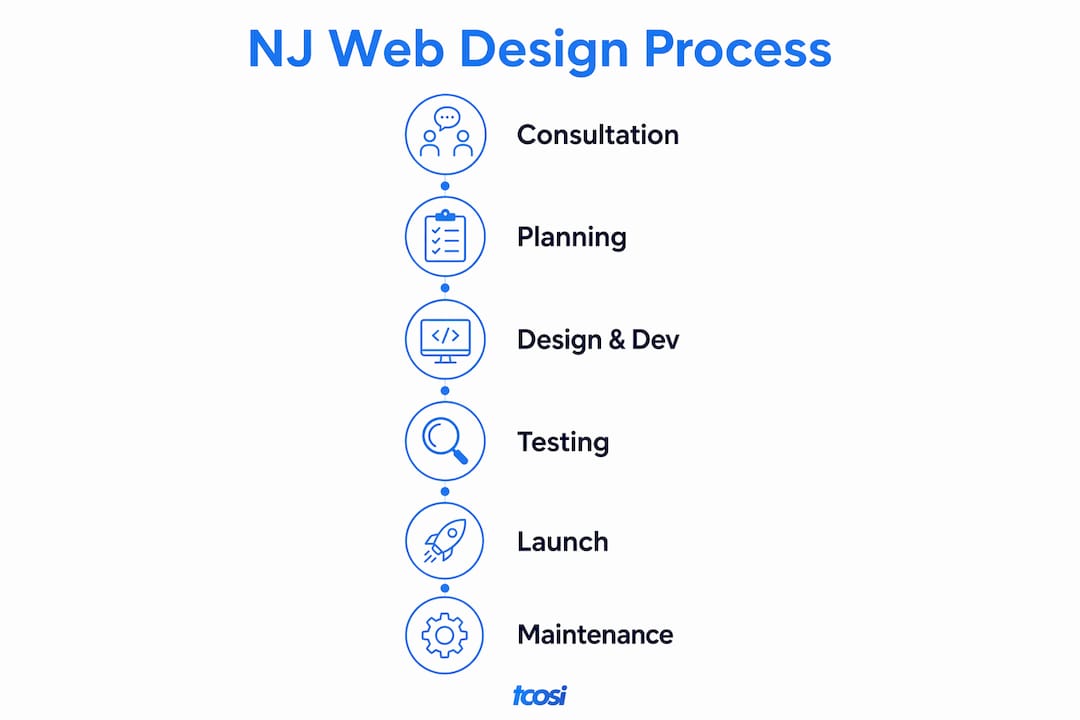
tcosi follows a five-step process designed to keep projects on track and clients informed at every stage. There are no surprises, and no disappearing acts between phases.
- Discovery call (Week 1). We talk through your business goals, target customers, competitors, and what you need the site to do. This shapes everything that follows.
- Strategy and sitemap (Week 1–2). I map out the page structure, content plan, and any integrations before a single design decision is made.
- Design mockups (Weeks 2–4). You see the homepage and key interior pages before development begins. Two rounds of revisions are standard.
- WordPress development (Weeks 4–9). The approved design gets built in WordPress, with all content entered, forms tested, and integrations connected.
- QA, launch, and handoff (Weeks 9–11). Every page is tested across devices and browsers. After launch, you get a walkthrough of the CMS so you can make basic updates yourself.
Post-launch options: tcosi offers website maintenance services covering security monitoring, plugin and core updates, performance checks, and regular backups. These are available as monthly plans so you’re not left managing WordPress upkeep on your own.
Communication and revisions: Expect clear updates at each phase transition, a shared project timeline, and direct access to Tommy throughout the project. No account managers, no handoffs to a junior team.

Pro Tip: Before your kickoff call, gather your logo files (SVG or high-res PNG), brand colors and fonts if you have them, login credentials for any existing analytics or Google Search Console accounts, and three to five websites you like the look of. Clients who come prepared typically cut two to three weeks off the timeline.
What technical features should every NJ business site include?
A site can look great and still fail on the technical side. These are the non-negotiables for any New Jersey small business website built in 2026.
- WordPress CMS. Gives you full control over content, a massive ecosystem of plugins, and no vendor lock-in. You own the platform.
- Responsive, mobile-first design. Most local searches happen on phones. A site that doesn’t work well on mobile loses those visitors immediately.
- Page speed optimization. Slow sites rank lower and convert worse. Image compression, caching, and a quality host all contribute. Web development trends consistently point to performance as a top ranking and UX factor.
- SSL certificate. HTTPS is a baseline trust signal and a minor ranking factor. Any reputable host includes it.
- Structured data (schema markup). Helps Google understand your business type, location, and services, which supports local search visibility.
- Automated backups. Daily or weekly backups stored off-server mean a hack or accidental deletion doesn’t cost you the whole site.
- Managed hosting. Shared hosting is cheap for a reason. A managed WordPress host (like WP Engine or Kinsta) handles server-level security and performance.
- Accessibility basics. Alt text on images, sufficient color contrast, and keyboard-navigable menus keep your site usable for everyone and reduce legal exposure.
- Interactive engagement features like contact forms, live chat, and clickable phone numbers directly affect how many visitors convert to leads.
The SEO benefits of well-built design go beyond keywords. Site architecture, internal linking, and page speed all feed into how Google ranks your pages for local searches.
Pro Tip: Run your current site through PageSpeed Insights right now. A score below 50 on mobile is a real problem. Check your site on your phone too — if you have to pinch and zoom to read anything, that’s costing you leads.
Real results: what tcosi has built for New Jersey clients
The most honest way to evaluate any web design agency is to look at what they’ve actually built and what happened after launch.
Case study: Redaelli Industries
Redaelli Industries needed a site that reflected the quality of their work and made it easy for potential clients to understand their capabilities at a glance. The existing site was outdated, slow, and not generating meaningful inquiries. tcosi rebuilt the site on WordPress with a clean, professional design, organized service pages, and a clear contact path. The result was a site that accurately represented the business and gave the sales team a credible digital presence to point prospects to. You can review the Redaelli Industries case study directly.
What to look for in any agency’s portfolio:
- Are the sites fast on mobile, or do they lag?
- Do the contact forms and calls to action actually work?
- Are there real local businesses in the portfolio, or only generic mockups?
- Can the agency explain what problem each site solved, not just how it looks?
Testimonials and references: Ask any agency you’re considering for two or three client references you can contact directly. A confident agency will provide them without hesitation.
Contract terms and payment schedules for New Jersey projects
Most New Jersey web design projects follow a split-payment structure tied to project milestones. A typical arrangement looks like this: 50% due at contract signing to begin the project, 25% due at design approval before development starts, and the remaining 25% due at launch. Some agencies use a three-way split (33% / 33% / 33%) across kickoff, mid-project, and launch.
What your contract must spell out:
- Site ownership. You should own the domain, hosting account, all design files, and the WordPress installation outright at the end of the project. Never sign a contract that leaves ownership ambiguous.
- Code and content rights. Custom code written for your project belongs to you. Make sure the contract says so explicitly.
- Hosting credentials. You should hold the login for your own hosting account, not the agency. If the agency manages hosting on your behalf, the contract should include a migration and export clause so you can move the site if you ever need to.
- Revision rounds. Define the number of included rounds per phase and what counts as a revision versus a scope change.
- Scope change process. Any work outside the original scope should require a written change order with a price and timeline impact before work begins.
- Termination clause. What happens if either party needs to end the project early? Who owns what at that point?
New Jersey doesn’t have web-design-specific contract regulations, but standard contract law applies. A written agreement protects both sides. If an agency resists putting terms in writing, that’s a clear signal to walk away.
A note on retainers vs. project fees: Some agencies charge a flat monthly retainer for ongoing design and development work. Others quote per-project. For a defined build (new site or redesign), a project-based fee with milestone payments is usually cleaner and easier to budget. Monthly retainers make more sense for ongoing content, SEO, or maintenance work after the site is live.
Key Takeaways
Hiring the right New Jersey web design partner comes down to local experience, a clear process, WordPress ownership, and a contract that protects your investment.
| Point | Details |
|---|---|
| Start with a price estimate | Use tcosi’s free estimator to get a realistic ballpark before any sales conversation. |
| Expect an 8–14 week timeline | Most custom WordPress projects run several weeks from kickoff to launch, depending on content readiness. |
| Demand site ownership in writing | Your contract must state you own the domain, files, and hosting credentials outright. |
| Verify technical basics | Every NJ business site needs SSL, mobile-responsive design, page speed optimization, and structured data. |
| tcosi for NJ businesses | tcosi builds custom WordPress sites for businesses across New Jersey with a clear process and post-launch support. |
Why I build sites the way I do
There’s a version of web design that’s all about the visual. Beautiful layouts, big hero images, clever animations. I’ve seen plenty of those sites. Most of them don’t generate a single lead.
What I care about is whether the site actually works for the business. Does it load fast on a phone? Does the contact form go somewhere useful? Does the copy explain what the business does in plain language, or does it bury the offer under vague marketing language? Those are the questions I ask before I touch a design file.
Working with New Jersey businesses specifically means I understand the local context. A contractor in Ocean County isn’t competing nationally. They need to show up when someone in their town searches for their service, and they need that visitor to call or fill out a form. That’s a different problem than building a brand presence for a national company, and it requires a different approach to both design and SEO.
WordPress is the right tool for most of these businesses because it gives them real ownership. No proprietary platform, no monthly software fee just to keep the lights on, no situation where switching agencies means starting from scratch. I build sites clients can actually use and take with them if they ever need to.
If you’re a business owner in New Jersey and you want a straight conversation about what your site needs, I’m easy to reach.
tcosi builds custom WordPress sites for New Jersey businesses
tcosi is the direct alternative to a large agency for New Jersey small business websites: no layers of account managers, no bloated retainers, and no templates dressed up as custom work. You get a custom WordPress site built by one person who knows your project from discovery to launch, with honest pricing and a process that’s easy to follow.
Projects start with a free estimate so you know the scope and cost before committing to anything. From there, the process is straightforward: discovery, design, build, launch, and ongoing support if you want it. tcosi serves businesses across New Jersey, including Monmouth County, Ocean County, Middlesex County, and the Jersey Shore corridor, with county-specific experience in Monmouth County web design and Ocean County development.
Ready to get started? Request a quote for your New Jersey website or use the free price estimator to get a number in minutes.
Useful sources
These tools and resources are worth bookmarking when you’re evaluating proposals or checking your current site’s performance.
- PageSpeed Insights — Run any URL through Google’s tool to get a real performance score for both mobile and desktop. Use it to test your current site and any agency’s portfolio examples.
- tcosi’s free website price estimator — Answer a few questions about your project and get a realistic cost range before you talk to anyone. Useful for setting a budget and vetting quotes.
- WordPress.org — The official resource for understanding what WordPress is, how it works, and what plugins are available. Helpful when reviewing a proposal that mentions specific plugins or page builders.
- tcosi’s website maintenance services page — Explains what ongoing maintenance actually covers, so you know what to ask for in a post-launch support plan.
- Interactive website features guide — A practical overview of engagement features (live chat, calculators, booking widgets) and when they’re worth adding to a small business site.
FAQ
How much does it cost to hire a web designer in New Jersey?
Pricing for web design in New Jersey varies based on scope, complexity, and the agency you choose. Use tcosi’s free website price estimator to get a ballpark specific to your project.
How long does a website project take from start to launch?
Most custom WordPress projects take 8–14 weeks from kickoff to launch. The timeline depends heavily on how quickly the client provides content, feedback, and approvals at each phase.
Is web design still worth investing in for small businesses?
Yes. A well-built site remains the foundation of local search visibility and lead generation. Customers research businesses online before calling, and a slow or outdated site loses those prospects to competitors with better digital presences.
What is the 3-second rule in website design?
The 3-second rule refers to the window you have to load your page and communicate your value before a visitor leaves. Research consistently shows that most users abandon a site that takes longer than 3 seconds to load on mobile, making page speed one of the highest-priority technical factors in any build.
Does tcosi offer ongoing support after a site launches?
Yes. tcosi offers website maintenance plans covering security monitoring, WordPress core and plugin updates, backups, and performance checks, so your site stays secure and fast after launch.