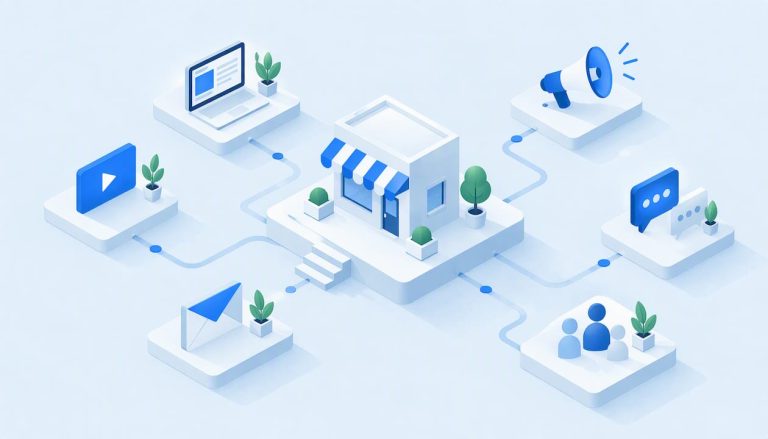
Small business marketing is the focused use of limited resources to attract the right customers, generate leads, and drive sales. Unlike enterprise marketing, which plays a long game with brand awareness and market share, small business marketing needs to show results. You are working with a real budget, a real deadline, and real revenue goals.
The good news? You do not need a big team or a massive ad spend to compete. What you need is a clear plan, the right channels, and the discipline to stay consistent. Customers increasingly expect companies to understand their unique needs during the buying journey, which means personalization and focus beat volume every time.
Here is what effective small business marketing looks like in practice:
- Know your customer. Understand who they are, what they need, and where they spend time online.
- Pick your channels. Focus on one or two platforms where your audience is actually active, not every platform that exists.
- Measure what matters. Track ROI on every channel. If you cannot measure it, it is hard to justify the spend.
- Own your assets. Your website and email list are yours. Social media profiles and paid ads are rented space.
- Stay consistent. Showing up regularly on fewer channels outperforms sporadic effort spread across many.
How do you build a marketing plan for a small business?
A written marketing plan is not optional. The U.S. Small Business Administration is direct about this: your plan must be action-oriented, describe your sales methods, and connect marketing costs to revenue. Without that connection, you are spending money without knowing why.
Here is how to build one that actually works.
Define your target market
Start with who you are selling to. Go beyond “homeowners in New Jersey” or “small business owners.” Describe your audience in detail: age range, income level, buying habits, pain points, and what they search for online. The more specific you are, the easier every other marketing decision becomes. A plumber targeting emergency residential repairs in a single county has a very different plan than one chasing commercial contracts.

Identify your competitive advantage
What makes you the better choice? It might be faster turnaround, a lower price, a specialty certification, or simply the fact that you answer the phone when others do not. Write it down in one or two sentences. That statement becomes the core of your messaging across every channel you use.
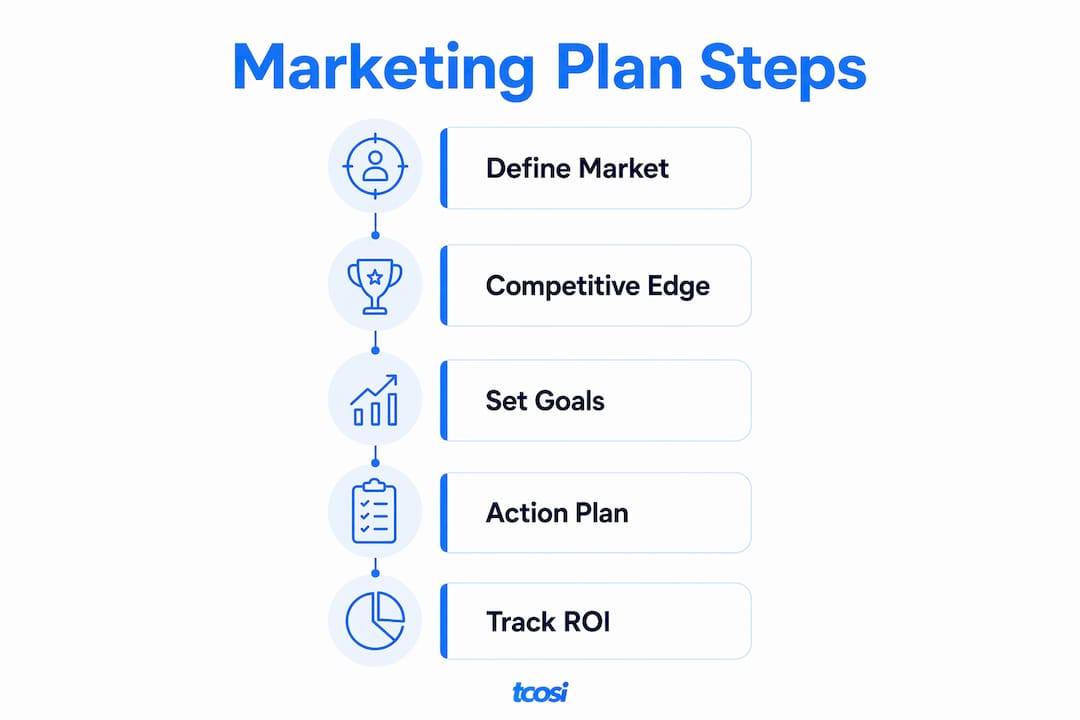
Set SMART marketing and sales goals
Vague goals produce vague results. Instead of “get more customers,” write “increase monthly website leads by 20% by the end of Q3.” Common goals for small businesses include growing an email subscriber list, increasing sales by a specific percentage, or improving Google review ratings. Tie every goal to a revenue number so you can measure whether the effort was worth it.
Build your marketing action plan
Your action plan lists the specific channels you will use and the steps you will take on each one. Common choices for small businesses include:
- Google Business Profile for local search visibility
- Email marketing for nurturing existing contacts
- Social media (one or two platforms, not five)
- Content marketing through a blog or video series
- Local advertising like community sponsorships or direct mail
For each channel, describe what you will do, how often, and who is responsible. Vague intentions do not get executed.
Budget realistically and track ROI
Include a full cost breakdown in your plan. Then track it. The SBA recommends comparing marketing and sales costs directly to the revenue they generate. If a channel is not producing a positive return, cut it or adjust it before the next budget cycle. A marketing plan should be a living document, reviewed at least once a year and updated whenever the data tells you something is not working.
Pro Tip: Download the SBA’s free marketing plan template at sba.gov to get a structured starting point. It covers every section above and helps you avoid missing anything critical.
What are the most cost-effective marketing strategies for small businesses?
The most effective low-cost marketing strategies share one trait: they build on assets you already own or can earn for free. Paid ads can work, but they stop the moment you stop paying. The strategies below keep working even when your budget is tight.
Prioritize owned assets first
Build your website before you invest in anything else. Then optimize your Google Business Profile. Only after those two foundations are solid should you layer in social media marketing or paid campaigns. Trying to run all channels at once leads to fragmented messaging and wasted effort, as research consistently shows.
Optimize your Google Business Profile
A fully completed Google Business Profile is one of the highest-ROI moves a local business can make. Add photos, keep your hours current, and respond to reviews within 24 hours. Regularly asking for Google reviews and responding promptly often delivers more traffic than many paid ad campaigns. A significant share of local searches result in a purchase within 24 hours result in a purchase within 24 hours, so showing up in local results is not a nice extra. It is where buyers are.
Focus on one or two social media platforms
Spreading yourself across every platform is a trap. Pick the one or two where your customers actually spend time, and show up there consistently. A landscaper gets more traction on Facebook and Nextdoor than on LinkedIn. A graphic designer may find Instagram more productive than Twitter. Consistent presence on one or two platforms outperforms low-effort activity across many, every time.

Use email marketing to stay in front of customers
Email is one of the most cost-effective channels available to small businesses. Build your list from day one, even if it starts with just 50 contacts. Send a monthly newsletter, a seasonal promotion, or a simple check-in. The goal is to stay top of mind so that when a contact is ready to buy, you are the first name they think of.
Start a referral program
Word of mouth is already happening. A referral program just makes it intentional. Offer a discount, a gift card, or a free service to customers who send you new business. Keep it simple and easy to share. Referrals convert at a higher rate than almost any other channel because they come with built-in trust.
Apply the 70/20/10 budget rule
When allocating your marketing budget, the 70/20/10 rule gives you a practical framework. Put 70% toward proven channels that already deliver results, 20% toward tactics you are testing for growth, and 10% toward experiments. This keeps your core revenue protected while leaving room to try new things without betting the whole budget on them.
Pro Tip: Set up a simple email automation sequence for new contacts. A three-email welcome series that introduces your business, shares a helpful tip, and makes a soft offer can convert cold leads into paying customers without any ongoing manual effort.
Why does your website matter more than any other marketing tool?
Your website is the only digital asset you fully own. Social media profiles can be suspended. Ad accounts can be shut down. Directory listings can change their terms. Your website stays yours, and it works for you around the clock.
A professionally designed website does several things that no other channel can replicate:
- Establishes credibility before a prospect ever contacts you
- Provides a stable address for every other marketing effort to point back to
- Captures leads through contact forms, quote requests, and email signups
- Supports SEO so you can be found in Google searches without paying for every click
- Gives you data through tools like Google Analytics to understand what is working
A website is not just a digital business card. It is the foundation that every other marketing channel depends on. When your social media, Google Business Profile, and email campaigns all point back to a well-built site, your entire marketing system works together instead of pulling in different directions.
The SEO benefits of a well-designed website compound over time. A site built with clean code, fast load speeds, and clear page structure earns organic traffic that does not disappear when you stop paying for ads. That is the kind of return that makes sense on a small business budget.
What makes a website actually work for marketing?
Not every website does the job. A site that looks outdated, loads slowly, or buries the contact information does more harm than good. Here is what a marketing-ready website needs:
- Mobile-friendly design. Most local searches happen on phones. If your site does not work on mobile, you are losing leads before they even read a word.
- Fast load time. Visitors leave slow sites. A page that takes more than a few seconds to load loses a measurable share of its traffic.
- Clear calls to action. Every page should tell the visitor what to do next: call, fill out a form, or request a quote.
- Consistent branding. Your logo, colors, and tone should match across your website, Google Business Profile, and social media. Inconsistency erodes trust.
- Basic SEO structure. Page titles, meta descriptions, and header tags should reflect what your customers are actually searching for.
If your current site is missing any of these, it may be worth reviewing the signs your website needs a redesign before investing more in driving traffic to it.
Brand consistency ties everything together
Every touchpoint a customer has with your business should feel like it comes from the same place. Your website, your email signature, your Google Business Profile photos, and your social media bios should all use the same logo, the same color palette, and the same tone of voice. When they do, recognition builds faster and trust follows. When they do not, prospects sense the inconsistency even if they cannot name it.
How do you measure and improve your marketing plan over time?
A marketing plan that never gets updated is just a document. The goal is to treat it as a working tool, one you revisit regularly and adjust based on what the numbers tell you.
Key metrics to track
Start with these:
- Return on investment (ROI): Total revenue generated divided by total marketing spend. This is the number that tells you whether your marketing is paying for itself.
- Cost per lead: How much you spend to generate each new inquiry. Lower is better, but only if the lead quality holds up.
- Website traffic: How many people visit your site, where they come from, and which pages they land on.
- Conversion rate: The percentage of visitors or leads who take the action you want, whether that is filling out a form, calling, or making a purchase.
- Return on ad spend (ROAS): Specific to paid campaigns, this tells you how much revenue each dollar of ad spend generates.
Use the right tools
Google Analytics is free and gives you a clear picture of your website traffic, user behavior, and conversion paths. Most email platforms include open rates, click rates, and unsubscribe data. Ad platforms like Google Ads and Meta Ads Manager provide ROAS and cost-per-click data. Without these tools, you are operating blind and guessing at what works.
Review and update regularly
The SBA recommends reviewing your marketing plan at least once a year. In practice, a quarterly check-in works better for most small businesses. Pull your numbers, compare them to your goals, and ask two questions: what is working well enough to invest more in, and what is not producing results worth the cost?
- Drop channels that consistently underperform after a fair test period.
- Double down on channels where your cost per lead is low and conversion is strong.
- Incorporate customer feedback. If multiple customers mention they found you through a specific channel or referral, that is a signal worth following.
- Watch for market shifts. A new competitor, a change in local search rankings, or a shift in customer behavior can all change which tactics work best.
The businesses that grow steadily are not the ones with the biggest budgets. They are the ones that pay attention, adjust quickly, and stay consistent on the channels that actually work for them.
Working with tcosi to build your marketing foundation
Every marketing strategy eventually points back to one place: your website. If that foundation is not solid, the rest of your efforts work harder than they need to. tcosi builds custom WordPress websites for small businesses across the United States, with a focus on clean design, fast performance, and sites that are built to support real growth.
Whether you are starting from scratch or your current site is holding you back, tcosi can help you build something worth sending traffic to. Explore website design services or website development options to see what a purpose-built site looks like for a business like yours.
Key Takeaways
Effective small business marketing requires a written, measurable plan built on owned assets, focused channel selection, and consistent ROI tracking to produce sustainable growth.
| Point | Details |
|---|---|
| Start with a written plan | A marketing plan must connect costs to revenue and be updated at least annually per SBA guidance. |
| Own your digital foundation | Your website and email list are permanent assets; social profiles and paid ads are rented and can disappear. |
| Focus beats volume | Consistent presence on one or two platforms outperforms scattered effort across many channels. |
| Apply the 70/20/10 rule | Allocate 70% of budget to proven channels, 20% to growth tests, and 10% to experiments. |
| Measure every channel | Track ROI, cost per lead, and conversion rate using free tools like Google Analytics to cut waste and grow what works. |
FAQ
What is the best marketing strategy for a small business?
The best approach combines a professional website, an optimized Google Business Profile, and consistent email marketing, all tied to a written plan with measurable goals. Focus on one or two channels where your customers are active rather than spreading effort across every platform.
What does marketing actually do for a small business?
Marketing generates awareness, attracts leads, and converts prospects into paying customers. For small businesses, it also builds the trust and credibility that turn one-time buyers into repeat customers and referral sources.
How much should a small business spend on marketing?
Budget guidance varies by industry and growth stage, but the U.S. Small Business Administration recommends tracking every dollar spent against the revenue it generates. The 70/20/10 rule gives you a practical framework for allocating whatever budget you have across proven, tested, and experimental channels.
How do I know if my marketing is working?
Track ROI, cost per lead, website traffic, and conversion rate using free tools like Google Analytics. If a channel cannot show a positive return after a fair test period, cut or adjust it before the next budget cycle.
Does a small business really need a website?
Yes. A website is the only digital asset you fully own and control. Social profiles, directories, and ad platforms can change their rules or disappear. A well-built site provides a stable, credible home for all your marketing efforts and works for you around the clock.