
Web design is the visual and functional expression of your brand online, and it shapes how visitors perceive, trust, and remember your business. The role of web design in branding goes far beyond choosing colors or fonts. It determines whether a potential customer stays or leaves, believes in you or doubts you, and returns or forgets you. For small business owners, this matters more than most realize. Your website is often the first real impression you make, and visual design is judged faster than any words on the page.
How web design shapes brand identity
Every design choice on your website sends a signal. The color palette you use, the fonts you pick, the photos you display, and even the way your navigation is organized all communicate something about who you are as a business. This is what professionals in the field call visual identity, and it is the foundation of brand recognition online.

Your logo is the starting point, but it is not the whole picture. A logo placed on a poorly designed website with clashing colors and hard-to-read text actually weakens your brand. The website design elements for brand identity that matter most work together as a system.
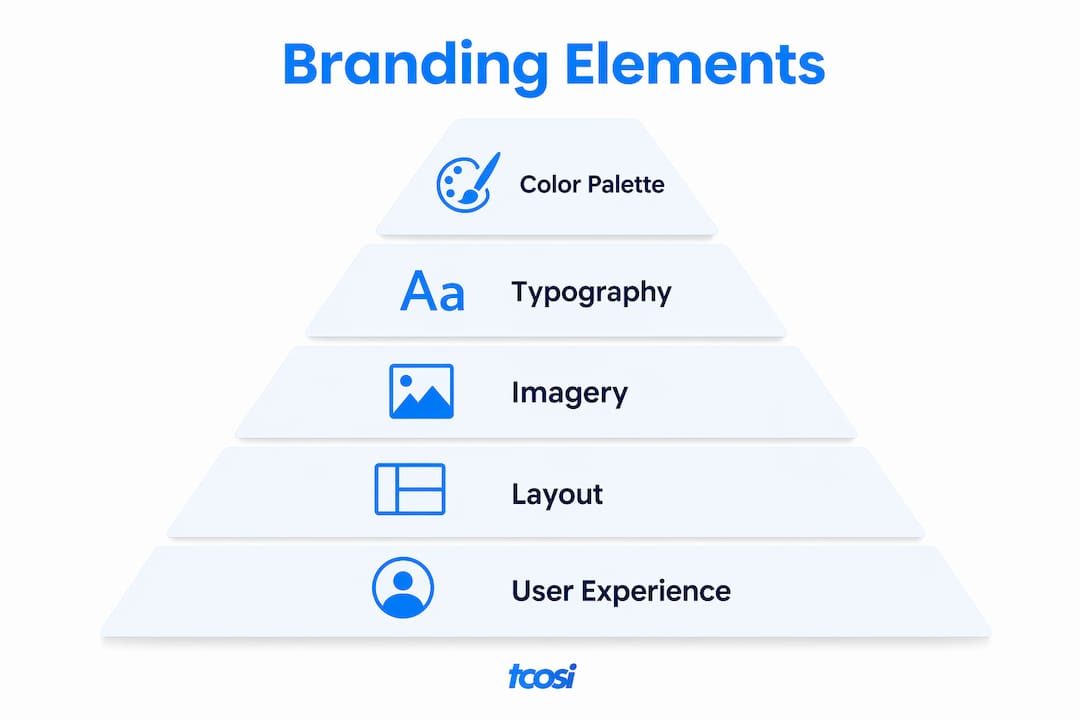
Here are the core elements that build brand identity through design:
- Color palette: Colors trigger emotional responses and create recognition. A consistent palette across every page builds familiarity fast.
- Typography: Your font choices communicate personality. A law firm and a children’s toy store should never share the same typeface.
- Imagery and photography: Stock photos that feel generic undercut authenticity. Custom or carefully curated images reinforce your brand story.
- Layout and visual hierarchy: Visual hierarchy combined with brand colors guides visitors toward the actions you want them to take.
- Custom icons and interactive elements: These small details add personality and make your site feel intentional rather than templated.
- White space: Breathing room in your layout signals confidence and professionalism. Cluttered pages feel untrustworthy.
Pro Tip: Limit yourself to one primary color, two accent colors, and no more than two typefaces. Limiting color palettes and typography prevents brand drift and keeps your site looking sharp over time.
The goal is coherence. Every element should feel like it belongs to the same family. When your website looks like it was assembled from different sources at different times, visitors sense the inconsistency even if they cannot name it.
Does user experience affect how your brand is perceived?
User experience, or UX, is not a separate discipline from branding. It is branding in action. Every interaction a visitor has with your site reflects your brand promise. If your site is slow to load, hard to navigate, or inaccessible on mobile, you are communicating something about your business whether you intend to or not.
The Interaction Design Foundation defines branding in UX design as embedding the brand promise into every interaction, including navigation structure, page hierarchy, and microcopy. Microcopy refers to the small pieces of text throughout your site: button labels, form instructions, error messages, and confirmation notes. These words carry your brand voice into moments that most designers overlook.
Here is a practical way to think about UX and branding together:
- Navigation clarity: If visitors cannot find what they need in two or three clicks, they leave. A clear menu structure signals that you respect their time.
- Page speed: A slow website feels neglected. Fast load times communicate that your business is attentive and well-maintained.
- Mobile responsiveness: More than half of web traffic comes from mobile devices. A site that breaks on a phone tells visitors you are not paying attention.
- Accessibility: An accessible website is not just a legal consideration. It shows that your brand values every visitor equally.
- Content clarity: Your messaging should match your brand voice on every page. Inconsistent tone between your homepage and your contact page creates subtle friction.
Pro Tip: Before you redesign anything, write down three words that describe your brand. Then ask whether every UX decision on your current site reflects those words. If it does not, you have found your starting point.
Strong UX and clear content storytelling work together to make your brand tangible. Visitors should leave your site with a clear sense of what you do, who you serve, and why you are the right choice.
Why brand consistency in web design matters
Brand consistency is the practice of presenting your business the same way across every page, platform, and touchpoint. On a website, this means your colors, fonts, imagery, tone, and messaging stay uniform from the homepage to the blog to the contact form.
Consistent brand presentation can boost revenue up to 23% and also improves search engine rankings. That is a significant return on what is essentially a discipline problem, not a budget problem.
Brand drift happens when a site grows without a guiding system. You add a new page here, a new section there, and over time the site starts to look like it was built by five different people with five different visions. Visitors feel the disconnect even when they cannot articulate it.
The table below shows how consistent and inconsistent brand presentations compare in practice:
| Element | Consistent brand presentation | Inconsistent brand presentation |
|---|---|---|
| Typography | Same fonts used site-wide | Multiple fonts mixed across pages |
| Color usage | Palette applied uniformly | Random colors added page by page |
| Tone of voice | Matching across all copy | Formal on one page, casual on another |
| Imagery style | Cohesive photography or illustration | Mixed stock and custom photos |
| Logo placement | Same size and position throughout | Varies by page or section |
Uniform typography, color palettes, and imagery reinforce familiarity and reduce the cognitive effort visitors spend making sense of your site. Less effort means more trust. More trust means more conversions.
The practical fix is to build a simple brand style guide before you touch your website. Document your colors with hex codes, name your fonts, define your image style, and write out your tone guidelines. Then treat that document as the rule book for every future design decision.
Common web design mistakes that hurt your brand
Small businesses make predictable mistakes when it comes to web design and branding. Knowing them in advance saves you time, money, and credibility.
- Treating web design as a one-time project. Your website is a living asset that needs ongoing attention as your business evolves. Web design requires ongoing stewardship to maintain brand integrity over time. A site built in 2021 and never updated is silently eroding your brand.
- Chasing design trends without strategic fit. A trendy animation or a bold layout choice that does not match your brand position actually hurts you. Treating web design like decoration rather than strategic communication leads to lost credibility.
- Confusing a logo with a brand. Your logo is one piece of a much larger recognition system. A brand is a full recognition system, and your website design must support every part of it.
- Ignoring mobile responsiveness and accessibility. These are not optional extras. They are baseline expectations that affect both user trust and search rankings.
- Skipping the strategy conversation. Many small business owners hire a designer based on portfolio aesthetics alone. Knowing how to choose the right web designer means finding someone who asks about your business goals, not just your color preferences.
- Failing to align design with brand voice. A visually polished site with copy that sounds nothing like your brand creates a disconnect that visitors notice immediately.
The common thread across all these mistakes is treating design as a visual exercise rather than a business communication tool. Your website is not a brochure. It is the most scalable version of your brand working on your behalf around the clock.
Key takeaways
Web design is the most direct way your brand communicates its identity, values, and trustworthiness to every visitor who lands on your site.
| Point | Details |
|---|---|
| Design shapes first impressions | Visual design is judged before words, making every element a trust signal from the first second. |
| Consistency drives revenue | Consistent brand presentation across your site can boost revenue by up to 23%. |
| UX is part of your brand | Navigation, speed, and microcopy all carry your brand promise into every visitor interaction. |
| Brand drift is a real risk | Adding pages without a style guide causes inconsistency that erodes visitor confidence over time. |
| Design is ongoing, not one-time | Your website needs regular updates to stay aligned with your evolving brand and business goals. |
Web design is a business decision, not just a creative one
I have worked with a lot of small business owners who came to me thinking they needed a “refresh,” meaning new colors or a cleaner layout. What they actually needed was a clearer brand strategy expressed through their design. Those are two very different problems, and only one of them gets solved by picking a new font.
The impact of web design on brand identity is not abstract. I have seen businesses lose leads because their website looked outdated compared to competitors, even when their actual service was superior. Visitors do not know your service is better. They only know what they see. And what they see in the first few seconds determines whether they stay or go.
What I advocate for with every client is treating the website as a brand governance tool, not a finished product. That means building with a style guide, reviewing the site regularly, and making updates that reflect real business growth rather than just cosmetic changes. The businesses that do this consistently are the ones that build real recognition and trust online.
The importance of design in branding is not about having the most beautiful site. It is about having a site that clearly and consistently tells your story to the right people. That is a strategic goal, and it deserves a strategic approach.
— Tommy Cosimano
Ready to build a site that actually represents your brand?
If you have been piecing your website together over time and it no longer feels like a true reflection of your business, you are not alone. Most small business owners reach that point eventually.
tcosi builds custom WordPress websites designed around your brand from the ground up. Whether you need a full redesign or a more focused refresh, the work starts with understanding your business goals, not just your visual preferences. Every site tcosi builds is built to support real growth, with clear design, reliable development, and ongoing support when you need it. Visit tcosi.com to learn more about working together on a site that represents your brand the right way.
FAQ
What is the role of web design in branding?
Web design is the primary way your brand communicates its identity online. It combines visual elements like color and typography with user experience and content to build trust and recognition with every visitor.
How does web design affect brand trust?
Visual design is judged immediately when a visitor lands on your site, before they read a single word. A well-designed site signals credibility; a poorly designed one signals risk.
What website design elements matter most for brand identity?
The most important elements are your color palette, typography, imagery style, layout structure, and brand voice in your copy. These must work together consistently across every page to build recognition.
Why does brand consistency matter on a website?
Consistent brand presentation can increase revenue by up to 23% and improves search engine performance. Inconsistency creates confusion and erodes the trust you are trying to build.
Is a logo the same as a brand?
No. A logo is one component of a broader recognition system. Your brand includes your voice, your values, your visual identity, and the full experience visitors have on your website. Design must support all of it, not just display a logo.