For most small and mid-sized businesses, VWO is the better fit. It is built for marketing-led teams, it has a free trial, and it bundles heatmaps and recordings with testing. Optimizely is built for enterprise product and engineering teams that run server-side tests, feature flags and large experiment programs, and it is priced and sold that way. I build and maintain WordPress sites for a living, so I see which tool a business can actually use. That depends on how much traffic the site gets, who will run the tests and how healthy the site underneath is.
TL;DR
- VWO suits marketing teams that want A/B testing, heatmaps and session recordings in one place, with little developer help.
- Optimizely suits enterprise product and engineering teams running server-side experiments, feature flags and warehouse-native analysis at scale.
- Price: VWO starts at roughly $314 a month on annual billing, according to Vendr. Optimizely publishes no prices and sells by custom quote.
- Statistics differ: VWO reports the probability that a variation beats the control. Optimizely uses sequential testing for always-valid results.
- A testing tool only tells you which version of a page wins. The page itself, its speed and its structure still have to be built well.
Table of Contents
- VWO vs Optimizely at a glance
- What VWO and Optimizely actually are
- How the testing and statistics differ
- Ease of use and setup
- What each one costs in the US
- Which one fits your team
- Do you have enough traffic to test?
- Where a testing tool fits in a website plan
- FAQ
- Sources
VWO vs Optimizely at a glance
| VWO | Optimizely | |
|---|---|---|
| Best for | SMB and mid-market marketing teams | Enterprise product and engineering teams |
| Statistics | Bayesian (SmartStats) | Sequential (Stats Engine) |
| Behavior tools | Heatmaps, recordings, forms, surveys built in | Experiment-focused; pair with outside analytics |
| Setup | Visual editor plus one JavaScript snippet | Visual editor for basic edits; developers for complex ones |
| Pricing | Custom, with a Starter entry near $314/month | Quote only, sold through a demo |
| Trial | 30-day free trial, no card | No trial shown on its plans page |
The rest of this article explains each row, so you can see where your own team lands.
What VWO and Optimizely actually are
Both tools let you show different versions of a page to different visitors and measure which one gets more of the action you care about. That could be a form fill, a purchase or a click. After that they diverge quickly.
VWO is an experience optimization suite. It includes A/B, multivariate and split URL testing, plus heatmaps and session recordings and personalization. Its main products are Testing, Insights, Personalize, Web Rollouts, Data360 and Plan. Insights covers heatmaps, recordings, form analytics, funnels and surveys, per one 2026 review. One thing to know if you search for it: VWO and AB Tasty merged in 2026 and later launched Wingify as a single brand, and vwo.com now redirects to wingify.com.
Optimizely is a broader digital experience platform sold to mid-market and enterprise teams. Its suite includes a CMS, experimentation and feature flags, a content marketing platform, personalization, B2B commerce, a customer data platform, and warehouse-native analytics, according to a 2026 pricing profile. Its experimentation products break down into Web Experimentation, Feature Experimentation with SDKs in 10+ languages, Analytics and Personalization, as listed on its plans page.
If you only want to test a headline on a landing page, you are shopping for a small slice of Optimizely. With VWO, that same need is close to the center of the product.
How the testing and statistics differ
This is the part that gets argued about most, and it is simpler than it sounds.
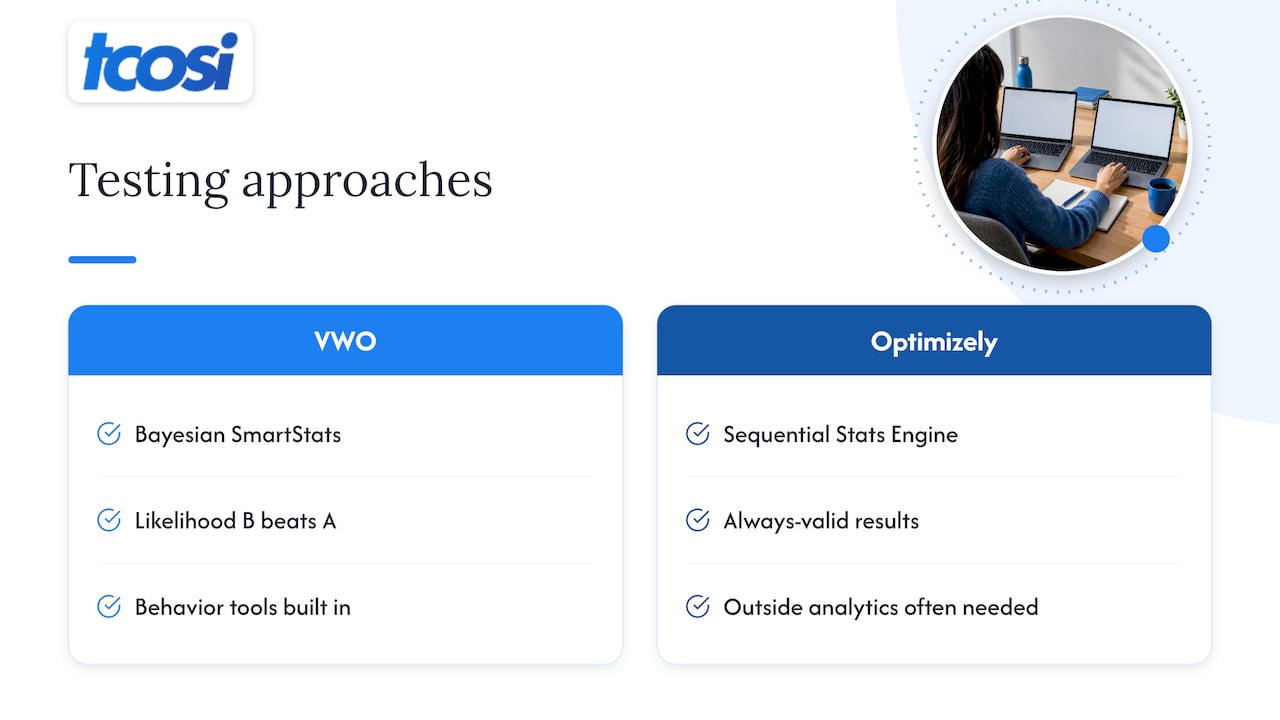
VWO uses Bayesian statistics, which it calls SmartStats. Instead of a p-value, it tells you how likely variation B is to beat A. That reads naturally for a marketer. Optimizely’s Stats Engine uses sequential testing, which is designed to give always-valid results. In practice, that means you can check results while a test is running without inflating your false-positive rate in the way a fixed-sample test would.
Neither approach is wrong. What matters is that your team understands the number on the screen. A small team that reads “92% likely to win” and acts on it sensibly will get more value than a team that has a rigorous engine and nobody who can explain the output.
Behavior data is the other difference. VWO keeps heatmaps, recordings, funnels, forms and surveys inside the same platform as the tests. Optimizely’s reporting is more experiment-focused, with significance, confidence intervals and uplift projections, and it typically needs pairing with outside analytics for behavioral insight. If you want to see where people stall before you decide what to test, the VWO model is more convenient. I have written about heatmap tools for small business websites for exactly this reason: watching real behavior comes before guessing at variations.
Ease of use and setup
VWO’s visual editor lets marketers build and launch tests without coding after a single JavaScript snippet (SmartCode) is installed, per Personizely’s comparison. The same comparison describes Optimizely as having a steeper learning curve, with developer support often needed for complex changes, even though a visual editor exists for basic edits.
There is a technical trade-off hidden in this. A snippet that swaps page elements in the browser can cause a brief flicker, where visitors see the original before the variant appears. That is the typical client-side approach, described by PulseRevOps for VWO. Optimizely also supports robust server-side testing, which renders the variant before it reaches the browser and removes flicker, but it requires developer instrumentation.
In plain terms:
- No developer on the team: VWO’s route is the realistic one.
- Engineers who own experimentation: Optimizely’s server-side depth becomes an advantage.
Integrations follow the same pattern. VWO lists Google Analytics, Adobe Analytics, HubSpot, Salesforce, Segment and Shopify, which covers the stack most small businesses run. Optimizely leans toward enterprise analytics, CRM and data warehouse connections. If you have strict compliance needs, note that Optimizely holds ISO 27001, SOC 2 Type 2, PCI DSS and TISAX certifications and offers selectable EU data hosting.
What each one costs in the US
Neither vendor gives you a simple price list, but the gap between them is large.
VWO. There is no public price list. Pricing depends on monthly tracked users, the products you pick and contract length. Vendr reports that VWO Starter begins at about $314 a month, billed annually, for up to 10,000 monthly tracked users and VWO Testing only. Growth, Pro and Enterprise require custom quotes. VWO also offers a 30-day free trial with no credit card, and the old free Starter plan is gone.
Optimizely. It publishes no price list, no free tier and no self-serve signup. Its plans page is a lead-capture form for a custom quote. Third-party figures vary. DRIP puts entry pricing around $36,000 a year, while GrowthTech Spotlight reports annual contracts from $50,000 to over $200,000 depending on traffic and features. Treat all of these as ranges, not quotes.

That answers the question many people type about why Optimizely is so expensive. It is sold through enterprise contracts to teams that need engineering resources to use it at scale. You are paying for a platform, not just a testing widget.
Which one fits your team
Pick VWO if:
- Marketing owns conversion work and has limited developer time.
- You want testing, heatmaps and recordings together.
- You want a trial before committing.
Pick Optimizely if:
- Product and engineering teams run experiments across web, mobile and APIs.
- You need feature flags, server-side rigor and warehouse-native analysis.
- Your budget is built for an enterprise contract.
That matches how several 2026 comparisons frame it: VWO for marketing-led teams, Optimizely for product and engineering teams, and VWO for landing-page teams with limited engineering bandwidth.
What to check in a pilot
A pilot that does not look like production gives false confidence. Practitioners suggest checking different things for each tool, per Artisan Growth Strategies:
- For VWO: run it on your real pages and application, including single-page-app behavior and data integration.
- For Optimizely: confirm the product and statistical mode, exposure logging, metric definitions and stopping rules.
- For either: agree in advance on the one metric that decides a winner, and how long a test must run.
Do you have enough traffic to test?
This is the question I ask first, because the tools do not fix it. A/B tests need enough visitors to reach a reliable result. If a page gets a few hundred visits a month, a test can take a very long time to say anything, and a $314 monthly subscription is mostly paying for waiting.
For lower-traffic sites, the better return usually comes from fixing what is already known to be wrong: slow hero sections, confusing navigation, thin page content, unclear calls to action. If you want to see how I think about this, Test First, Polish Later covers hero sections and page speed, and why websites need ongoing optimization covers the long game. Growing engagement is also about what the page offers, not only which button color wins, and these strategies to increase website engagement are a good companion to any testing plan.
Where a testing tool fits in a website plan
Either platform sits on top of your website. It does not replace one. If the site is slow, hard to edit, or built on a theme nobody understands, a testing tool will surface problems you then have to fix anyway. Snippets, variants and third-party scripts also add weight to pages, so the foundation matters more, not less.
I build custom WordPress sites, redesigns and ongoing support for US businesses, and my Growth package is $2,400 one-off, with Essentials at $1,200 and Premium at $4,800. A monthly Ongoing Maintenance plan is $100 per month. You can see everything listed on the website pricing page. If your site needs a stronger base before you invest in experimentation, that is where I would start.

If you already know what you want, browse my design and development services and tell me about your site. I will walk you through the process in plain language, with no jargon.
What we think about testing tools
We see a lot of businesses reach for an enterprise-grade tool because it feels like the serious choice. Our view is that a testing platform multiplies the quality of the website it runs on. A clear structure, fast pages and a design that explains the offer give any test something real to improve.
We build sites so that the person who owns them can understand them. That means sensible page layouts, clean WordPress builds and ongoing support so changes get made carefully instead of patched on. When a business is ready to test, a site built this way gives the testing tool, whichever one you choose, a solid page to work from.
Choose VWO or Optimizely for what your team can actually run. Then make sure the website underneath deserves the traffic you are sending it.
Tommy Cosimano
FAQ
Is VWO or Optimizely better for small businesses?
VWO is usually the better fit. It is framed as suited to SMBs and marketing teams, it has a 30-day free trial, and it bundles heatmaps and recordings with testing. Optimizely is framed as an enterprise and product-team platform with custom contracts.
How much does VWO cost compared with Optimizely?
VWO Starter begins at about $314 a month on annual billing for up to 10,000 monthly tracked users, according to Vendr, with higher plans by quote. Optimizely publishes no prices. Third-party reports put its contracts from roughly $36,000 to well over $100,000 a year, so ask for a quote.
What is the difference between how they calculate results?
VWO uses Bayesian SmartStats and reports the probability that a variation beats the control. Optimizely’s Stats Engine uses sequential testing, which is designed to give valid results even when you check a running test.
Do I need a developer to use them?
VWO’s visual editor lets non-technical users launch tests after one snippet is installed. Optimizely has a steeper learning curve, and complex changes typically need developer support. Server-side testing on either needs engineering involvement.
Sources
- VWO Review 2026: Custom Pricing, Wingify, Pros and Cons
- VWO Review 2026: Experimentation Suite, Pricing, CRO Impact
- VWO vs Optimizely: Features, Pricing and Best Fit (2026)
- Optimizely Pricing | UsagePricing
- Optimizely – Plans & Pricing
- Optimizely vs VWO – 4Analytics
- VWO vs Optimizely: 2026 Comparison for E-Commerce | DRIP
- VWO vs Optimizely: Features, Pricing, and Best Fit | Personizely
- What is the best tool for A/B testing landing pages | PulseRevOps
- Optimizely Features & Pricing | Agentic Index
- VWO Software Pricing & Plans 2026 | Vendr
- Conversion Rate Optimization Tools 2026 | GrowthTech Spotlight
- Optimizely vs VWO vs Statsig: How to Choose an A/B Testing Platform
- How to Increase Website Engagement