Most small-business websites in the US cost roughly $100 to $500 a month to maintain once you count hosting, plugin licenses, and routine support. E-commerce stores usually start around $500 a month and climb from there. Your real number depends on plan tier, hosting quality, and a buffer for the incident that always seems to show up in month four. Find your site type below, then use the total cost of ownership formula to build an honest budget.
TL;DR:
- Small business websites typically pay $100 to $300 a month for maintenance, while e-commerce stores often start around $500 and can exceed $1,000.
- Maintenance costs increase with higher traffic, custom code, payment processing, and plugin dependencies, moving sites into higher cost brackets.
- Common monthly expenses include hosting ($5–$200), licenses ($50–$200 per plugin annually), domain renewal, SSL certificates, backups, and security tools.
- Plans with proactive human review and staging testing cost $100 to $300, with premium options offering faster response times and incident remediation.
- Total ownership costs should include internal labor and incident buffers, with realistic monthly expenses around $390 even for mid-tier plans.
Table of Contents
- How Much Does Website Maintenance Cost by Website Type?
- What Are the Core Website Maintenance Cost Components?
- What Do Budget, Mid-Tier, and Premium Maintenance Plans Include?
- How Do You Calculate Total Cost of Ownership for Website Maintenance?
- Why Does E-Commerce and WooCommerce Maintenance Cost More?
- What Are Typical Hourly Rates and Incident Fees for Website Work?
- How Do You Choose the Right Website Maintenance Plan?
- When Is Agency-Managed Maintenance the Right Investment?
- Get an Agency-Managed Maintenance Plan Built for Your Business
- Sources
- FAQ
How Much Does Website Maintenance Cost by Website Type?
Your maintenance bill depends almost entirely on what kind of site you’re running and how much stands to break. A five-page brochure site with no forms and no payment processing has a fundamentally different risk profile than a WooCommerce store processing orders every hour.
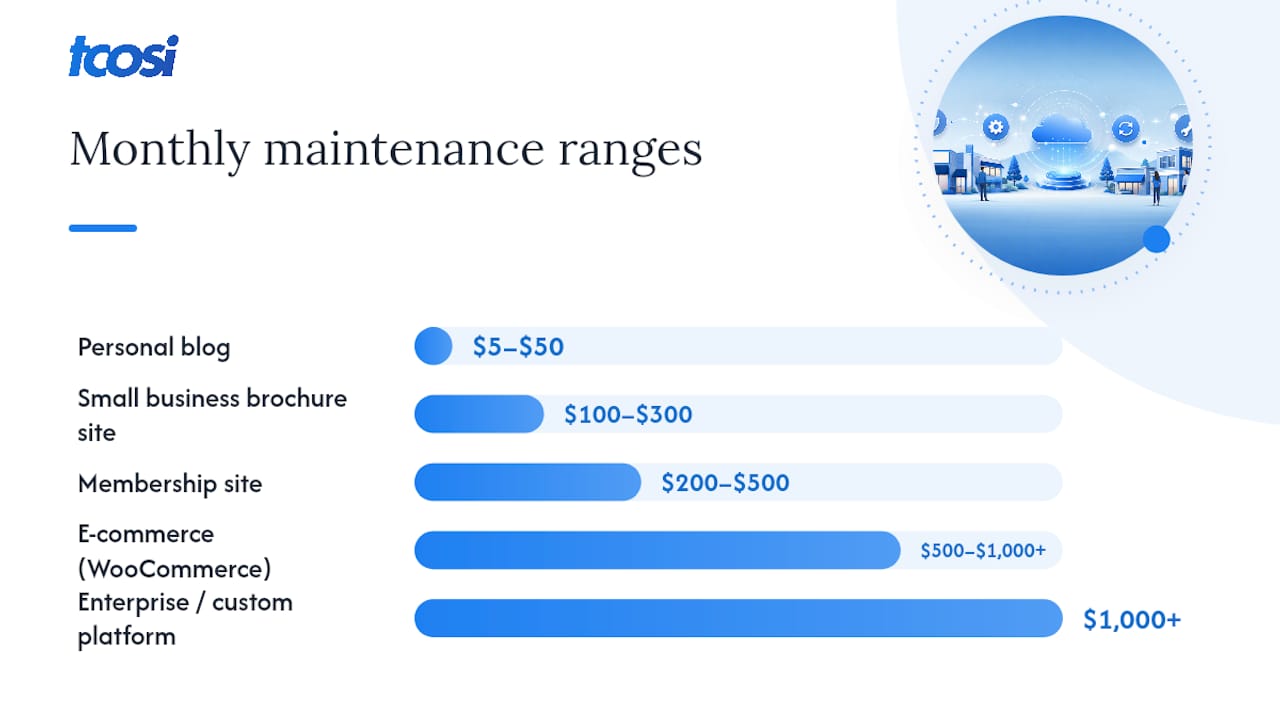
Personal blogs and hobby sites sit at the low end, typically $5 to $50 a month, covering basic hosting and the occasional plugin update. Small business brochure sites, the kind most local service providers and professional firms run, usually land in the $100 to $300 a month range once you add a maintenance plan, decent hosting, and a handful of plugins. Membership sites and sites with gated content tend to have higher maintenance costs because of the added complexity around user accounts and payment gateways. E-commerce and complex custom sites regularly run $300 to $1,000 or more per month, and enterprise sites with multiple integrations can exceed that easily.
A few factors move a site from one bracket to the next:
- Traffic volume. More visitors mean more load, which often means upgrading from shared to managed hosting.
- Custom code. Custom-built features and unique templates require a developer who can actually read the code, not just click “update.”
- Payment processing. Any site handling transactions needs tighter security monitoring and faster incident response.
- Plugin count. Every plugin is another dependency that can break during a WordPress core update.
Here’s a rough example: a local landscaping company running a 12-page WordPress site with a contact form and a blog might pay $40 a month for managed hosting, $150 a month for a mid-tier maintenance plan, and $15 a month across two premium plugins. That’s about $205 a month before factoring in any custom work.
| Website Type | Typical Monthly Range | Primary Cost Driver |
|---|---|---|
| Personal blog | $5–$50 | Hosting only, minimal plugins |
| Small business brochure site | $100–$300 | Maintenance plan + managed hosting |
| Membership site | $200–$500 | User accounts, payment integration |
| E-commerce (WooCommerce) | $500–$1,000+ | Real-time backups, payment monitoring |
| Enterprise / custom platform | $1,000+ | Custom code, integrations, compliance |
What Are the Core Website Maintenance Cost Components?
Every maintenance invoice, whether it comes from a freelancer or a full agency, breaks down into the same set of line items. Knowing what each one costs on its own helps you spot when a quote is bundling things it shouldn’t, or leaving out something you’ll need.
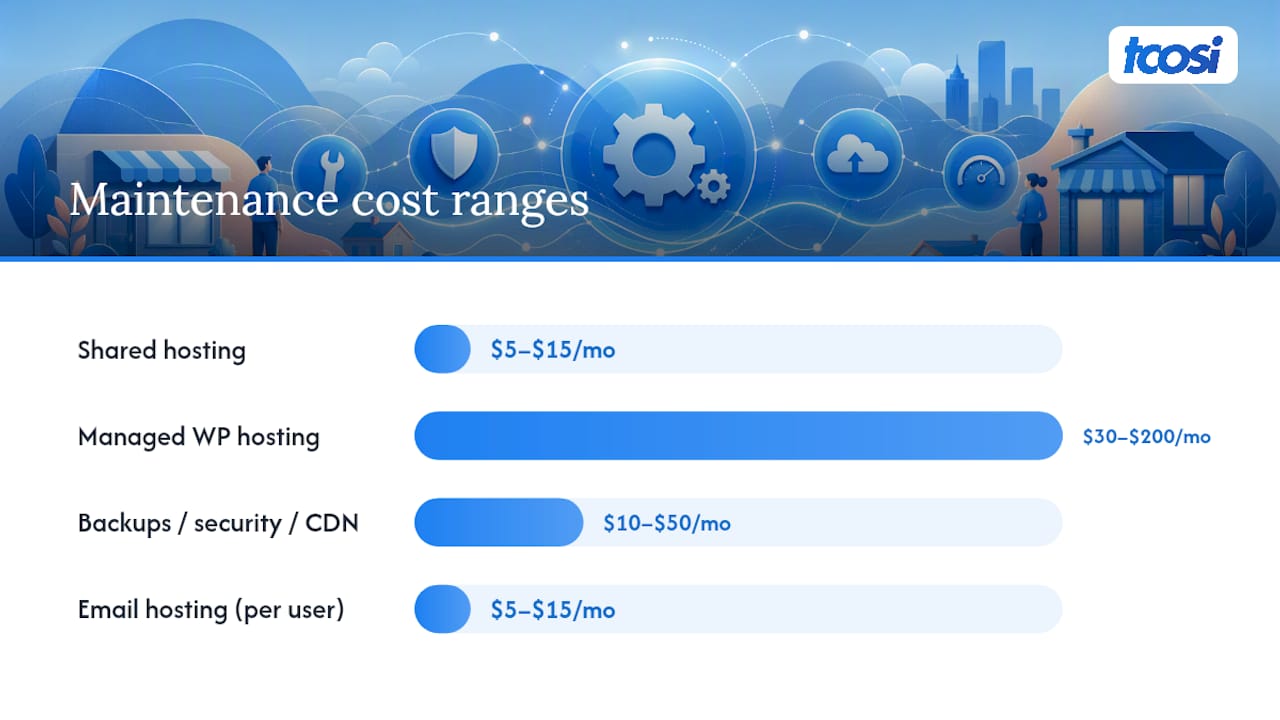
Hosting is usually the largest recurring infrastructure line. Shared hosting runs $5 to $15 a month, while managed WordPress hosting, which includes better performance and built-in security, runs $30 to $200 or more depending on traffic and support level. Domain renewal is a small annual cost, typically $10 to $30 a year, and it’s easy to forget until the renewal notice lands in a spam folder and the site goes dark.
SSL certificates can be free. Let’s Encrypt provides standard encryption at no cost, and most managed hosts include it automatically. Premium SSL certificates with extended validation, or advanced malware monitoring layered on top, add an annual fee that some providers quietly fold into a “security package” line.
Plugins and themes vary widely. A single premium plugin license often runs $50 to $200 a year, and a typical business site running five to eight premium plugins can expect $300 to $1,000 a year just in licensing. Backups, security scanning, and a CDN are frequently bundled into a maintenance plan rather than billed separately, but if you’re piecing together your own stack, expect $10 to $50 a month combined for a small site. Email hosting (a real business inbox, not a free webmail forward) typically runs $5 to $15 per user per month through providers like Google Workspace or Microsoft 365.
The most common billing mistake in this category: providers advertising a “$99 maintenance plan” that doesn’t include hosting at all, so the real monthly number is closer to $150 to $200 once you add it back in.
Pro Tip: Ask any provider for a single all-in monthly number before you sign anything. If they can only quote the plan price and can’t tell you what hosting and licenses will run on top of it, you’re not getting the full picture.
A quick reference for what’s typically monthly versus annual:
- Hosting, security monitoring, and CDN: billed monthly
- Domain renewal and many plugin licenses: billed annually
- SSL: free with Let’s Encrypt, or a paid annual add-on for premium certificates
- Backups: often bundled into hosting or the maintenance plan itself
What Do Budget, Mid-Tier, and Premium Maintenance Plans Include?
WordPress maintenance plans fall into three fairly distinct tiers, and the jump between them isn’t just about price, it’s about how much human attention actually touches your site before changes go live.
Budget plans, running roughly $30 to $100 a month, typically cover automated core, plugin, and theme updates plus basic uptime monitoring. The catch: these updates usually run directly on your live site with no testing step, so if a plugin update conflicts with your theme, you find out when a customer emails you about a broken checkout page.
Mid-tier plans, around $100 to $300 a month, add a staging environment where updates get tested before going live, plus regular backups and some level of human review. This is where reactive maintenance starts becoming proactive.
Premium plans, $300 to $1,000 or more a month, include staging with visual regression testing, faster response SLAs, and often built-in remediation if something breaks. The core difference between budget and premium isn’t the update itself, it’s whether a human catches the problem before your customers do.
What each tier generally includes:
- Budget: automated updates, basic monitoring, minimal support
- Mid-tier: staged updates, scheduled backups, email support, monthly reporting
- Premium: staging with QA review, priority response times, included incident remediation, dedicated point of contact
Pro Tip: Estimate your site’s hourly revenue before picking a tier. If your site generates or supports $200 an hour in business (bookings, orders, lead form conversions), a premium plan that prevents even one hour of downtime a year has already paid for itself several times over.
How Do You Calculate Total Cost of Ownership for Website Maintenance?
The sticker price on a maintenance plan is never the real number. Total cost of ownership adds three things together: direct spend, the dollar value of internal labor, and a buffer for the incident that will eventually happen.
TCO = Plan Price + Hosting + Licenses + Internal Labor Value + Incident Buffer
Internal labor is the piece most business owners skip, and it’s often the biggest hidden cost. If you or an employee spends three hours a month fielding “the site looks broken” emails, updating a blog post, or chasing down a plugin conflict, and your time is worth $50 an hour, that’s $150 a month in labor you’re not counting.
Here’s a worked example for a small professional services firm:
- Mid-tier maintenance plan: $175/month
- Managed hosting: $60/month
- Plugin licenses (annualized): $40/month
- Internal labor (2 hours at $50/hour): $100/month
- Incident buffer (sized at one month of the plan price): $175/month set aside annually, or roughly $15/month amortized
Total realistic monthly cost: around $390/month, not the $175 the plan price alone suggests.
| TCO Component | Example Monthly Value |
|---|---|
| Maintenance plan | $175 |
| Hosting | $60 |
| Licenses | $40 |
| Internal labor | $100 |
| Incident buffer (amortized) | $15 |
| Total | $390 |
A good rule of thumb for the incident buffer: size it at one to three months of your plan price, held in reserve for the year something genuinely goes wrong.
Why Does E-Commerce and WooCommerce Maintenance Cost More?
An online store has more moving parts than a brochure site, and every one of them can fail in a way that costs you actual sales, not just embarrassment. That’s why WooCommerce maintenance commonly starts around $500 a month and can exceed $3,000 a month for larger stores.
The jump in price reflects real added work. Every plugin or WooCommerce update needs to be tested against your checkout flow before it goes live, because a broken cart during a sale weekend is a direct revenue hit, not an inconvenience.
Stores need a specific set of services that brochure sites usually don’t:
- Real-time backups, not just nightly ones, so an order dispute or database issue doesn’t wipe out hours of transactions.
- Payment gateway monitoring to catch failed transactions before customers start abandoning carts.
- PCI-related security checks, since any site touching card data has compliance obligations that go beyond a basic firewall.
- Inventory integrity checks to catch sync issues between your store and any connected fulfillment or accounting system.
Stores also need faster response commitments. A brochure site with a 48-hour response window is annoying if something breaks. A store with the same window during a product launch can lose real money every hour the checkout is down, which is exactly the downtime economics that should drive your tier selection.
What Are Typical Hourly Rates and Incident Fees for Website Work?
Ad-hoc work outside a maintenance plan gets billed hourly, and rates vary a lot depending on who you hire. Freelancers typically charge $75 to $150 an hour, while agencies with dedicated development teams run $150 to $250 an hour.
- Freelance developer: $75–$150/hour
- Agency development team: $150–$250/hour
- Standalone malware cleanup: a few hundred dollars to $1,000+ depending on severity
- Emergency after-hours fix: often billed at 1.5x to 2x standard hourly rate
Retainers make financial sense once your ad-hoc hours start adding up to more than the plan price. If you’re calling a freelancer three or four times a year at $150 an hour for a two-hour fix, that’s $900 to $1,200 annually, roughly the same as a solid mid-tier plan that also includes proactive monitoring instead of just emergency response.
How Do You Choose the Right Website Maintenance Plan?
Picking a plan comes down to matching coverage to what your site actually needs, and asking specific enough questions that vague answers become obvious.
Run through this checklist before signing anything:
- Does the plan include a staging environment for testing updates, or do changes go straight to the live site?
- How often are backups taken, and where are they stored?
- What’s the guaranteed response time for a broken site?
- How many support hours are included, and what happens beyond that?
- Do you get monthly reporting on what was actually done?
- Is there a documented emergency procedure for hacks or outages?
Ask a potential provider these exact questions, and listen for specifics rather than reassurance:
- “What’s your response time if my site goes down at 11 PM on a Saturday?” A good answer names an actual SLA in hours, not “we’ll get to it quickly.”
- “Is testing done on staging before anything touches my live site?” The answer should be yes, with a description of the process.
- “What happens if my site gets hit with malware, is cleanup included or billed separately?” You want this in writing.
Red flags worth walking away from: no staging environment offered at any tier, a vague or unwritten SLA, no clear malware-cleanup terms, and a monthly report that’s just an automated email listing “12 updates installed” with no context.
When Is Agency-Managed Maintenance the Right Investment?
Automated plans work fine until they don’t, and the sites that get hurt worst are usually the ones running important business functions on the cheapest tier available. tcosi works with local service providers, professional firms, and nonprofits across the US who’ve usually already learned this the hard way, often after a plugin update broke a contact form for two weeks without anyone noticing.
Agency-managed maintenance earns its price through staging-tested updates, a dedicated point of contact instead of a ticket queue, and ongoing strategic input on why the site needs continued optimization rather than just patching. For a business where the website drives real leads or revenue, that difference between detection and prevention is worth the higher tier.
— Tommy Cosimano
Get an Agency-Managed Maintenance Plan Built for Your Business
tcosi handles custom WordPress design, development, and ongoing maintenance for small and mid-size businesses across the US, and that combination matters: the team that built your site is the same team keeping it running.

Instead of piecing together hosting, a plugin bundle, and a freelancer on call for emergencies, you get one plan that covers staging-tested updates, backups, and a dedicated contact who already knows your site’s history. Full details on what’s included at each level are on the website maintenance services page, and current pricing examples are on the website pricing page. If your current setup is running on autopilot with no staging and no clear response time, reach out for a quote and get a plan that actually matches how your site is used.
Sources
- What WordPress maintenance plans actually include and cost | Pantheon
- WordPress Website Maintenance Cost Explained with Real Market Data for 2026 – Codeable
- Website maintenance cost: Monthly and yearly pricing
FAQ
How much should I charge for website maintenance?
Freelancers typically charge $75 to $150 an hour, while agencies charge $150 to $250 an hour; monthly retainer plans usually range from $100 to $300 for a small business site.
How much does it cost to hire someone to maintain a website?
Hiring a freelancer or agency for ongoing maintenance typically costs $100 to $300 a month for a small business site, or $500 or more for an e-commerce store, depending on the tier and services included.
How much does it cost to maintain a website?
Total monthly cost usually falls between $100 and $500 for a small business site once you include the maintenance plan, hosting, plugin licenses, and an incident buffer, with e-commerce sites often starting around $500 a month.
Is $1,500 a good price for a website?
That price is more relevant to building a website than maintaining one; for maintenance specifically, amounts above $1,000 a month would sit well into premium enterprise territory, far above what most small business sites need. If that refers to a one-time project cost, it’s reasonable for a basic custom WordPress site, though ongoing maintenance would still be billed separately.