
Which medical websites should you actually trust?
When you need reliable health information online, the source matters as much as the content itself. The most credible medical websites in the United States fall into three categories: government-backed resources, academic medical centers, and editorially rigorous consumer health platforms. Here is a quick reference list to bookmark right now.
- MedlinePlus — National Library of Medicine (NIH); free, non-commercial, 24/7 access
- WebMD — consumer-friendly health news with an active medical review board
- Mayo Clinic — academic medical center with deep clinical research backing
- Healthline — medically reviewed content with a network of over 130 reviewers
- CDC (Centers for Disease Control and Prevention) — official U.S. public health guidance
- Merck Manuals — free, multi-language clinical reference for both consumers and professionals
- Cleveland Clinic — academic hospital with peer-reviewed patient education content
Each of these sites earns its place for a specific reason. None of them sell you a product in exchange for the advice they give.

What makes each of these healthcare websites stand out?
Not every trusted site serves the same purpose. Knowing what each one does best helps you go to the right place for the right question.
- MedlinePlus is a service of the National Library of Medicine, part of NIH. It covers thousands of health topics, drug information, medical encyclopedia entries, and lab test explanations, all without advertising or commercial influence.
- WebMD publishes health news, symptom checkers, and condition overviews aimed at general readers. Its editorial policy requires physicians to review content regularly, keeping information current as medical research evolves.
- Mayo Clinic backs its patient education content with $660 million in annual research investment and more than 3,000 full-time researchers. That depth shows up in its condition articles, which go further than most consumer sites.
- Cleveland Clinic operates similarly, publishing clinically reviewed articles written by its own physicians and specialists. Its Health Library is particularly strong for cardiology and digestive health topics.
- Healthline reaches millions of readers monthly and employs a network of over 130 medical reviewers to vet every article. It covers mental health, nutrition, and chronic conditions with a tone that feels accessible without being watered down.
- CDC translates complex epidemiological data into plain-language public health guidance. It is the go-to source for vaccine schedules, outbreak updates, and disease prevention recommendations.
- Merck Manuals offers free, multi-language medical reference content in both a consumer version and a professional version, letting you choose the level of clinical detail you want.
Pro Tip: Many of these sites offer separate sections for patients and for healthcare professionals. If the consumer version feels too simplified, look for a “professional” or “clinician” tab on the same site.

How do you evaluate whether a medical website is credible?
Knowing which sites are trusted is useful. Knowing why they are trusted makes you a sharper reader of any health information you find online.
- Check the domain. Sites ending in .gov or .edu are non-commercial and evidence-based, which is why librarians and health educators consistently recommend them first.
- Look for a medical review board. Credible commercial sites publish their editorial policies and list the physicians who review content. If you cannot find that information, treat the site with skepticism.
- Verify update frequency. Reliable sites note when each article was last reviewed. Medical guidelines change, and a page last updated in 2018 may not reflect current standards.
- Look for accreditation seals. HONcode (Health On the Net Foundation) and URAC are two recognized certifications that evaluate medical websites for ethics, accuracy, and content quality.
- Distinguish peer-reviewed from user-generated content. Forum posts, comment sections, and patient testimonials can be valuable for lived experience, but they are not a substitute for clinically reviewed information.
- Watch for commercial bias. Sponsored content and affiliate links are not automatically wrong, but they should be clearly labeled. If a site’s top recommendation happens to be a product it sells, that is worth noting.
- Review the privacy policy. Any site where you enter personal health data should explain clearly how that data is stored and whether it is shared. Good website security practices protect sensitive information from exposure.
How are trusted medical information sites held to high standards?
The sites on this list did not earn their reputations by accident. Each one follows a set of practices that keeps their content accurate and their readers protected.
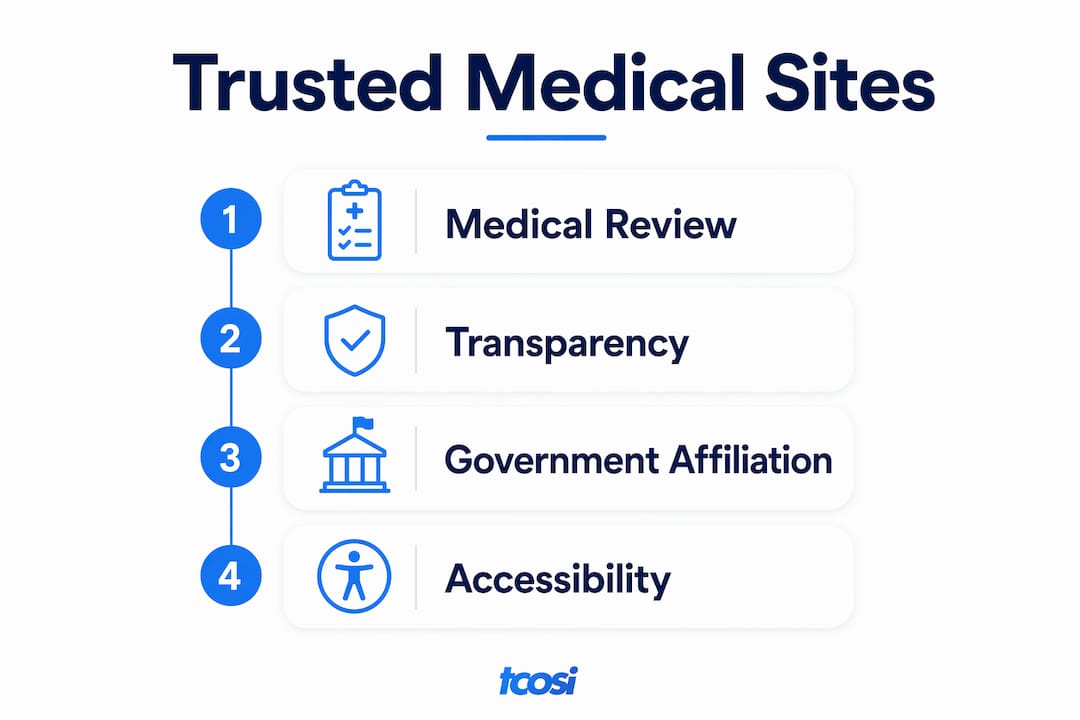
Medical reviewer networks are the backbone of content accuracy on commercial health platforms. Physicians, pharmacists, and specialists review articles before publication and on a scheduled basis afterward. This process catches outdated claims before they reach readers.
Academic medical centers like Mayo Clinic and Cleveland Clinic go a step further. Their content is written by clinicians who treat patients daily, so the information reflects real clinical practice rather than a generalist’s summary. That connection to active patient care is hard to replicate.
Transparency in sourcing is another marker of quality. The best sites cite the studies and guidelines they draw from, so you can follow the chain back to the primary research. Sites that make claims without citations are asking you to take their word for it.
Government affiliation, as with MedlinePlus and the CDC, removes commercial incentive from the equation entirely. These organizations publish health information as a public service, which means their editorial decisions are not influenced by advertising revenue or product sales.
Finally, website accessibility matters too. A trustworthy medical site is built so that people with disabilities can use it, including those relying on screen readers or keyboard navigation.
Building a medical website? Here is what the design needs to get right.
If you are a healthcare provider or health organization looking to create a medical website that patients actually trust, the design and technical foundation matter as much as the content. Readers judge credibility partly on how a site looks and functions. A slow, cluttered, or hard-to-navigate site signals carelessness, even when the content is solid.
tcosi builds custom WordPress websites for healthcare providers and medical organizations, with attention to clean design, mobile performance, and the kind of clear information architecture that helps patients find what they need fast. If your current site is not working as hard as it should, that is worth a conversation.
Key Takeaways
The most credible medical websites combine government or academic authority, active medical review, and transparent editorial policies to deliver health information you can rely on.
| Point | Details |
|---|---|
| Government sites lead on trust | MedlinePlus and CDC are non-commercial, evidence-based, and free from advertising influence. |
| Academic centers offer clinical depth | Mayo Clinic invests $660 million annually in research, backing its patient education content. |
| Reviewer networks ensure accuracy | Healthline employs over 130 medical reviewers to vet content before it reaches readers. |
| Accreditation signals quality | HONcode and URAC certifications indicate a site meets recognized ethics and accuracy standards. |
| Peer-reviewed beats user-generated | Clinically reviewed articles are more reliable than forum posts or unattributed testimonials. |
FAQ
Which is the best medical website overall?
MedlinePlus is widely considered the most credible starting point. It is a service of the National Library of Medicine, part of NIH, and carries no advertising or commercial bias.
What is the most trustworthy source for medical information online?
Government and academic sites, specifically MedlinePlus, the CDC, Mayo Clinic, and Cleveland Clinic, consistently rank as the most reliable. They combine expert authorship, regular updates, and transparent editorial standards.
What is a good health website for everyday questions?
Healthline and WebMD are both strong options for general health questions. Both maintain active medical review boards and publish clearly labeled, regularly updated content.
How do you know if a medical website is reliable?
Check for a .gov or .edu domain, a named medical review board, a visible editorial policy, and a clear date showing when the content was last reviewed. Accreditation seals like HONcode add an extra layer of verification.