There is no single app that replaces Facebook. The best alternative depends on which job you need done: reaching local customers, networking with other professionals, running a community, or owning your audience outright. For most small businesses, the strongest setup is one or two social platforms that match your customers, plus a website you control.
I build websites for small businesses, so I hear this question often. Usually it comes from an owner who is tired of an algorithm that hides their posts, worried about a locked account, or just done with the noise. Below I compare the real options honestly, including where Facebook is still hard to beat.
TL;DR
- Facebook is really several tools in one (feed, groups, events, Marketplace, Messenger, photos), so you replace it one job at a time, not with one app.
- For local reach, look at Nextdoor. For B2B, LinkedIn. For broad text-based reach, Threads, Bluesky and Mastodon. For privacy-first communities, Mastodon or Friendica.
- Facebook is still huge in the U.S., so most businesses should diversify rather than leave entirely.
- The one alternative nobody can take away from you is your own WordPress website and email list.
Table of Contents
- Why Facebook is hard to replace
- Quick comparison of Facebook alternatives
- Alternatives for reaching local customers
- Alternatives for B2B and professional audiences
- Alternatives for broad reach
- Alternatives for privacy and ownership
- Replacing Facebook Groups and communities
- What I recommend for most small businesses
- Our perspective on owning your online presence
- Why your website is the best alternative
- How tcosi can help
- How to choose: a five-step process
- FAQ
- Sources
Why Facebook is hard to replace
Facebook is still one of the most used platforms in America. Pew Research Center reports that 71% of U.S. adults say they use it, second only to YouTube. Use is highest among adults 30 to 49, at 80%. Those are the people who often hire local service providers, professional firms and agencies.
That is why “quit Facebook” is rarely good advice for a business. The better question is how much of your marketing should depend on it. Ethical.net points out that Facebook is really six apps in one: a friends and family feed, groups, events, Marketplace, Messenger and photos. Each alternative tends to take over one or two of those jobs.
So before you compare platforms, write down what you actually use Facebook for. Most owners find the list is short:
- Being found by local customers
- Sharing updates and photos of your work
- Running a group or community
- Promoting events or offers
- Answering questions by message
Each item on that list has a different best alternative.
Quick comparison of Facebook alternatives
| Option | Best for | Main trade-off |
|---|---|---|
| Nextdoor | Local service businesses | Limited to neighborhoods |
| B2B, professional firms, recruiting | Not built for casual or consumer content | |
| Threads | Broad reach, text-first posting | Feed is algorithmic and you do not control it |
| Bluesky | Conversation-driven, newer audience | Smaller audience than Threads |
| Mastodon | Privacy-minded, ad-free communities | Reach works differently, server choice matters |
| Friendica | Facebook-style features on a federated network | Small audience, more technical |
| Interest-based communities | Not for personal branding or quick promotion | |
| Your own website | Ownership, search traffic, leads | Takes planning and upkeep |
Alternatives for reaching local customers
Nextdoor
If you run a plumbing company, a landscaping crew or a bakery, your customers are your neighbors. Nextdoor is built around that idea: neighborhood updates, recommendations and local events. Brafton’s roundup lists it as the pick for local communities, with the obvious limit that it only works within geographic areas.
That limit is also the strength. You are not competing for attention with the entire internet, just with other businesses in your service area. If recommendations from neighbors drive your sales, this is worth a serious test.
Your Google Business Profile and website
Many local searches never touch social media. A person types “electrician near me” and picks from the results. A fast, clear website with real service pages and a complete business listing does more for those customers than a Facebook post that disappears in a day. I come back to this near the end because it is the part you fully control.
Alternatives for B2B and professional audiences
For selling to other businesses, LinkedIn is the standard. SocialKit’s 2026 comparison cites a member base of 1.2 billion and a focus on professional content. If you are an accountant, consultant, agency or law firm, your buyers are more likely to be reading there than scrolling Facebook on a Sunday.
A good rule: post what you would say in a client meeting. Short lessons from real projects, before and after stories, and answers to questions clients ask. Skip the generic motivational graphics.
Professional networking also pays off beyond any one platform. This piece on why networking matters for marketing growth is a useful read if you are deciding between consumer reach and a professional audience.
Reddit works for niche topics where people ask for advice. Treat it as a place to help, not to advertise. Communities tend to reject anything that reads like a pitch. It can build trust slowly, but it is a poor fit if you need quick leads.
Alternatives for broad reach
Threads, Bluesky and Mastodon
These three share a text-first format. According to SocialKit, Threads is the biggest audience of the three, with an estimated 400 to 450 million monthly active users in 2026 and an Instagram-style recommendation feed. Bluesky sits in the middle, with a conversation-heavy audience. Mastodon is the smallest but the most independent.

The same source notes that because the formats are so similar, the same core post often works on all three with small edits. Its suggestion is simple: post to all three and see where engagement actually lands. I like that approach because it treats platforms as experiments, not commitments.
Alternatives for privacy and ownership
Mastodon
Mastodon is a non-profit, ad-free network with a chronological feed. Ethical Consumer gave it a privacy score of 80 out of 100 in 2026. It is part of the Fediverse, a group of connected platforms that use the ActivityPub protocol, so a post on one service can often be seen by people on others.
Two things to know before you join:
- You join a server, not just a platform. Each server has its own rules and moderation. Mastodon’s documentation explains that you can move your followers later, but your past posts generally do not come with you.
- Reach looks different. There is no algorithm pushing your content, so the numbers you are used to from Facebook will not map over directly.
Friendica
Friendica is the closest to a Facebook-style experience on this list. Its feature list includes status updates, photo albums, an events calendar, and the ability to show different profiles to different people. It also supports self-hosting your own node, which gives you full control of your data. That is a real option for technical teams, but most small businesses will not want to run a server.
The business model matters
Ethical.net notes that Facebook makes money from advertisers who want your audience’s attention, while many alternatives are funded by donations, memberships or non-profit foundations. For a business, that changes the feel of a platform. Ad-free networks are friendlier to community, but they usually offer fewer tools to promote yourself and a smaller audience to promote to.
Replacing Facebook Groups and communities
Some owners are not leaving Facebook as a marketing channel. They are leaving Facebook Groups because they want a branded space for customers, members or students. Several community platforms exist for this, and the roundups that Circle, Disciple and GroupApp publish compare many of them. I will not rank them here, since each one is built for a different kind of community.
What I would check on any of them:
- Can members join without already having an account on a big platform?
- Can you export your member list?
- Does it connect to your website so a visitor can find it?
- What does it cost per month as the group grows?
If you cannot export your members, you have just traded one walled garden for another.
What I recommend for most small businesses
Here is the setup I suggest to most clients:
- Pick one platform where your customers already are. Local customers: Nextdoor or Facebook. Business buyers: LinkedIn.
- Add one experiment. Try Threads or Bluesky for a few months and watch the results.
- Keep Facebook if it still works for you. About half of U.S. adults visit it daily, according to Pew, so abandoning it can cost real customers.
- Put your website at the center. Every post, profile and bio should lead back to it.
- Collect emails. A newsletter list is an audience no algorithm can reduce.
Our perspective on owning your online presence
We build websites for a living, so we are biased, but we have seen the same story many times. A business grows a large following on a social platform, the platform changes its rules or an account gets restricted, and the owner realizes they have no direct line to their own customers.
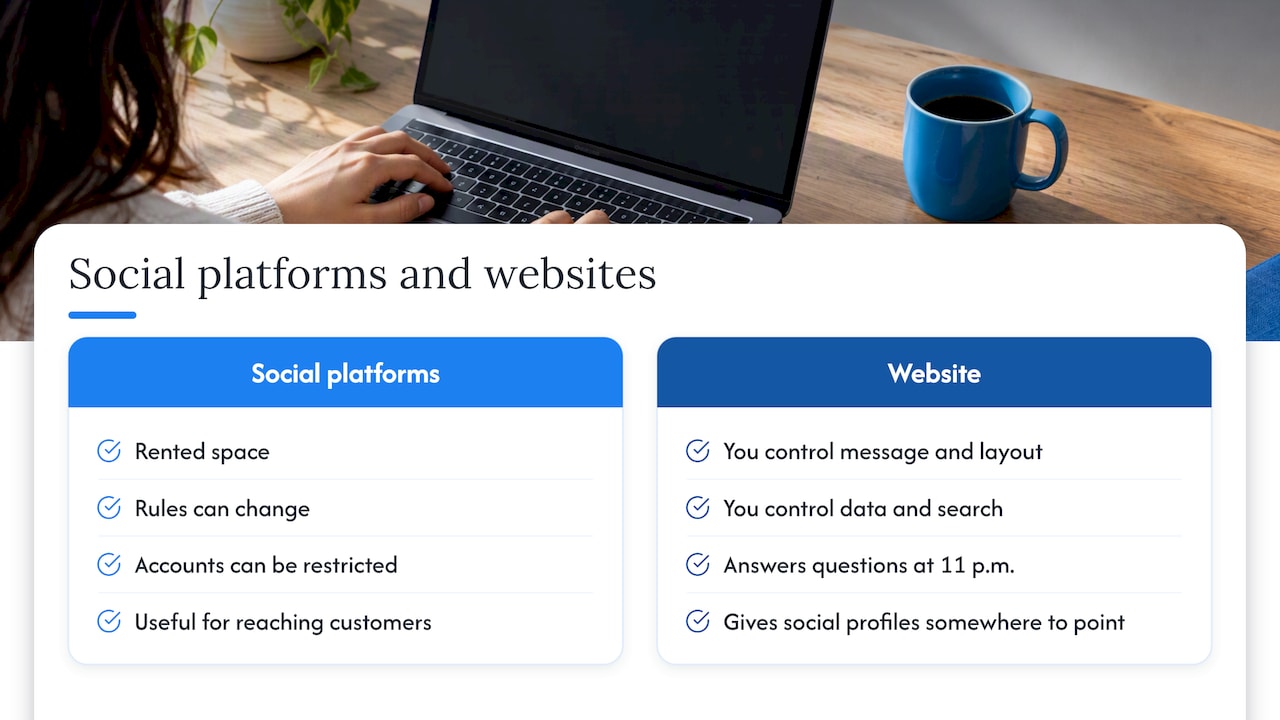
Social platforms are rented space. They are useful, and we do not tell clients to avoid them. But the website is the one place where you decide the message, the layout, the data and the search presence. When it is built well on WordPress, it also does the quiet work of answering questions at 11 p.m. when nobody is online.
What we focus on is making that process clear. Many owners tell us the technical side feels like a wall between them and their own business. Our job is to take that wall down, explain choices in plain language and build something that lasts. A website does not have to compete with your social profiles. It gives them somewhere to point.
— Tommy Cosimano
Why your website is the best alternative
A website does what no social platform can promise:
- Ownership. Your content, design and customer data stay yours.
- Search traffic. People find you through Google without you posting daily. Our WordPress SEO checklist covers the first steps.
- Credibility. Buyers often check a website before they trust a social profile. Our small business marketing guide shows how the pieces fit together.
- Stability. You choose when to change things, not an algorithm update.
You do not need a huge site. A clear home page, service pages, contact details and a way to collect emails is enough to start.
How tcosi can help
If you are ready to build the home base, I offer packaged WordPress projects with published pricing on our website pricing page:
- Base Website: $875 one-off
- Essentials: $1,200 one-off
- Growth: $2,400 one-off
- Premium: $4,800 one-off
SEO Setup is $375 one-off, and Ongoing Maintenance is $100 per month if you want someone watching updates, plugins and security after launch. If you are not sure which package fits, start with a conversation through tcosi.com and tell me what your Facebook page does for you today. We will build around that.
How to choose: a five-step process
- List your Facebook jobs. Write down what you use it for and which of those actually bring in customers.
- Check where your customers spend time. Ask five recent customers how they found you.
- Choose a primary and a test platform. Do not spread across six at once.
- Set a review date. After 90 days, look at inquiries, not likes.
- Connect everything to your website. Make sure every profile links to a page built to turn visitors into leads.
FAQ
What do millennials use instead of Facebook?
Many still use it. Pew found that 80% of adults aged 30 to 49 use Facebook, a range that covers most millennials. Those who have moved on tend to spread across Instagram, YouTube and other platforms, so it is more a mix than a single replacement.
What is the best open source alternative to Facebook?
For a Facebook-like feature set, Friendica is the strongest open source option, with photo albums, events and fine-grained privacy controls. Mastodon is the more popular open source choice and is simpler to join. Both run on the Fediverse, so they can interact with each other.
Can a business replace Facebook with just one platform?
Usually not. Facebook combines a feed, groups, events, Marketplace and messaging, and alternatives tend to cover only part of that. Most businesses do better choosing a main platform for their audience and backing it with their own website.
Is it safe to leave Facebook entirely?
It depends on where your customers are. If a large share of your leads come from Facebook, cut back gradually and track what changes before deleting anything. Download your photos and content first, and make sure your website and email list are in place.
Sources
- Americans’ Social Media Use 2025, Pew Research Center
- Americans’ Social Media report (PDF), Pew Research Center
- Facebook alternatives: the most ethical social networks, Ethical.net
- Social Media Platforms, Ethical Consumer
- Threads vs Bluesky vs Mastodon (2026), SocialKit
- Mastodon documentation
- Features, Friendica
- 7 Facebook Alternatives, Brafton