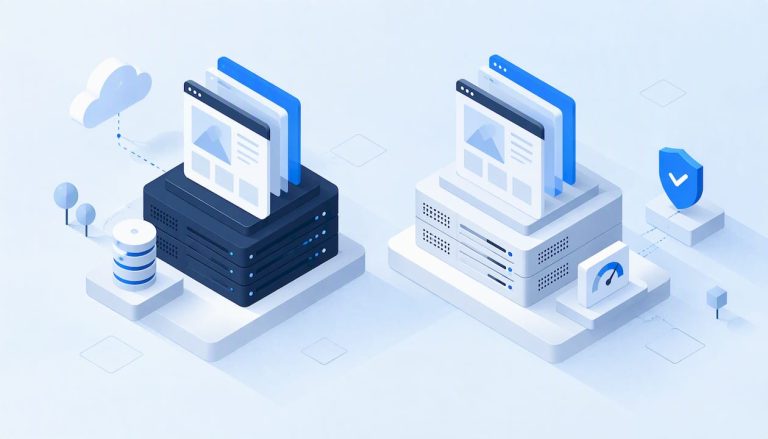
If you are comparing a DIY website builder to hiring a professional web developer, the real question is not just which option gets you online faster. It is which option gives your business the right foundation for growth, visibility, and long-term flexibility.
For some businesses, a template-based builder is enough to get started. For others, it quickly becomes a limitation. Below is a clear breakdown of the differences in cost, SEO, customization, performance, and long-term value so you can decide which direction makes the most sense for your business.
Quick answer: A DIY website builder can work well for a simple site or early-stage business, but hiring a web developer is usually the stronger choice if your website needs to support SEO, lead generation, custom functionality, or long-term growth.
At a Glance: DIY Website Builder vs Hiring a Web Developer
Before getting into the details, here is the simplest way to look at it. DIY builders prioritize speed and convenience. A professional developer prioritizes strategy, flexibility, and performance. Neither is automatically wrong, but they solve very different problems.
| Category | DIY Website Builder | Professional Web Developer |
|---|---|---|
| Upfront Cost | Lower initial investment | Higher initial investment |
| Ease of Setup | Fast and beginner-friendly | Takes more planning and collaboration |
| Customization | Limited to platform templates and built-in features | Tailored to your brand, goals, and workflow |
| SEO Potential | Basic controls, but more technical limitations | Stronger technical foundation and better long-term SEO flexibility |
| Performance | Can be slowed down by heavier platform code | Can be optimized intentionally for speed and usability |
| Scalability | Can become restrictive as needs grow | Built to expand with your business |
| Support | General platform support | Direct support from the person building the site |
What a DIY Website Builder Does Well
DIY website builders such as Wix, Squarespace, Shopify, or other drag-and-drop platforms are designed to help people launch a site without needing design or development experience. That convenience is the main reason they appeal to so many small businesses. You can choose a template, swap in your content, and get online fairly quickly.
That speed can absolutely be valuable. If you are testing a business idea, building a temporary landing page, or simply need a very basic online presence, a DIY platform can be a practical first step. It lowers the barrier to entry and gives you control over simple edits without needing outside help.
Main Advantages
- Lower upfront cost
- Fast launch for a simple site
- No coding knowledge required
- Easy to handle basic text and image updates
Where It Starts to Fall Short
- Limited design flexibility
- Restrictions around advanced functionality
- Harder to stand out from template-based competitors
- Can become more expensive as add-ons pile up
What Changes When You Hire a Web Developer
Hiring a web developer is not just about having someone build pages for you. It changes the whole approach. Instead of asking, “Which template is closest to what I want?” the question becomes, “What does my business actually need this website to do?”
That shift matters. A professional website can be planned around your content, your customer journey, your service structure, and your long-term growth goals. Rather than bending your business to fit the builder, the site is designed to fit the business.
This is usually where the value becomes clearer for businesses that care about lead generation, stronger branding, SEO, or a more polished user experience. A custom build gives you more room to shape the site intentionally instead of working around the boundaries of a platform.
The Cost Difference: Cheap Upfront vs Better Long-Term Value
One of the biggest reasons business owners lean toward DIY website builders is cost. On paper, it often looks like the more affordable option. In the short term, that is usually true. A builder gives you a monthly subscription, a template, and enough tools to launch something without a large upfront investment.
The issue is that the lower entry cost does not always mean lower cost overall. Premium templates, paid apps, upgraded plans, transaction fees, and third-party tools can add up quickly. Even more importantly, your own time has value. If you spend hours trying to force a platform to do something it was never built to do, that cost should count too.
Hiring a web developer usually requires a larger investment upfront, but the result is a site built with more intention from the start. When done well, it can save time, reduce future rework, and support better results over the long run.
DIY Costs Often Include
- Monthly platform subscription
- Premium templates or themes
- Paid apps or plugin-like add-ons
- Extra fees for e-commerce or advanced features
- Your time spent learning, troubleshooting, and rebuilding
Developer Costs Often Include
- Strategy and planning
- Custom design and development
- Testing and launch support
- Hosting and optional maintenance
- A site designed to perform better and scale more cleanly
SEO and Performance: This Is Where the Gap Gets Bigger
If your website only needs to exist, a DIY builder may be enough. If your website needs to attract search traffic, generate leads, and support real business growth, SEO and performance become much more important.
Most DIY website builders offer the basics. You can usually edit page titles, meta descriptions, and image alt text. That is helpful, but it is only part of the picture. Technical SEO also depends on page speed, clean markup, heading structure, crawlability, internal linking, and how well the overall site is organized.
This is where professional development tends to create a stronger foundation. A custom-built site can be structured more intentionally, optimized more aggressively, and designed with search visibility in mind from the beginning. That does not guarantee rankings, of course, but it does remove a lot of the limitations that can hold a site back.
| SEO / Performance Factor | DIY Website Builder | Professional Web Developer |
|---|---|---|
| Page Speed | Can be decent, but often affected by platform bloat | Can be optimized more intentionally for load speed |
| Technical SEO | Basic built-in controls | Greater flexibility around structure, markup, and architecture |
| Content Structure | Often limited by the editor and theme framework | Built around a stronger content hierarchy and search intent |
| Future Optimization | More platform restrictions over time | Easier to expand and refine as SEO strategy evolves |
Customization and Scalability
This is often the point where many businesses outgrow a DIY site. In the beginning, a template may seem close enough. But once you want more control over layout, more advanced functionality, or a more intentional content experience, the limitations become obvious.
That could mean needing custom page structures, dynamic sections, stronger service pages, more refined mobile design, or integrations that support how your business actually operates. These are the kinds of things that are much easier to plan and build properly when the site is being developed around your needs rather than squeezed into a preset system.
If your website is meant to stay simple, that may not matter. But if the site is expected to grow with the business, scalability should absolutely be part of the decision.
When a DIY Website Builder Makes Sense
A DIY website builder is often a smart choice when simplicity matters more than flexibility. That may be the case if you are just starting out, validating an idea, or trying to launch a basic site as quickly as possible without a major investment.
- You need a simple online presence fast.
- Your budget is very limited right now.
- You are comfortable working within templates.
- You do not need advanced SEO, custom functionality, or a highly strategic site structure yet.
When Hiring a Web Developer Is the Better Move
Hiring a web developer becomes the stronger option when your website needs to play a more serious role in the business. If the site is meant to help you rank, convert, support a more refined brand presence, or scale over time, professional development usually delivers much more value.
- Your site needs to generate leads, not just exist online.
- You care about stronger SEO and performance.
- You want a more custom design or user experience.
- You need functionality beyond what a template builder handles well.
- You would rather have the site built right from the start instead of rebuilding later.
Final Verdict: Which Option Is Right for You?
If your goal is to get something online quickly and keep costs low at the beginning, a DIY website builder can absolutely be the right move. It gives you a practical way to launch without a large commitment.
If your website is meant to be a serious business asset, though, hiring a web developer is usually the better long-term decision. You gain more control, better scalability, a stronger SEO foundation, and a site that is built around your business instead of around a template.
In many cases, the real difference is this: a DIY builder helps you launch a website, while a professional developer helps you build a platform your business can actually grow on.
Frequently Asked Questions
Is it cheaper to build your own website?
It is usually cheaper upfront, but not always cheaper long-term. DIY website builders can become more expensive over time once you factor in premium plans, add-ons, third-party tools, and the time spent trying to work around platform limitations.
Can a DIY website rank on Google?
Yes, a DIY website can rank on Google, especially for lower-competition searches. The challenge is that many website builders place more limits on performance, structure, and technical SEO than a professionally developed site would.
When should I hire a web developer instead of using a website builder?
You should consider hiring a web developer when your website needs to support stronger branding, SEO, lead generation, custom functionality, or long-term growth. That is usually the point where a template-based solution starts to feel restrictive.
Need a Website That Is Built to Grow With Your Business?
If you are weighing your options and trying to decide whether a DIY site is enough or whether it is time to invest in something more strategic, that is exactly the kind of conversation worth having early.
I work one-on-one with businesses to plan and build custom WordPress websites that are designed for performance, usability, and long-term growth. The goal is not to overcomplicate things. It is to build the right website for where your business is now and where you want it to go next.