
For most U.S. business owners, the best starting point is a vetted small WordPress agency or a senior freelance WordPress designer with custom-theme experience. You get professional deliverables, clear communication, and a site built to support real growth — not just a template with your logo dropped in.
Here is a quick shortlist to get you oriented:
- Top pick: Small WordPress design agency — the right fit for most business owners who want a defined process, reliable communication, and post-launch support baked in from day one.
- Alternative 1: Senior freelance WordPress developer — a strong choice when budget is tighter and you have a clear, well-scoped project with no need for an ongoing team.
- Alternative 2: Specialist agency for complex builds — the right call for membership sites, e-commerce, or custom integrations that require a full team and structured QA.
Your immediate next step: request a portfolio and a rough project timeline from at least two options before committing to anyone.
Table of Contents
- Which WordPress designer option fits your business?
- What each option actually looks like in practice
- How do you choose the right WordPress designer?
- What does hiring a WordPress designer typically cost?
- What does a WordPress designer do, and is WordPress the right choice?
- How tcosi approaches WordPress design and development
- Key Takeaways
- Agency partner or solo contractor: which one actually serves you better?
- Work with tcosi on your next WordPress project
- Useful sources and further reading
- FAQ
Which WordPress designer option fits your business?
The table below maps each shortlisted option to the situations where it tends to perform best.
| Option | Best for | Pricing model | Timeline (small / medium / large) | Ongoing support | Where to hire |
|---|---|---|---|---|---|
| Small WordPress agency | Most small-to-mid-size businesses, service firms, local brands | Fixed-fee packages or scoped retainer | 3–4 weeks / 6–10 weeks / 12+ weeks | Usually included or available as add-on | Direct agency website |
| Senior freelance WordPress designer | Lean budgets, well-defined single projects | Hourly or fixed-fee | Weeks to a few months depending on project size | Varies; often limited or project-only | Freelancer platforms, referrals |
| Specialist agency (complex builds) | E-commerce, membership, custom integrations | Scoped fixed-fee or retainer | Several weeks to multiple months depending on project size | Structured maintenance plans | Direct agency or agency partner |
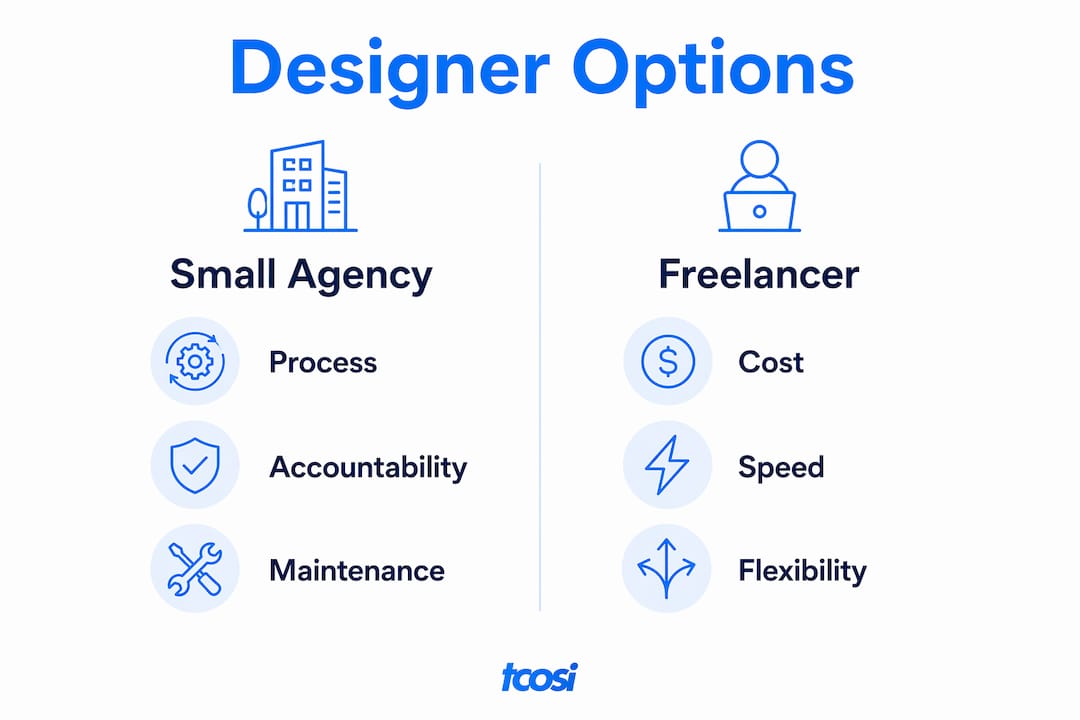
The small WordPress agency wins most often for business owners because it combines a defined process with accountability. You have a named contact, a clear scope document, and someone to call after launch. That last part matters more than most owners realize until something breaks.
What each option actually looks like in practice
Small WordPress agency
A small agency engagement typically starts with a discovery call, moves into a design phase with mockups for your review, then development, QA, and launch. Deliverables usually include a custom or semi-custom theme, mobile-responsive layouts, basic SEO setup, and a CMS your team can actually edit without calling a developer every week.

Portfolio signs to look for: service-firm websites, local business sites, and landing pages with clear calls to action. Watch for custom WordPress themes built for specific industries rather than generic templates reskinned with a logo swap.
Trade-offs: slightly higher cost than a solo freelancer, but you get process, accountability, and usually a maintenance option. The scope document matters here. A good agency will hand you one before you sign anything.
Senior freelance WordPress designer
A strong freelancer can move fast and keep costs lean. They tend to work best when you arrive with a clear brief: you know your pages, your goals, and your content. The risk is availability. A solo practitioner juggling multiple clients may slow down mid-project, and post-launch support can be informal or nonexistent.
Portfolio signs to look for: clean, performance-focused builds, evidence of custom theme development rather than just page-builder work, and client sites that load quickly. Ask specifically whether they build custom themes or rely on premium theme frameworks.
Trade-offs: lower cost, faster start, but less structured process and often no formal maintenance plan.
Specialist agency for complex builds
When your project involves WooCommerce, a membership system, API integrations, or a large content library, you need a team. A specialist agency brings a project manager, a designer, a developer, and a QA reviewer. Deliverables include technical architecture planning, staging environments, performance testing, and structured handoff documentation.
Portfolio signs to look for: e-commerce sites, multi-role membership platforms, and sites with visible custom block or ACF-driven layouts. ACF (Advanced Custom Fields) lets agencies build complex, repeatable content layouts that non-technical editors can manage without touching code.
Trade-offs: higher investment, longer timeline, but the right tool for the job when complexity is real.
How do you choose the right WordPress designer?
Work through this checklist before you sign a contract.
Business fit
- Does their portfolio include sites in your industry or of similar complexity?
- Can they explain their process in plain language, without jargon?
- Do they offer a defined scope document before work begins?
- Are their timelines realistic for your launch date?
Technical fit
- Do they build custom WordPress themes or rely on premium theme frameworks? (Both can be valid — you want to know which and why.)
- Can they explain how they handle the WordPress template hierarchy? A designer who understands which template file controls which page type is operating at a professional level.
- Do they use ACF or similar tools to make the CMS editable for non-technical users?
- Do they follow secure coding practices — escaping output and sanitizing inputs — before pushing to production?
Process and communication
- How do they handle client feedback rounds? How many revisions are included?
- Do they use a staging environment before going live?
- What project management tools do they use to keep you informed? Vendors who use WordPress-native collaboration tools or shared project boards give you real visibility into progress.
Post-launch support and pricing
- Do they offer a maintenance plan, or does support end at launch?
- Is pricing clearly published or provided in writing before you commit?
- Are there clear terms around scope changes and additional costs?
Red flags: vague timelines with no phases, no written scope, portfolio with no real client sites, and pressure to sign quickly.
Pro Tip: Ask any candidate to walk you through their staging and deployment workflow. Experienced practitioners describe this clearly in two or three sentences. A vague or confused answer is a reliable signal that their process is equally loose in practice.
What does hiring a WordPress designer typically cost?
Pricing varies widely by scope, experience level, and whether you hire a freelancer or an agency. Here is how the common models break down.
Pricing models
- Fixed-fee package: A defined scope with a set price. Best for projects with clear deliverables. Prevents scope creep when the contract is written well.
- Hourly rate: Common with freelancers. Flexible, but harder to budget. Works best for small, well-defined tasks.
- Retainer (ongoing support): A monthly agreement for maintenance, updates, and ongoing changes. Worth it for businesses that update their site regularly or need someone on call.
tcosi publishes website pricing guidance directly on its site, which is a good benchmark for understanding what a transparent agency looks like.
Project phases and what each delivers
| Phase | Typical deliverables |
|---|---|
| Discovery | Goals, sitemap, content inventory, technical requirements |
| Design | Wireframes, mockups, brand alignment, UX review |
| Development | Theme build, plugin setup, content entry, mobile optimization |
| QA | Cross-browser testing, performance check, form testing, security review |
| Launch | DNS transfer, final checks, go-live |
| Post-launch maintenance | Updates, backups, uptime monitoring, content changes |
Timeline by project scope
- Small (landing page or marketing site): short-term project timeline
- Medium (multi-page business site): medium-term project timeline
- Large (e-commerce, membership, custom integrations): long-term project timeline
Scope creep is the most common reason projects run over budget and over time. A clear scope document, signed before work begins, is the single best protection against it.
What does a WordPress designer do, and is WordPress the right choice?
A WordPress developer handles both front-end and back-end work: design mockups, custom theme or template setup, block and ACF integration, performance tuning, launch, and optional ongoing maintenance. The role covers more ground than most business owners expect.
When WordPress is the right platform
- You need a site you fully own, including the code and hosting.
- Your content is complex: multiple post types, custom layouts, or a large archive.
- You want extensibility — the ability to add e-commerce, memberships, or integrations later.
- SEO is a priority. WordPress gives you fine-grained control over technical SEO elements.
- You want a CMS your team can edit without a developer for routine updates.
When a simpler site builder might fit
- You need a basic brochure site with five or fewer pages and no plans to expand.
- Speed of setup matters more than long-term flexibility.
- You have no developer on call and want a fully managed, drag-and-drop experience.
For most growing businesses, WordPress wins on flexibility and ownership. The trade-off is that it requires a competent designer to set up correctly.
WordPress pros and cons at a glance
| Factor | WordPress | Simple site builder |
|---|---|---|
| Customization | High — custom themes, blocks, plugins | Limited to platform templates |
| Code and data ownership | Full ownership | Platform-dependent |
| Cost to extend | Varies; plugins and dev time | Usually subscription-based add-ons |
| Editing friendliness | Good with proper CMS setup (ACF, Gutenberg) | Very easy out of the box |
Block themes with theme.json improve editor-driven customization for clients, but many professional projects still use classic or hybrid themes for precise control over complex integrations. Both approaches are valid in 2026. What matters is that your designer can explain the choice.
How tcosi approaches WordPress design and development
tcosi is a U.S.-based WordPress design and development agency founded by Tommy Cosimano. The focus is on custom WordPress websites, redesigns, and ongoing support for businesses across the country — from local service providers and professional firms to nonprofits and marketing agencies.
The process runs in clear phases:
- Discovery: Goals, sitemap, content review, and technical requirements defined upfront.
- Design: Mockups built around your brand, reviewed and approved before development starts.
- Development: Custom theme or template build, plugin configuration, mobile optimization, and CMS setup so your team can make edits without developer help.
- QA: Cross-browser testing, performance review, form testing, and a security check before anything goes live.
- Launch: DNS transfer, final review, and go-live with a sharp eye on the details.
- Maintenance: Ongoing updates, backups, and support so the site keeps working after launch day.
Portfolio types tcosi works across include service-firm websites, local business sites, nonprofit pages, and marketing agency white-label builds. Trust signals include a defined process, published pricing, and direct communication with Tommy throughout the project.
Pro Tip: Before your first call with any designer, prepare a short list: your goals, your target audience, three sites you like the look of, and your rough launch date. That 10-minute prep makes the conversation twice as productive.
To get started, visit tcosi.com or review the website development services page to understand scope and next steps.
Key Takeaways
For most U.S. business owners, a vetted small WordPress agency delivers the best combination of process, accountability, and post-launch support compared to hiring a solo freelancer or a large enterprise firm.
| Point | Details |
|---|---|
| Start with a clear shortlist | Evaluate a small agency, a senior freelancer, and a specialist agency before deciding. |
| Request portfolio and timeline first | Ask for real client sites and a phase-by-phase timeline before signing anything. |
| Confirm post-launch support | A maintenance plan should be part of the conversation, not an afterthought. |
| Scope document prevents overruns | A written scope signed before work begins is your best protection against cost and timeline creep. |
| tcosi as a U.S. option | tcosi offers a defined process, published pricing, and direct communication for businesses across the United States. |
Agency partner or solo contractor: which one actually serves you better?
Most business owners frame this as a cost question. It is really a risk question.
A solo freelance WordPress designer can do excellent work. The problem is single points of failure. If they get sick, take on a bigger client, or simply go quiet mid-project, you have limited recourse. There is no team to absorb the gap. For a one-time, well-scoped project with a flexible timeline, that risk is manageable. For anything tied to a product launch, a seasonal campaign, or a site that needs to stay live and updated, it is a real exposure.
An agency partner brings structure. You get a defined process, a contact who is accountable, and usually a maintenance option that keeps the relationship going after launch. The cost is higher, but the reliability tends to justify it for businesses that depend on their website to generate leads or serve customers.
The decision point I see most often: owners choose a freelancer to save money, then spend more fixing problems six months later because there was no QA phase, no staging environment, and no one to call. A site built right the first time, with a maintenance plan attached, costs less over three years than a cheap build followed by two emergency repairs.
If your website is a core part of how you get business, treat it like one.
Work with tcosi on your next WordPress project
Most business owners searching for a WordPress web designer want the same thing: a site that looks professional, works reliably, and does not require a developer to update a phone number. tcosi delivers exactly that, with a process that is clear from the first conversation to the final launch.
An initial conversation with tcosi covers your goals, a rough scope, a realistic timeline, and what ongoing support would look like for your situation. No pressure, no vague estimates. You can browse the top custom WordPress agencies page to see how tcosi compares, or go straight to the website pricing page to get a sense of what a project like yours typically costs. When you are ready to talk, reach out at tcosi.com/contact.
Useful sources and further reading
These resources are worth bookmarking before you hire anyone. Each one helps you ask smarter questions or understand what good WordPress work actually looks like under the hood.
- Coursera: What Does a WordPress Developer Do? — A clear breakdown of the front-end and back-end scope of a WordPress developer role. Good for understanding what you are actually buying.
- WP Pioneer: Build a Custom WordPress Theme From Scratch — Covers classic and block theme approaches, template hierarchy, and security basics. Useful for vetting a designer’s technical depth.
- Advanced Custom Fields: Building WordPress Custom Themes — Explains how ACF enables modular, editor-friendly layouts. Ask your designer if they use it and why.
- GrowthPlugins: WordPress Project Collaboration — Shows how Kanban and time-tracking tools inside WordPress can give you real visibility into a project’s progress.
- tcosi: How to Build a Professional Business Website Fast — A practical guide from tcosi to help you prepare for an agency conversation and set realistic expectations.
- tcosi: Website Pricing — Published scope and pricing guidance. A useful benchmark for what transparent agency pricing looks like.
- tcosi: Why Websites Need Ongoing Optimization — Makes the case for post-launch maintenance and explains what ongoing optimization actually involves.
- tcosi: How to Choose the Right Web Designer in 2026 — A companion guide to the vetting checklist in this article, with additional criteria and questions to ask.
FAQ
What does a WordPress designer do?
A WordPress designer handles design mockups, custom theme or template setup, plugin configuration, mobile optimization, and launch. According to Coursera, the role spans both front-end and back-end work, including theme development and plugin integrations.
How much does it cost to hire a WordPress designer?
Costs vary by scope and experience level. Small agencies and senior freelancers typically offer fixed-fee packages for defined projects, with ongoing support available as a monthly retainer. tcosi publishes pricing guidance directly on its website for business owners who want a concrete starting point.
Is WordPress still worth it in 2026?
Yes, for most business websites. WordPress gives you full ownership of your code and hosting, strong extensibility, and fine-grained SEO control. Both classic PHP themes and block themes with theme.json remain valid professional approaches in 2026.
Why are some businesses moving away from WordPress?
The most common reason is complexity. WordPress requires a competent setup to run well, and owners who built their own sites without professional help often find maintenance and updates harder than expected. A well-built WordPress site managed by a professional does not have these problems.
How do I vet a WordPress designer before hiring?
Request a portfolio of real client sites, ask for a written scope document before signing, and ask them to explain their staging and deployment workflow. A clear, confident answer to that last question is one of the most reliable signals of an experienced practitioner.