For most small businesses, Namecheap is the better pick for a domain name, mainly because of lower renewals and free privacy on eligible domains. GoDaddy makes more sense if you want phone support and one company for everything. Still, the domain is the cheapest part of getting online. The site built on it, and how well it is kept up, decides whether it brings in customers.
Below is a plain comparison on the things that matter to a business owner: price over several years, renewals, privacy, hosting plans, support and policy changes. Then I’ll show where the money really goes once the domain is bought.
TL;DR
- Domains: Namecheap is cheaper to keep over time. GoDaddy’s low first-year offers are followed by a higher regular renewal.
- Hosting: Both advertise low entry prices that jump at renewal, so compare the renewal price, not the headline.
- Support: GoDaddy lists 24/7 phone support. Namecheap offers 24/7 chat and email, but no phone line.
- Bigger picture: A domain costs about $20 a year. A professional WordPress site and its upkeep are the real investment.
Table of Contents
- The short answer: which should you pick?
- Domain prices: first year versus the year after
- Privacy, transfers and policy changes
- Hosting: compare the renewal, not the banner
- Support: phone versus chat
- A quick checklist before you buy
- Where the real cost is
- Our approach: buy the domain, then build something worth visiting
- What tcosi offers once your domain is ready
- FAQ
- Sources
The short answer: which should you pick?
Pick Namecheap if you want one or a few business domains, a clean dashboard and a lower long-term cost. A U.S. comparison from WebChoiceDesk, updated in October 2026, reaches the same conclusion for most buyers who mainly want a registrar. It cites the lower .com renewal, free privacy on eligible domains and a domain-focused interface.
Pick GoDaddy if you value a person on the phone, want domains, email, hosting and marketing tools under one login, or manage a larger portfolio of names.
Neither choice locks you in. A domain can move between registrars, so the decision is smaller than it feels. Whichever you choose, use a login only you control, and turn on two-factor authentication.
Domain prices: first year versus the year after
A domain registrar is the company you buy and renew your web address through. Registrars compete on the first-year price and make their money on renewals, which is why the number on the ad is rarely the number you pay in year two.
Here is what published sources show for a .com:
| Namecheap | GoDaddy | |
|---|---|---|
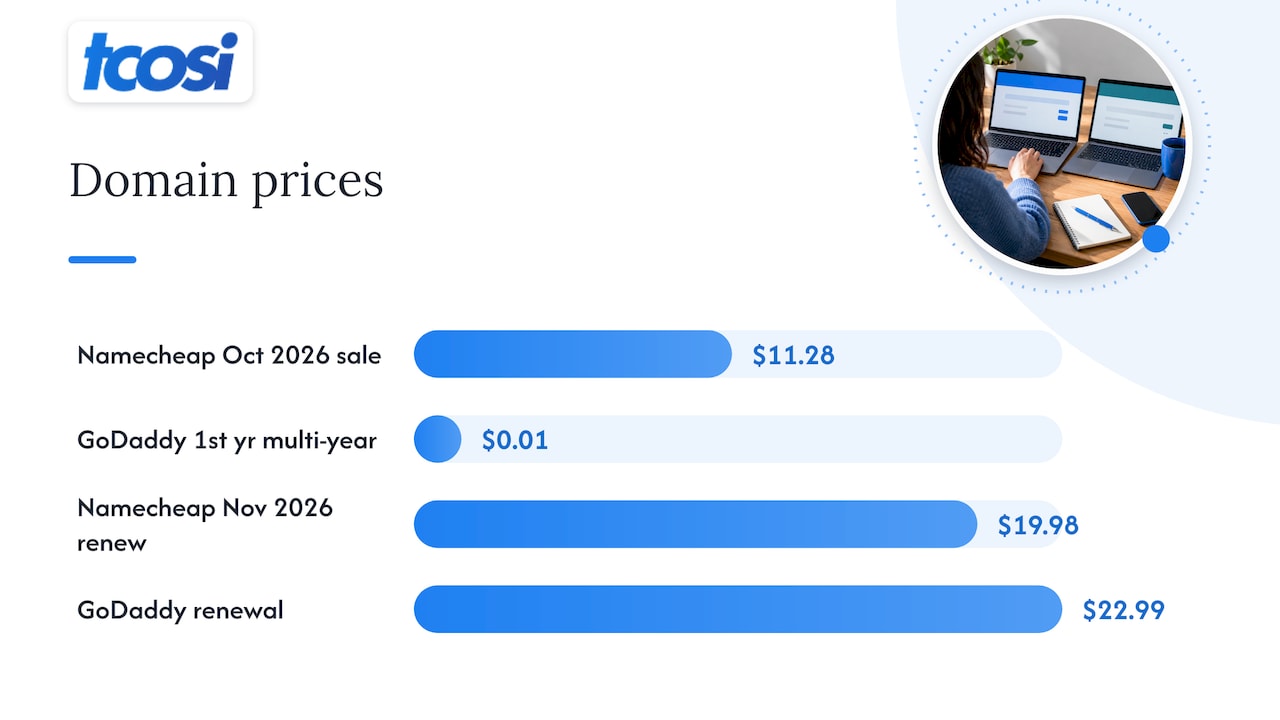
| First-year .com | $11.28 in an October 2026 sale, per WebChoiceDesk | $0.01 with a multi-year purchase, per the same comparison |
| .com renewal | $18.48 in that comparison; Namecheap’s own notice sets $19.98 a year from November 1, 2026, before the ICANN fee | $22.99 regular renewal in that comparison |
| Phone support | No | Yes, 24/7 |
Namecheap’s official notice says .com registration and transfer rose to $15.98 a year on November 1, 2026, and renewal to $19.98 a year, not counting the ICANN fee. ICANN is the body that oversees domain names, and its fee is passed through to every registrant. The October comparison figures therefore predate that change.
These numbers move. Registries (the organizations that run each extension, like .com) raise wholesale prices, and registrars pass them on. Treat any table, including this one, as a snapshot, and check each registrar’s checkout page before you buy.
The practical reading: a $0.01 first year looks like a giveaway, but the multi-year commitment and the regular renewal that follows are what you will live with. Over five years, a lower renewal usually wins unless you intend to sell or drop the name early.
Other extensions cost more and change more
If you want something other than .com, check the renewal price before you fall for the first-year deal. Namecheap announced that on October 6, 2026 a registry raised prices across 226 extensions, with .academy renewal going from $59.98 to $69.98. Extensions like .biz and .design have also been repriced by their registry. For a business that will print the name on trucks and business cards, a .com keeps things simpler and cheaper to hold.
Privacy, transfers and policy changes
WHOIS is the public record of who owns a domain. Privacy services hide your personal details from it. Namecheap comparisons consistently note free privacy on eligible domains, while one professional comparison points out that eligibility varies by extension. Check that the extension you want qualifies.
GoDaddy changed how it handles this data. Its own blog explains that from August 21, 2025 it collects and shows only minimum registrant information for gTLDs, following ICANN’s Registration Data Policy, with organization names hidden unless you opt in.
One more GoDaddy change is worth knowing. HostScore reported that its February 2, 2026 terms describe the services as not intended for private, personal or household use and define the customer as a business customer. If you are a business, that wording is about you, and it is simply worth reading before you sign up.
Moving a domain between them
Namecheap publishes a step-by-step guide for moving from GoDaddy. In general, you unlock the domain, request an authorization code from the current registrar and approve the transfer at the new one. New registrations typically can’t be moved straight away, so don’t plan a transfer for the week after you buy.
Hosting: compare the renewal, not the banner
Both companies also sell hosting, which is the server space where your website files live. The pattern repeats from domains: low intro price, higher renewal.
| Plan | First term | Renewal |
|---|---|---|
| Namecheap Stellar (shared) | $2.28/month on its annual offer, per Namecheap | $55.88/year, per Namecheap’s May 2026 notice |
| Namecheap Stellar Plus | $2.98/month, per Namecheap | $85.44/year, per the same notice |
| GoDaddy Economy | $5.99/month on a three-year term | $11.99/month, per Namecheap’s transfer guide |
| GoDaddy WordPress Basic | $6.99 for a first one-year term, per GoDaddy | Check GoDaddy’s page for the regular rate |
The GoDaddy figures for Economy come from Namecheap’s guide, so read them as the way a rival frames them and confirm on GoDaddy’s own page. A November 14, 2026 price check by TrueCost Hosting lists Stellar at $27.36 for the first year and $70.56 a year at the $5.88 monthly renewal rate, which shows how much billing term changes the number.
What the plans include
Namecheap says all its shared plans include free SSL, Imunify360 security, unmetered bandwidth and free migration. Its EasyWP managed WordPress plans add a CDN, automatic WordPress updates and malware scanning, with the entry plan listed at $3.24 a month billed yearly and a higher renewal. GoDaddy’s hosting page lists daily backups, malware scans, free SSL and a 99.9% uptime guarantee, with features varying by tier.
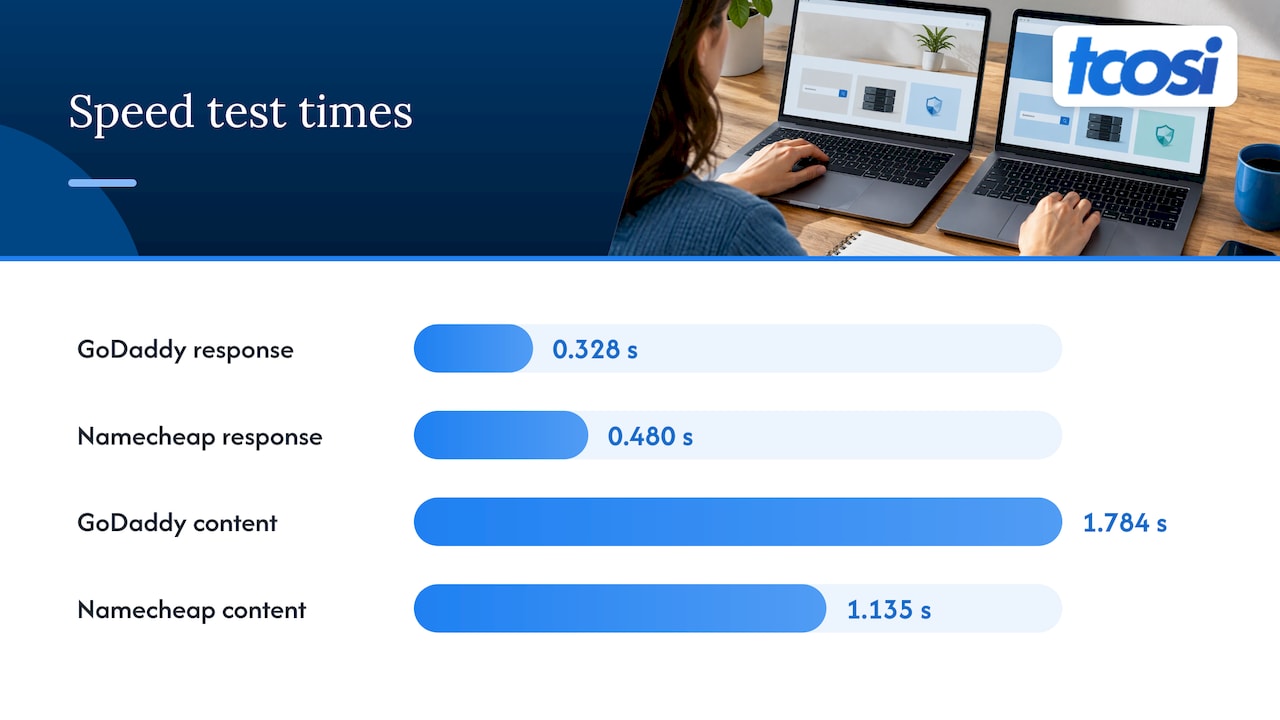
Speed is mixed. In Cybernews’s tests, GoDaddy had a faster first response (0.328 seconds against Namecheap’s 0.480), while Namecheap loaded the main content faster (1.135 seconds against 1.784). These are results from one tester’s sample sites, not a promise for yours. Hosting is only one part of speed. Images, plugins and theme code matter just as much, and a guide on boosting website speed covers the basics. If you want to go deeper on what actually slows WordPress, see our piece on fixing hosting first for site owners.
If you are weighing hosts beyond these two, our guide to WordPress hosting for small business walks through the options.
Support: phone versus chat
GoDaddy’s contact page lists a U.S. phone number and says its sales and support team is available 24/7. Namecheap says its shared plans include 24/7 support through chat and email, and comparisons note it has no phone line.
If you will be anxious the first time something breaks and want to talk to a person, that is a real point for GoDaddy. If you are comfortable typing out a problem, chat is usually quick enough for domain and DNS questions. DNS is the setting that points your domain at your site and email, and it is where most first-timers need help.
A quick checklist before you buy
- Write down the year-two and year-three price, not just the first year.
- Check privacy eligibility for your extension.
- Register in your business’s name with an email address that more than one person can access.
- Turn on auto-renew and two-factor login. A lapsed domain takes your site and email down with it.
- Keep domain and website access documented. Whoever builds your site will need DNS access, so keep the login in a shared, secure place.
Where the real cost is
Here is the part most comparison pages skip. You can spend an afternoon deciding between two registrars to save $4 a year, and still end up with a site that doesn’t bring in customers. A domain and a hosting plan are infrastructure. They don’t design your pages, write your structure for search, or keep your plugins current.
To put numbers on it, our guide to what a WordPress website costs for U.S. small businesses breaks down build and yearly costs. The domain is a rounding error next to those figures. Where decisions matter more is on the site itself: the design, the page structure, how it is set up for search, and who updates it after launch.
That is also why hosting security deserves a second look. Whatever host you choose, the site still needs plugins and WordPress core kept current, which our security plugin roundup and maintenance cost guide explain.
Our approach: buy the domain, then build something worth visiting
We build custom WordPress sites, and the question we hear before almost every project is which registrar and host to use. Our honest answer is that it matters less than people think. Pick a reputable registrar with a renewal price you can live with, keep the login in your own name, and move on to the part that moves the business.
The sites that do well tend to share the same few things: a clear design, a structure that search engines can follow, and someone paying attention after launch. Owners often tell us the thing they value most is understanding what is happening with their site, so we work to keep the process clear and collaborative and to explain technical decisions in plain words.
That is why we publish our pricing and keep maintenance as a simple monthly plan. A domain is a line item. A website is an asset, and it needs care to stay one.
Tommy Cosimano
What tcosi offers once your domain is ready
We publish our project pricing on the pricing page: Essentials at $1,200, Growth at $2,400 and Premium at $4,800, each a one-time fee. If you need a smaller piece, the Base Website is $875, a Style Guide is $300, Wireframes are $175 and SEO Setup is $375. After launch, Ongoing Maintenance is $100 per month, covering plugin and security management and content updates.

If you already own your domain, or have just bought one, see how tcosi designs and builds WordPress sites for small businesses, startups, nonprofits and agencies. Agencies that need extra capacity can look at our white-label WordPress development.
FAQ
Is Namecheap better than GoDaddy?
For most small businesses that mainly need a domain, yes. Namecheap’s renewals are lower in published comparisons, and privacy is free on eligible domains. GoDaddy is stronger on phone support and an all-in-one setup. Compare the three-year cost, not only the first year.
Is Namecheap still good in 2026?
Yes, for domains and budget hosting. Its prices have risen: .com renewal went to $19.98 a year before the ICANN fee on November 1, 2026, and shared hosting renewals rose in May 2026. It is still lower than GoDaddy’s regular .com renewal in the comparisons we reviewed.
Can I use one for my domain and the other for hosting?
Yes. Your domain only has to point at your host through DNS settings. Many owners register the domain at one company and host elsewhere so that the domain stays under their control no matter what happens to the site.
Does the registrar affect my search rankings?
No. Search engines don’t rank a site by which registrar sold the name. What helps is the site itself: fast pages, clear structure, good content and sound technical setup. Our WordPress SEO checklist covers the priorities.
Sources
- WebChoiceDesk: Namecheap vs GoDaddy (2026)
- Namecheap: .com price change, November 1, 2026
- Namecheap: price update on 226 Identity Digital extensions
- GoDaddy Blog: Whois changes explained
- HostScore: GoDaddy’s February 2026 terms
- Namecheap: how to transfer from GoDaddy to Namecheap
- Namecheap web hosting
- Namecheap: shared hosting pricing changes, May 2026
- GoDaddy hosting solutions
- TrueCost Hosting: Namecheap pricing
- Namecheap EasyWP pricing
- Cybernews: Namecheap vs GoDaddy
- GoDaddy contact page
- Boosting website speed